Phones
Xiaomi POCO C71
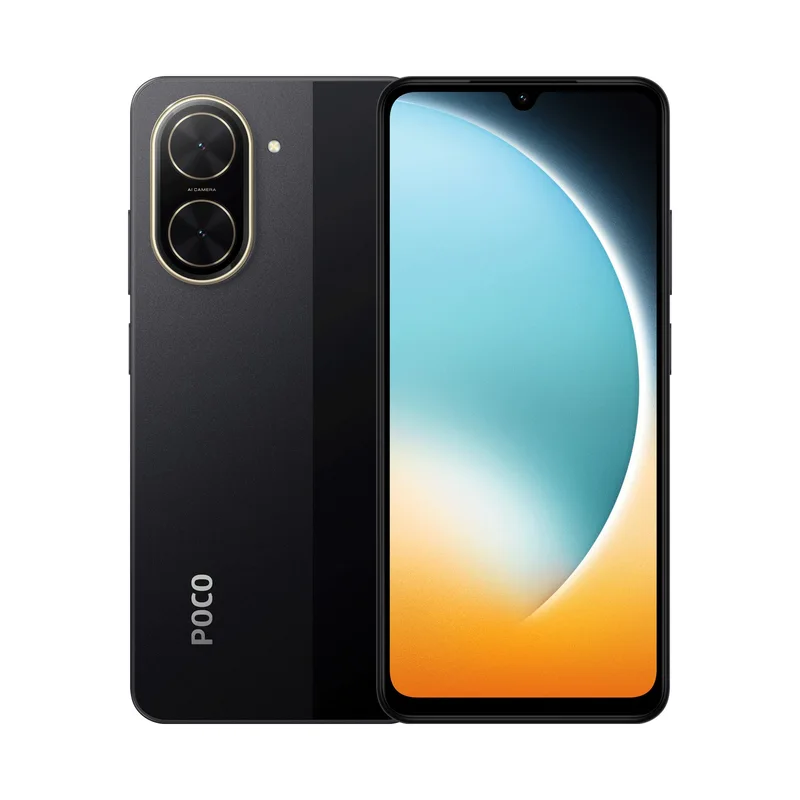
POCO C71 is an entry-level phone with a 6.88-inch 120Hz screen, a UNISOC T7250 chip, 5200 mAh battery with 15W charging and Android 15 Go Edition, built around a headphone jack and microSD slot.
Key figures at a glance
Gallery

Specifications
- Display
- 6.88" LCD, 1640x720, up to 120Hz, 450 nits (typ), 240Hz touch sampling
- Chipset
- UNISOC T7250 (12nm, octa-core, up to 1.8GHz)
- RAM
- 4GB
- Storage
- 64GB / 128GB, microSD slot
- Memory extension
- 3GB up to 6GB, 4GB up to 8GB (virtual)
- Rear Camera
- 32MP main + auxiliary lens, f/2.0
- Front Camera
- 8MP, f/2.0
- Battery
- 5200 mAh (typ), 15W wired
- OS
- Android 15 (Go Edition)
- Dimensions
- 171.79 x 77.8 x 8.26 mm, 193 g
- Connectivity
- Dual SIM, LTE, Bluetooth 5.2, 3.5mm headphone jack, FM radio, side fingerprint, AI face unlock
- Colors
- Black, Blue, Gold
The POCO C71 is the plainest, most price-focused phone in Xiaomi's POCO range: a big 6.88-inch screen, a UNISOC T7250 processor, a 5200 mAh battery and Android 15 in its lightweight Go Edition. Nothing about it is meant to impress on a spec sheet. What it offers instead is a short list of practical things that cheap phones often drop, namely a 3.5mm headphone jack, a microSD slot, FM radio and a side-mounted fingerprint sensor. This page is based on the published specifications and the manufacturer's own product information, and it tries to explain who that combination suits and where the limits are.
Where the C71 sits in the lineup
POCO uses the C series for its lowest price tier, below the M series that most buyers know from phones such as the POCO M7. The C71 is the successor of the C61, and Xiaomi's own page compares the two in several places, for example when it says the new chip is 83 percent faster than the previous generation in POCO's internal AnTuTu test. The newer POCO C85 and POCO M8 sit above or beside it today, so the C71 is best treated as the cheapest rung on the ladder rather than as a current volume model for every market.
Xiaomi's page does not give a launch date or a price, and configurations are described as region dependent. The memory table lists 3GB with 64GB and 4GB with 128GB, so what you can actually buy depends on where you live. Keep that in mind before reading any review of the phone that mentions only one version.
Design and display
The 6.88-inch panel is the first thing the C71 sells. Xiaomi gives the resolution as 1640 by 720 pixels, which works out to about 260 pixels per inch, together with a refresh rate of up to 120Hz, a typical brightness of 450 nits and touch sampling up to 240Hz. A screen-to-body ratio of 90 percent is claimed, and the company states that the 120Hz setting applies to supported apps. In everyday terms that is a large, smooth but soft picture. At this pixel density text will be readable without being crisp, and 450 nits is enough for indoor use but will be a limit in strong sunlight.
The panel carries TÜV Rheinland certificates for low blue light (a software solution), flicker-free operation and a circadian-friendly mode, although the last one is described as something that may arrive by OTA update, so do not assume it is present at launch. DC dimming is also listed, which matters for people who are sensitive to flicker at low brightness.
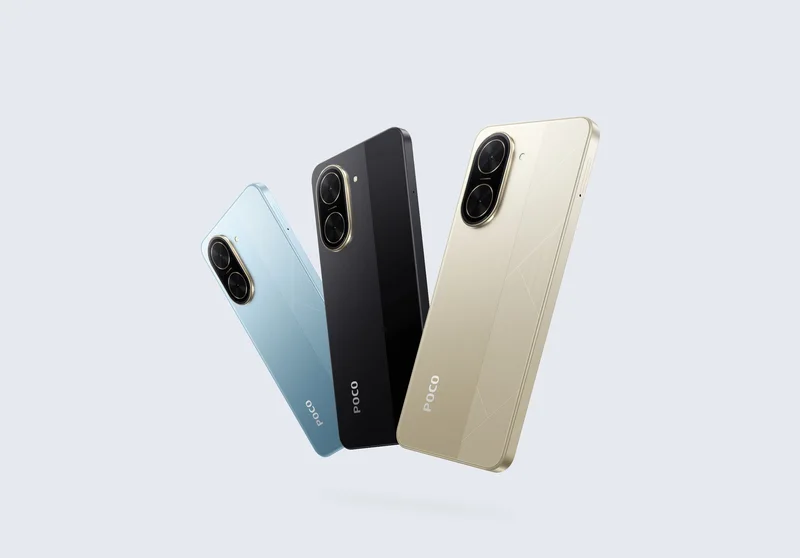
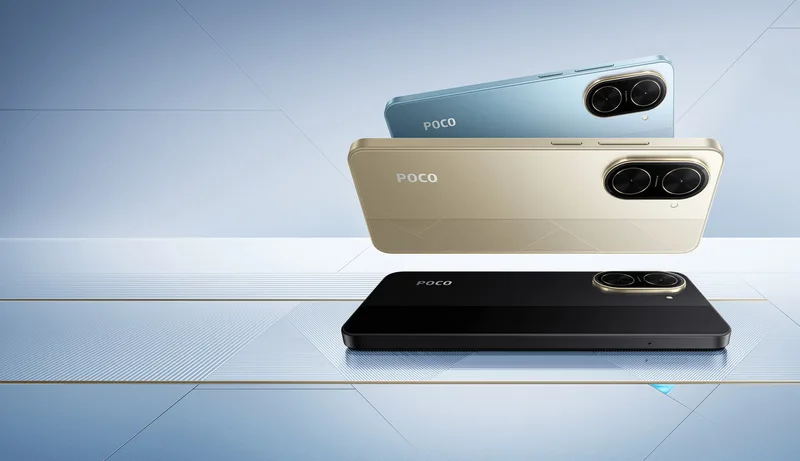
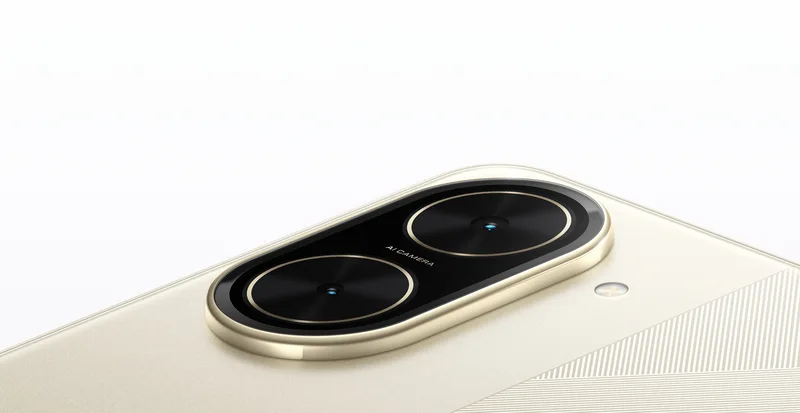
The body is 171.79 mm tall, 77.8 mm wide and 8.26 mm thick, and it weighs 193 g. That is not a thin phone, but it is not especially heavy for the screen size either. Xiaomi describes a small vertical-edge, high-gloss ring around the camera lenses, and the official images show an oval gold-trimmed module holding two lenses and a flash. There are three colours, black, blue and gold, and the rear carries a faint geometric pattern. A protective case is listed in the box in the specification, though package contents differ by region.
Performance and software
The UNISOC T7250 is an octa-core chip built on a 12nm process, with two Cortex-A75 cores at up to 1.8GHz and six A55 cores at 1.6GHz, plus a Mali-G57 GPU. POCO reports an AnTuTu v10 score above 260,000, measured in its own lab. For comparison, the manufacturer's claim of 83 percent growth only tells you that the old chip was very slow, not that this one is fast. Expect it to handle messaging, social media, video playback and light browsing, and expect waiting when you switch between heavy apps or load a modern 3D game.
Memory is where the numbers need careful reading. The physical options are 3GB and 4GB of LPDDR4X, and the storage is eMMC 5.1, which is slower than the UFS storage found in dearer phones. POCO's headline figure of 8GB RAM is a virtual extension of the 4GB model, and the 6GB figure is the extended version of the 3GB model. The extension uses part of the storage, and the specification itself warns that it only works when there is enough free space. A microSD slot is present, which makes the 64GB model more usable than it would otherwise be, but a card is no substitute for fast internal storage when apps are loading.
The operating system is Android 15 in the Go Edition. Go Edition trims the system to run in less memory and is a sensible match for 3GB or 4GB of RAM. It also means some Google apps are lighter variants and the overall look is simpler than a full HyperOS build. Xiaomi mentions a "36-months smooth as new" promise, based on its own software aging test, which is a claim about smoothness rather than a pledge of update years. No Android update or security patch period is given on the page, so it is not possible to say how long the phone will be supported.
Camera
The rear camera is listed as a 32MP main camera with an f/2.0 four-element lens and an unspecified auxiliary lens, so in practice it is a single usable camera with a depth or support sensor beside it. Xiaomi says the larger sensor lets in 18 percent more light than on the C61, which is useful in low light but does not change the fact that a budget sensor and a small aperture will produce visible noise in dim scenes. Video is capped at 1080p at 30 frames per second, with 720p as the other option.
The front camera is 8MP with an f/2.0 lens, a selfie soft-aperture mode and a fill-light option. Photo modes include HDR, portrait, night, time-lapse and a "film camera" look. A customisable frame watermark is also offered. If photography matters to you, this is not the phone to buy; if you only need to scan documents, take photos for marketplaces and send snapshots, it should do.
Battery and charging
The battery is rated at 5200 mAh (typical), and Xiaomi quotes 28 hours of calling, 108 hours of music, 20 hours of video playback and 15 hours of continuous use in its own tests. Those numbers use laboratory conditions and should be read as relative, not as a promise. The company also says the cell retains at least 80 percent of its capacity after 1,000 charge cycles, which would equal about three years of daily charging.
Charging is the weak spot. The C71 supports 15W wired charging over USB-C, which is slow for a 5200 mAh cell; the competing realme C71 uses 45W with a 6300 mAh cell, and the Tecno Spark 40 uses 45W with 5200 mAh. Xiaomi's page does not give a full-charge time, and no wireless or reverse charging is listed. A charger and a USB-C cable are included in the box according to the specification, but again that can vary by region.
Connectivity and everyday details
The phone takes two SIM cards plus a microSD card, uses Bluetooth 5.2, dual-band Wi-Fi, and supports GPS, Glonass, Galileo and BDS (the last only on the B1C band). The list of mobile bands includes GSM, WCDMA and LTE FDD and TDD, with no 5G entry, so this is a 4G phone. There is an FM radio that works with wired headphones, and a 3.5mm headphone jack; the specification page says nothing about stereo speakers. Security is handled by a side fingerprint reader and AI face unlock. There is no NFC entry on the specification page, which may matter if you pay by phone.
Who should consider it
- First-time smartphone users and older relatives who want a big, clear screen and a simple system.
- Secondary or backup phones where a headphone jack, FM radio and microSD slot still count for something.
- Markets and budgets where every unit of currency counts and 5G is not yet useful.
Compromises to weigh
The C71 gives up on charging speed, display sharpness, camera quality and network speed, and relies on eMMC storage and a small amount of RAM. If you can stretch to a model with faster charging and a stronger chip, look at the POCO C71 against the realme C71, or against a more capable phone such as the Galaxy A56. The wider picture of how cheap phones stack up is on the rankings page. For a phone that costs little and will mostly be used for calls, messages and video, the C71's combination of screen size and basic features is its entire pitch, and it is honest about it.
Where it ranks
Compare Xiaomi POCO C71 with similar devices
More from Xiaomi
Frequently asked questions
When was the Xiaomi POCO C71 released?
The Xiaomi POCO C71 was released on 2025-04-01, according to the manufacturer’s published information.
What are the main specs of the Xiaomi POCO C71?
Headline figures for the Xiaomi POCO C71: Battery: 5,200 mAh, Refresh rate: 240 Hz, Main camera: 32 MP, RAM: 4 GB. The full specification table is further up this page.
Is the Xiaomi POCO C71 worth buying?
That depends on your priorities. Use the editorial review on this page for our view, check the rankings above to see where the device stands on battery, display and camera, and compare it directly with similar models before you decide.


