Phones
Xiaomi POCO C85
An entry-level phone with a large 6.9-inch 120Hz-capable screen, a 6,000 mAh battery, a headphone jack and a microSD slot, powered by the Helio G81-Ultra.
Key figures at a glance
Gallery

Specifications
- Display
- 6.9" Dot Drop display, 1600x720, up to 120Hz, 660 nits typical / 810 nits HBM, 240Hz touch sampling
- Chipset
- MediaTek Helio G81-Ultra (octa-core, Cortex-A75 + Cortex-A55, up to 2.0GHz), Mali-G52 MC2
- RAM
- 8GB
- Storage
- 128GB / 256GB (eMMC 5.1), microSD up to 1TB
- Rear Camera
- 50MP main (f/1.8) + auxiliary lens
- Front Camera
- 8MP (f/2.0)
- Battery
- 6000 mAh (typ), 33W wired, 10W wired reverse charging
- OS
- Xiaomi HyperOS 2
- Body
- 171.56 x 79.47 x 7.99 mm, 205 g; IP64
- Connectivity
- Dual SIM + microSD, Bluetooth 5.4, NFC (varies by market), 3.5mm headphone jack, FM radio
- Colors
- Black, Purple, Green
The POCO C85 is an entry-level Android phone from Xiaomi's POCO brand, and its spec sheet reads like a list of the things budget buyers actually ask for: a big 6.9-inch screen that can run at up to 120Hz, a 6,000 mAh battery, a 50MP main camera, a microSD slot and a 3.5mm headphone jack. It runs on the MediaTek Helio G81-Ultra and ships with Xiaomi HyperOS 2. This page is a spec-and-information-based review compiled from the manufacturer's published specifications; it is not a hands-on test. Wherever a figure comes from POCO's own lab or marketing, we say so, and where the official page is silent we say that too.
Where it sits in the lineup
POCO's C series is the brand's lowest rung, aimed at buyers who want a large screen and long battery life at the smallest possible price rather than raw speed. The official page does not state a US price, and the model is sold in selected markets, so this page does not quote a price. Above the C series, the brand's M and X lines sit higher in the range; the POCO M8 and the POCO X8 are the natural next steps if the budget stretches. To see exactly what you give up by going cheaper, the POCO C85 vs POCO M8 comparison shows the published numbers side by side. The C85 is also worth reading alongside the other budget Android phones in our phone rankings, where battery size and screen refresh rate are among the figures we track.
Design and build
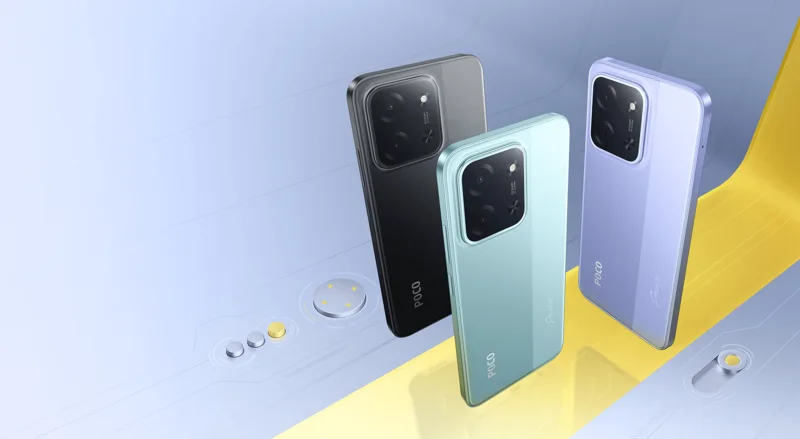
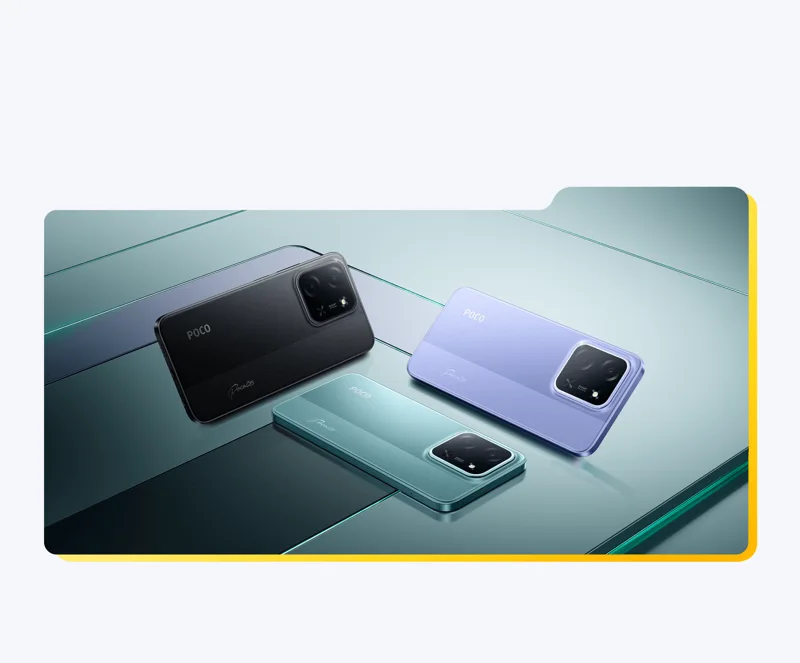
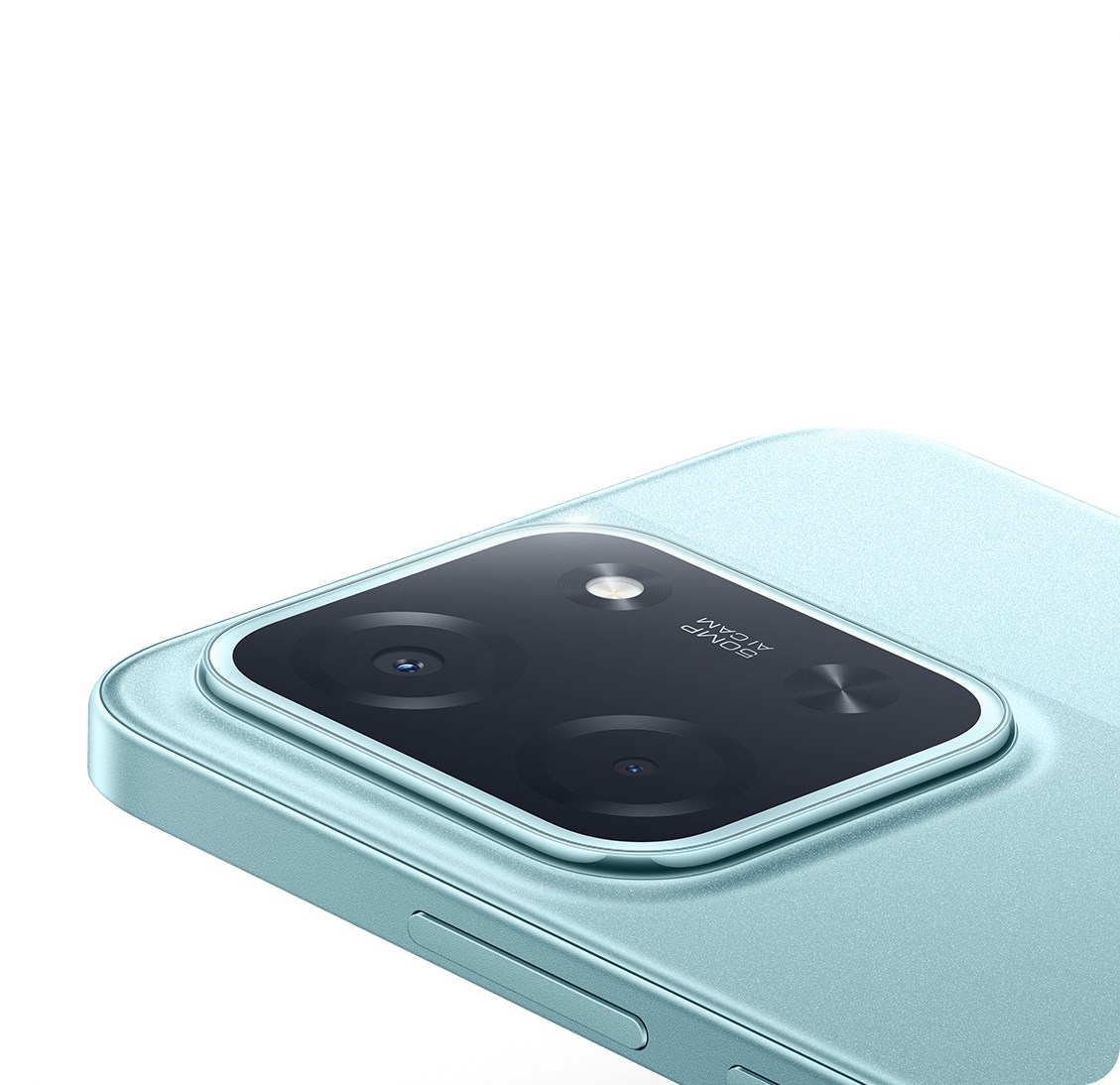
POCO describes the C85's look as inspired by a night-sky aurora and offers it in three colours: Black, Purple and Green. The back has a quad-curved shape and a square camera module with what the brand calls a floating crater decoration, which on the product images is a raised module with two lenses and a flash. At 7.99 mm thick and 205 g, with dimensions of 171.56 by 79.47 mm, it is a slim phone considering its battery, though the 6.9-inch screen makes it a large one to hold. The official page lists IP64 protection, which means dust resistance and splash resistance but not submersion; POCO adds the usual warning that protection can degrade with daily use. A side-mounted fingerprint sensor and AI face unlock handle authentication, and a protective case is listed in the box. The phone also keeps a 3.5mm headphone jack and FM radio support, both of which have become rare on newer phones.
Display
The screen is a 6.9-inch Dot Drop panel with a resolution of 1600 by 720 pixels. The refresh rate goes up to 120Hz, though POCO notes that 120Hz applies to supported apps and can be adjusted. Typical brightness is 660 nits, with 810 nits in high-brightness mode, touch sampling goes up to 240Hz and the colour gamut is listed at 83% NTSC with 8-bit colour. The contrast ratio is 1200:1. In plain terms, this is a large HD+ panel, so text and video will look softer than on a phone with a full-HD display, and sunlight visibility will be adequate rather than excellent. What the 120Hz figure does give is smoother scrolling, which is rarely found at this price. The screen has TUV Rheinland certifications for low blue light (software solution), flicker-free operation and circadian friendliness, along with DC dimming and what POCO calls Wet Touch Display 2.0 for use with damp fingers. Those are eye-comfort and usability features, not image-quality claims, and they are certifications that depend on the maker's test set-up.
Performance, memory and software
The processor is the MediaTek Helio G81-Ultra, an octa-core chip combining Cortex-A75 and Cortex-A55 cores at up to 2.0GHz, with a Mali-G52 MC2 graphics unit. It is a modest, long-established design, and it is best suited to messaging, browsing, video streaming and casual games. Demanding 3D titles will need low settings. Memory comes as LPDDR4X with eMMC 5.1 storage, in 6GB plus 128GB or 8GB plus 256GB configurations, depending on region. eMMC is slower than the UFS storage found in pricier phones, which affects app installs and loading times. POCO also advertises memory extension that borrows storage to behave like up to 16GB of RAM on the 8GB model; this uses up storage space and should not be confused with real memory. For more room, a microSD card of up to 1TB can be added in the shared dual-SIM tray, which is sold separately.
The phone runs Xiaomi HyperOS 2. POCO highlights Xiaomi interconnectivity features such as call sync and a shared clipboard with other Xiaomi phones and tablets, along with Google's Gemini assistant and Circle to Search. Availability of these features depends on region and software version. The official page does not state how many Android or security updates the phone will receive, which is a typical weak point for entry-level models, so budget buyers who keep phones for years should check that before purchase.
Camera
The rear camera is built around a 50MP main sensor with an f/1.8 aperture and a five-element lens, plus an auxiliary lens whose resolution the page does not state. The camera app offers HDR, night mode, portrait mode, time-lapse and a film camera mode. Video recording tops out at 1080p at 30 fps, with 720p also available, so there is no 4K video here. The front camera is 8MP with an f/2.0 aperture and a soft-light ring, and it shares the same 1080p 30 fps limit. POCO's marketing speaks of vivid colours and rich textures from an AI dual-camera system, but as always these are claims. At this level, expect good results in daylight, noticeably softer and noisier images indoors or at night, and no optical stabilisation or zoom lens to help. It will do the job for social-media photos, documents and video calls, but it will not replace a dedicated camera phone.
Battery and charging
This is the phone's other major selling point. The battery is rated at 6,000 mAh typical, and POCO's lab figures claim up to 22 hours of video playback, 20 hours of reading, 82 hours of music playback and 2.14 days of mixed use on a light-use model, with 80% or more of capacity kept after 1,000 full charge cycles. These are the manufacturer's own results and real-world numbers will vary. Charging is 33W wired, and POCO claims 31 minutes to reach 50%; importantly, no power adapter is included in the box, and the company recommends a Xiaomi 33W adapter, which means an extra cost for many buyers. The phone also supports up to 10W wired reverse charging so that it can charge an accessory. Smart-charging features such as boost charging and battery protection are listed too. For a phone that is expected to last a long day away from a socket, this is a strong set of numbers, and a 6,000 mAh cell is the main reason to look at the C85 over rivals with smaller batteries.
Connectivity and extras
The phone supports dual SIM with a microSD option in the same tray, Wi-Fi on 2.4GHz and 5GHz, Bluetooth 5.4 with AAC, SBC and LDAC audio, GPS, GLONASS, Galileo and BeiDou, and a USB-C port. NFC is listed, but POCO notes that availability varies by market. The network bands listed cover GSM, WCDMA and LTE; the official specification does not list 5G, so this is a 4G phone, which matters for buyers in countries where 5G coverage is already widespread. The phone also has a volume boost described as 200% over the standard maximum, which is a software setting rather than a hardware speaker upgrade. Its release date in our catalogue is the approximate date supplied for this listing, because the official page does not state one.
Who it is for and the compromises
The POCO C85 suits students, first-time smartphone owners, secondary-phone users and anyone who values a big screen, a very long battery life, a headphone jack and expandable storage over cameras and speed. The compromises are clear: an HD+ screen, an older processor, eMMC storage, 1080p video only, no 5G in the published specification and no charger in the box. If you can stretch to a higher-tier model, the POCO M8 is the obvious step up, but if low cost and battery are the priority, the C85 is built for exactly that.
Where it ranks
Compare Xiaomi POCO C85 with similar devices
More from Xiaomi
Frequently asked questions
When was the Xiaomi POCO C85 released?
The Xiaomi POCO C85 was released on 2025-09-01, according to the manufacturer’s published information.
What are the main specs of the Xiaomi POCO C85?
Headline figures for the Xiaomi POCO C85: Battery: 6,000 mAh, Refresh rate: 240 Hz, Main camera: 50 MP, RAM: 8 GB. The full specification table is further up this page.
Is the Xiaomi POCO C85 worth buying?
That depends on your priorities. Use the editorial review on this page for our view, check the rankings above to see where the device stands on battery, display and camera, and compare it directly with similar models before you decide.


