Phones
Xiaomi POCO F6
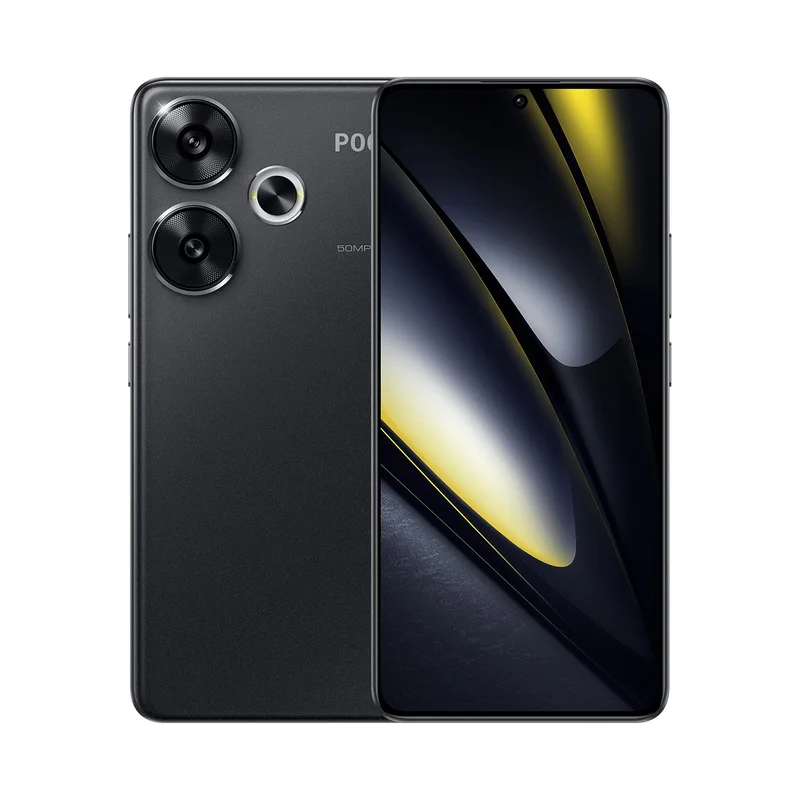
The POCO F6 pairs a Snapdragon 8s Gen 3, a 6.67-inch 120Hz AMOLED, a 5000 mAh battery and 90W charging in a 7.8 mm body, with up to 12GB RAM.
Key figures at a glance
Gallery

Specifications
- Display
- 6.67" CrystalRes 1.5K Flow AMOLED, 2712x1220 (446 ppi), up to 120Hz, 2400 nits peak, HDR10+, Dolby Vision, 1920Hz PWM dimming, Gorilla Glass Victus
- Chipset
- Snapdragon 8s Gen 3 (TSMC 4nm), LPDDR5X, UFS 4.0
- RAM
- 12GB
- Storage
- 256GB / 512GB (8GB+256GB, 12GB+512GB)
- Rear Camera
- 50MP main (Sony IMX882, f/1.59, OIS) + 8MP ultra-wide
- Front Camera
- 20MP
- Battery
- 5000 mAh (typ), 90W turbo charging with 90W in-box charger
- OS
- Xiaomi HyperOS
- Dimensions
- 160.5 x 74.4 x 7.8 mm, 179 g
- Connectivity
- Dual SIM, 5G, Wi-Fi (802.11 a/b/g/n/ac/ax), Bluetooth 5.4, NFC, USB-C, IR blaster, in-screen fingerprint, AI face unlock, dual speakers with Dolby Atmos
- Durability
- IP64 dust and splash resistance
- Colors
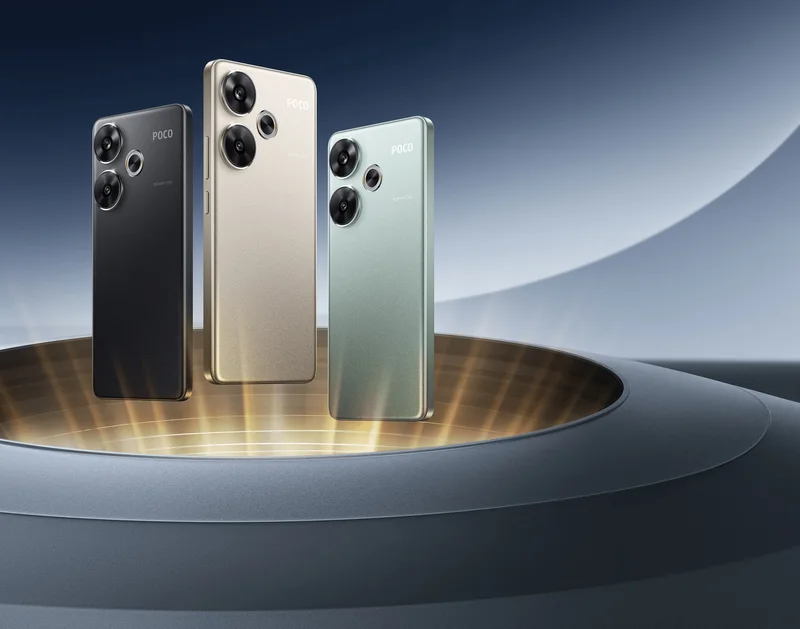
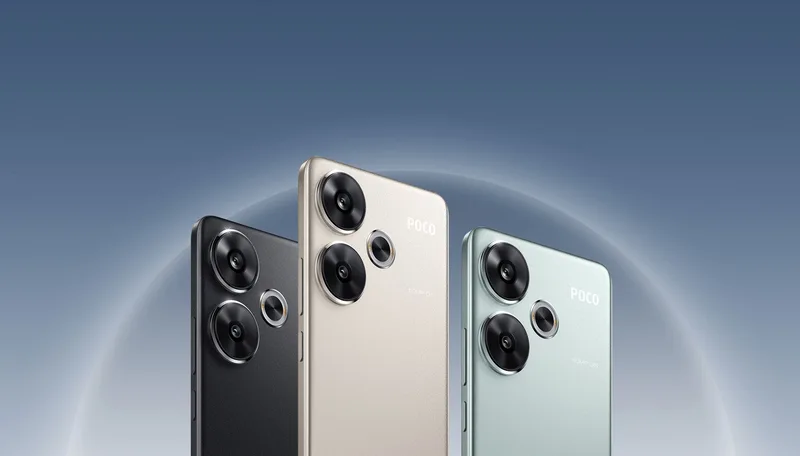
- Black, Green, Titanium
The POCO F6 is the more compact, more affordable-minded half of POCO's 2024 F-series pairing. Where its sibling, the POCO F6 Pro, chases a flagship chip and a QHD screen, the standard F6 takes a different route: the newer but slightly trimmed Snapdragon 8s Gen 3, a 6.67-inch 1.5K AMOLED, a 5,000 mAh battery with 90W charging, and a body only 7.8 mm thick that weighs 179 g. This overview is based on the published specifications and the manufacturer's own product pages, so it explains what the hardware is designed to do and marks POCO's statements as claims rather than measured results.
Where it sits in the lineup
POCO is Xiaomi's performance-oriented sub-brand, and the F line is its gaming-minded tier. The F6 is the entry point of the 2024 F6 generation. It is offered in two memory and storage combinations according to the official specification page: 8GB with 256GB and 12GB with 512GB, both using LPDDR5X memory and UFS 4.0 storage. Three colours are listed: Black, Green and Titanium. The manufacturer's pages did not state a United States price, so none is given here, and the release date used on this site (23 May 2024) is the commonly cited launch date rather than a date printed on the product page.
The clearest way to understand the F6 is against the Pro. The Pro uses the older but higher-tier Snapdragon 8 Gen 2, a 3200x1440 display with a 4,000-nit peak, 120W charging and a 16MP front camera. The F6 lowers the resolution to 2712x1220, quotes a 2,400-nit peak, charges at 90W and uses a 20MP selfie camera, but in return it is slimmer and lighter (7.8 mm and 179 g against roughly 8.2 mm and 209 g for the Pro). If you want to see the two side by side, the POCO F6 vs POCO F6 Pro page lines up the numbers. Later generations such as the POCO F7 carry the same idea forward.
Design and display
POCO describes the back as an evenly curved panel with four curved edges, and the front as a near-borderless design with bezels it quotes at 1.35 mm, 2.27 mm and 1.3 mm and a 94.27% screen-to-body ratio. The phone measures 160.5 x 74.4 x 7.8 mm. For a 6.67-inch screen that is a thin and light chassis, and 179 g is noticeably lighter than most phones with a 5,000 mAh cell. Protection is Corning Gorilla Glass Victus on the front, an IP64 rating for dust and splash resistance, and an SGS five-star drop-resistance certificate. IP64 is a modest level: it covers splashes, not immersion, and POCO's own footnotes stress that the rating is a laboratory result that can degrade with use.
The panel is a flat 6.67-inch Flow AMOLED with a 2712x1220 resolution (446 ppi), which POCO calls CrystalRes 1.5K. The refresh rate goes up to 120Hz, touch sampling up to 480Hz (with an instant rate of 2,160Hz stated for gaming mode) and the specification lists 500 nits typical, 1,000 to 1,200 nits in high-brightness mode and 2,400 nits peak. It supports HDR10+ and Dolby Vision, covers 100% of DCI-P3 and can show up to 68 billion colours. For comfort, POCO quotes 1,920Hz PWM dimming and 16,000 brightness levels, plus TUV Rheinland certifications for hardware low blue light, flicker-free and circadian-friendly operation. As always, nit and contrast figures come from the manufacturer's laboratory and should be treated as claims. The practical takeaway is that this is a bright, sharp, high-refresh screen at a resolution that is gentler on the battery than the Pro's QHD+ panel.
Performance, cooling and software
The Snapdragon 8s Gen 3 is built on TSMC's 4nm process. The specification page lists one Cortex-X4 core at up to 3.0GHz, four Cortex-A720 cores at 2.8GHz and three Cortex-A520 cores at 2.0GHz with an Adreno GPU. POCO states that it uses the same prime-core architecture as the full Snapdragon 8 Gen 3 and claims top-tier CPU and GPU performance. It also publishes comparisons against the previous generation, but those come from its own labs with unspecified conditions, so this review does not repeat the percentages. The practical reading is simple: this is a high-end chip for current games and heavy multitasking, one step below the absolute top of Qualcomm's range.
Sustained performance is where POCO puts its engineering story. The phone uses what it calls LiquidCool Technology 4.0 with IceLoop, which pairs a stainless-steel circulating cooling pump with a vapor-liquid separating design and a stated 4,800 mm² surface area. Eight temperature sensors monitor the interior, and POCO says its upgraded graphite layer has 13% higher thermal conductivity than the previous generation. Whether that is enough to hold frame rates in long sessions is something independent testing must show, but the hardware list is more ambitious than most phones at this size and weight.
The software is Xiaomi HyperOS. POCO lists AI-based scheduling, frame-rate stabilisation and a super-resolution rendering feature that, according to the page, currently supports only one game. Several generative AI tools are listed, namely AI Expansion, AI Magic Erase Pro, AI Subtitles and AI album search, with the footnote that features other than the first two are initially available via beta access and roll out by region through over-the-air updates. The Android version is not stated on the pages used here, so it is omitted rather than guessed.
Camera
The rear camera is a two-lens system rather than the Pro's three. The main sensor is a 50MP Sony IMX882 with an f/1.59 aperture, 1.6 micrometre effective pixels (4-in-1 binning), a six-element lens and optical image stabilisation. Beside it sits an 8MP ultra-wide camera (IMX355). Video goes up to 4K at 30 or 60 frames per second, with 1080p slow motion at 120 or 240 fps. POCO also mentions a 50MP ultra-HD mode, a RAW-domain algorithm update and a faster camera engine that allows up to 50 shots in a single burst.
Compared with the Pro, there is no dedicated macro camera, and the ultra-wide is the same 8MP class. What improves is the selfie camera: a 20MP OV20B sensor at f/2.2 recording 1080p at up to 60 fps. It also doubles as an always-on camera for a set of gesture and presence features, namely air gestures, smart lock detection that locks the screen when nobody is looking, a smart always-on display that wakes when it detects a face, and a smart rotating screen. Those are convenience features with a privacy trade-off that some owners will want to review in settings, but POCO presents them as optional. For everyday photography the main sensor and its stabilisation are the point; anyone who relies on telephoto or serious macro work will need another phone.
Battery and charging
The battery is a 5,000 mAh typical-capacity cell, and a 90W charger is included in the box in most markets (POCO's note says some countries ship without a power adapter, so check the local listing). POCO claims a 2% to 100% charge in about 35 minutes with the in-box charger when the boost setting is enabled manually and the screen is off, and that the cells keep at least 90% of their capacity after 1,000 full cycles. Other claims include 13 hours of online YouTube playback at minus 15 degrees Celsius and a hibernation mode that gives about 2.5 hours of standby and a 33-minute call at 1% charge. All of these are laboratory figures from POCO's own tests.
Software protections are listed as well: a charge limit of 80% in certain scenarios to slow ageing, smart overnight charging, heavy-load charging management and three layers of temperature threshold control. Wireless charging is not mentioned anywhere on the specification page, so assume wired only. Against the Pro, the F6 gives up 30W of charging speed but keeps the same battery capacity in a thinner shell, which is an efficiency story more than a limitation for most users.
Connectivity and extras
The F6 supports dual-SIM 5G, Wi-Fi 802.11 a/b/g/n/ac/ax, Bluetooth 5.4, NFC (depending on market), a USB-C port and an infrared blaster. The fingerprint reader is in the screen and AI face unlock is also available. Stereo audio comes from dual speakers with Dolby Atmos, Hi-Res Audio and Hi-Res Wireless Audio certification. There is no headphone jack mentioned on the list.
Who it is for
The F6 suits buyers who want current-generation gaming hardware without paying for a QHD display or the biggest chip. It is a good match for people who find large flagships heavy: 179 g and 7.8 mm are genuinely light for this class. Users who stream, scroll and play demanding games will benefit from the bright 120Hz AMOLED and the cooling system, while 90W charging makes short top-ups practical. If you want a broader view of how it fares among rivals, see the rankings page, or check a mainstream alternative such as the POCO F6 vs Galaxy A56 comparison.
Compromises to keep in mind
- No telephoto and no macro lens. The camera system is a 50MP main and an 8MP ultra-wide only.
- IP64 only. It resists splashes and dust but is not rated for immersion.
- Wired charging only. No wireless charging is listed.
- Laboratory claims. Cooling, charging speed and battery endurance numbers are POCO's own and depend on settings.
- Some AI features are beta. The page states that most generative tools are rolled out by region and beta access.
In short, the POCO F6 is a slim, light and quick performance phone whose strengths are the 8s Gen 3 chip, a bright 120Hz screen and fast charging, and whose compromises are a basic camera set and a modest water-resistance rating.
Where it ranks
Compare Xiaomi POCO F6 with similar devices
More from Xiaomi
Frequently asked questions
When was the Xiaomi POCO F6 released?
The Xiaomi POCO F6 was released on 2024-05-23, according to the manufacturer’s published information.
What are the main specs of the Xiaomi POCO F6?
Headline figures for the Xiaomi POCO F6: Battery: 5,000 mAh, Refresh rate: 920 Hz, Main camera: 50 MP, RAM: 12 GB. The full specification table is further up this page.
Is the Xiaomi POCO F6 worth buying?
That depends on your priorities. Use the editorial review on this page for our view, check the rankings above to see where the device stands on battery, display and camera, and compare it directly with similar models before you decide.


