Phones
Xiaomi Redmi Note 15 Pro+
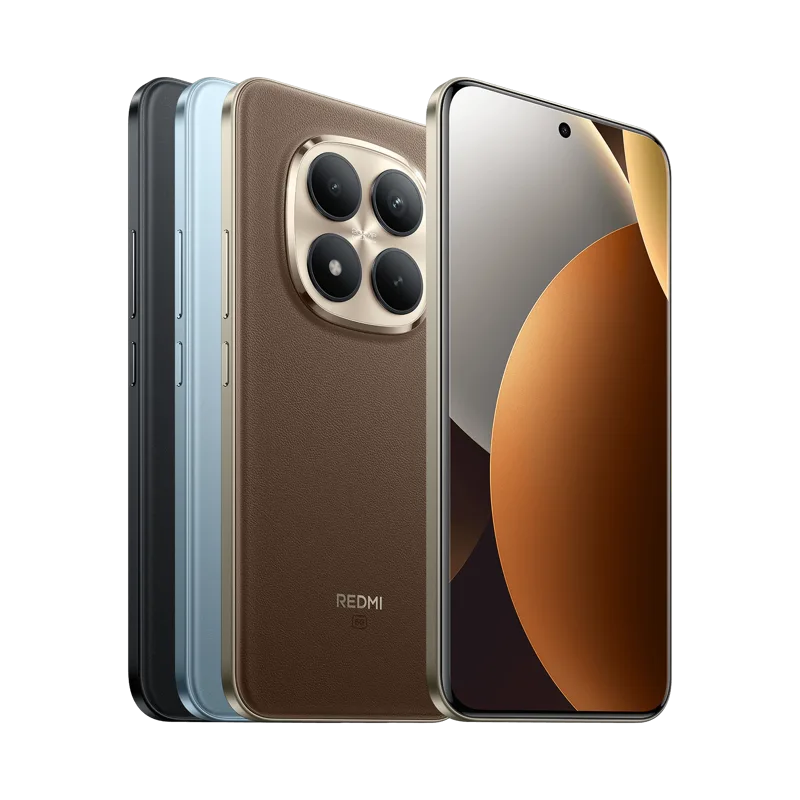
Xiaomi's top Redmi Note 15 pairs a 6,500 mAh battery and 100W charging with a 200MP stabilised camera, a 6.83-inch 120Hz AMOLED screen and IP69K protection.
Key figures at a glance
Gallery


Specifications
- Display
- 6.83" CrystalRes AMOLED, 2772x1280 (1.5K), up to 120Hz, 3200 nits peak, Gorilla Glass Victus 2
- Chipset
- Snapdragon 7s Gen 4 (4nm)
- RAM
- 12GB
- Storage
- 256GB / 512GB
- Rear Camera
- 200MP main (f/1.7, 1/1.4", OIS) + 8MP ultrawide
- Front Camera
- 32MP
- Battery
- 6500 mAh, 100W wired (in-box charger), 22.5W reverse wired
- Dimensions
- 163.34 x 78.31 x 8.19 mm, 207.1 g (Black, Glacier Blue)
- Protection
- IP66 / IP68 / IP69 / IP69K
The Xiaomi Redmi Note 15 Pro+ is the top model of the Redmi Note 15 family, a series that Xiaomi positions as its mainstream workhorse line. Where many phones in this segment trim the specification sheet to hit a price, the Pro+ is built around a short list of headline numbers: a 6,500 mAh battery, 100W charging with the charger in the box, a 200MP main camera with optical stabilisation and a 6.83-inch 1.5K AMOLED panel rated for 3,200 nits at peak. This page is based on the published specifications and manufacturer information, and it tries to separate what the specification sheet states from what Xiaomi merely claims.
Place in the lineup
The Redmi Note 15 range on Xiaomi's global site has three 5G models that matter here: the Redmi Note 15, the Redmi Note 15 Pro and this Pro+. No official US price or US availability is stated on the manufacturer pages we reviewed, so this page carries no price. What the Pro+ buys over the Pro is mostly about processor, charging and the selfie camera. Both share the same 6.83-inch 2772x1280 panel size, the same 200MP main sensor and the same 8MP ultrawide, but the Pro+ moves to a Snapdragon 7s Gen 4 instead of a MediaTek Dimensity 7400-Ultra, a 32MP front camera instead of 20MP, and 100W charging instead of 45W. The Pro, on the other hand, carries a slightly larger 6,580 mAh battery and a thinner 7.96 mm body. Buyers who want to see how it sits against a sibling from the same group can open the Redmi Note 15 Pro+ vs POCO X8 Pro page, which puts the two phones side by side.
Design, materials and durability
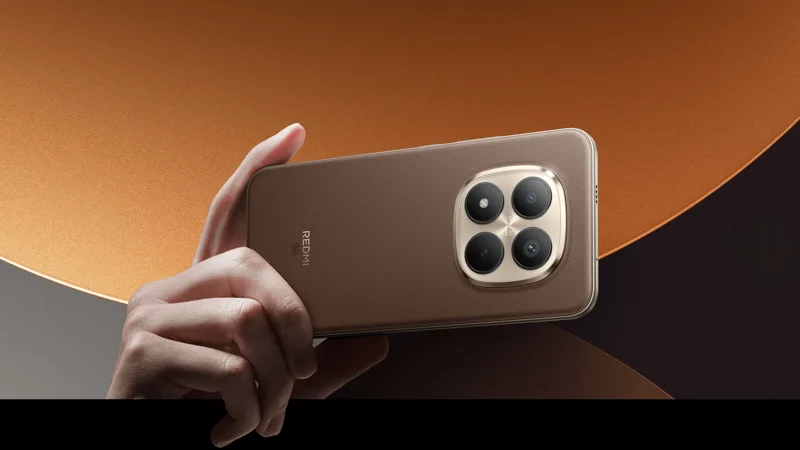
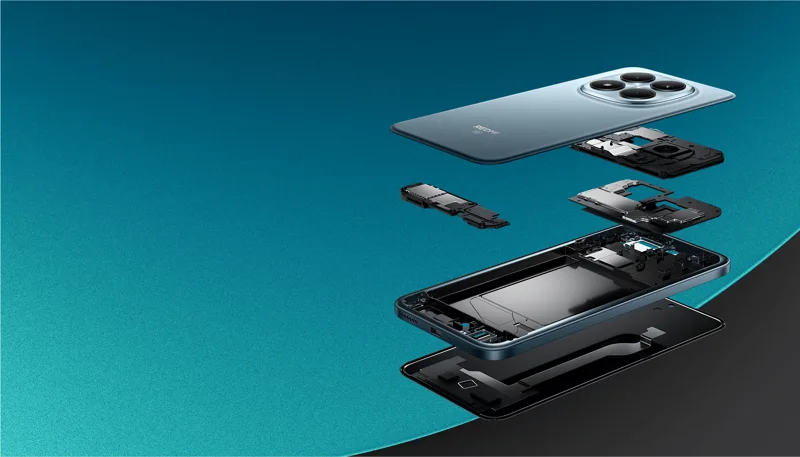
The phone measures 163.34 x 78.31 x 8.19 mm and weighs 207.1 g in Black and Glacier Blue; the Mocha Brown version is slightly thicker at 8.47 mm and heavier at 208 g. Xiaomi says the Black and Glacier Blue versions use a fibreglass back panel, which it describes as lightweight and impact absorbing, while the front uses Corning Gorilla Glass Victus 2 or a cover glass of equivalent or higher durability, a wording that leaves some room for substitution between production batches. The frame is described as aluminium-alloy reinforced, and the company says the phone passed an SGS-certified 2.5-metre drop test onto a smooth granite surface, along with SGS five-star premium performance for drop, bend and crush resistance. These are laboratory claims and they should be read as such; they are not a promise that the phone will survive any fall.
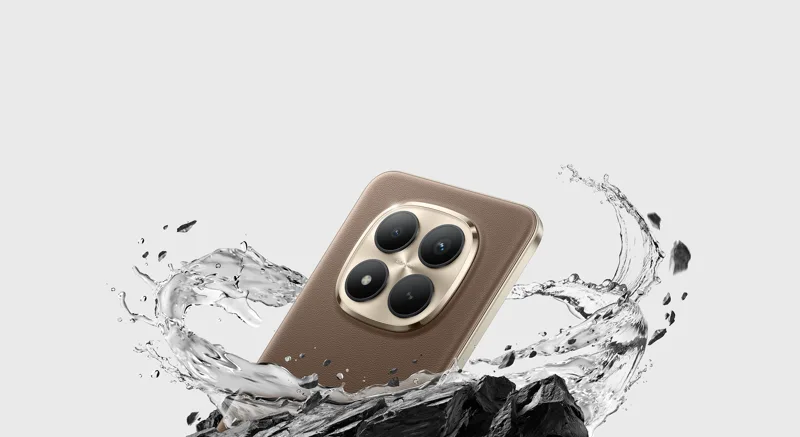
The more concrete figure is the ingress protection. The Pro+ is listed as IP66, IP68, IP69 and IP69K, which means it was tested against high-pressure hot-water jets as well as static immersion to 2 metres for up to 30 minutes. Xiaomi also cites a TÜV SÜD water-resistance endurance certification and a software feature that vibrates water out of the speaker. As always, the warranty does not cover liquid damage and the company advises against deliberate beach or pool use, so the rating is best treated as a safety margin for rain, spills and accidents rather than a feature to use on purpose.
Display
The 6.83-inch CrystalRes AMOLED panel runs at 2772 x 1280 pixels, about 447 pixels per inch, with a refresh rate of up to 120Hz. Xiaomi quotes 3,200 nits as peak brightness and 1,800 nits as high-brightness mode, 12-bit colour depth, DCI-P3 coverage, HDR10+ and Dolby Vision support, and 3,840Hz PWM dimming. The touch sampling rate is up to 480Hz in normal use, with a 2,560Hz instantaneous rate that only activates in Game Turbo mode. Three TÜV Rheinland certificates cover low blue light, circadian friendliness and flicker-free operation. On paper this is a display that would have been a flagship feature a few years ago. The caveat is that peak brightness figures refer to small highlight areas, and real-world full-screen brightness will be lower; Xiaomi does not publish a typical-brightness figure for this model on the page we reviewed.
Performance and software
The processor is the Qualcomm Snapdragon 7s Gen 4, made on a 4nm process, with an octa-core CPU clocked up to 2.7GHz and an Adreno GPU. Xiaomi says it delivers nearly 10 percent more overall performance than the Redmi Note 14 Pro+, which is a comparison with its own earlier model rather than an independent benchmark. The phone comes with 8GB or 12GB of LPDDR4X memory and UFS 2.2 storage in 256GB or 512GB sizes, with the 12GB and 512GB configuration noted as depending on region. That combination deserves a note: LPDDR4X and UFS 2.2 are older and slower standards than the LPDDR5X and UFS 3.1 found in some more expensive phones such as the OPPO Reno15 Pro, so app launches and large file transfers may not feel as fast as the processor name alone suggests. The memory extension feature can add virtual RAM, giving a headline of up to 24GB on the 12GB model, but it uses storage space and does not behave like physical memory.
The product page refers to Xiaomi HyperOS 2 features and promises six years of security updates. It does not give an Android version number, and this page does not guess one. The phone also supports Google Gemini and Circle to Search, plus Xiaomi's own AI tools for writing, transcription, interpreting and image editing, whose availability depends on region and language. One unusual item is Xiaomi Offline Communication, a voice-call feature that works without a mobile network over distances of about a kilometre in open spaces and requires a SIM card and a Xiaomi account; the company states that it is not intended for emergency use.
Camera
The rear camera is a two-lens system. The main sensor has 200MP resolution, a 1/1.4-inch size, an f/1.7 aperture, optical image stabilisation and 16-in-1 pixel binning. Beside it sits an 8MP ultrawide with an f/2.2 aperture. There is no dedicated telephoto lens; Xiaomi's marketing describes five focal lengths from one lens, from 23mm to 92mm equivalent, achieved by cropping the high-resolution sensor and processing with its 200MP AI Engine. Crop zoom of this kind can look good at 2x, and Xiaomi claims optical-level quality at 2x and 4x, but it is still a crop, and a phone with a real telephoto lens, such as the OPPO Reno15 Pro, will usually do better at 3x and beyond. Video goes up to 4K at 30 frames per second on the rear and 1080p at up to 60 frames per second on the front. The 32MP front camera is a clear step up from the 20MP unit in the Pro. As with every camera, picture quality cannot be judged from a specification list, and the sensible approach is to look at independent sample galleries before assuming that 200 megapixels means better pictures.
Battery and charging
The battery is the part where the Pro+ is most convincing. Xiaomi lists a typical capacity of 6,500 mAh using a silicon-carbon cell with 10 percent silicon content, and quotes up to two days of battery life, up to 25 hours of video playback and 47 hours of calling in its internal tests. Charging runs at 100W with a charger in the box, and the company says a full charge takes 40 minutes in boost mode under laboratory conditions with the screen off. The phone can also act as a power bank with up to 22.5W wired reverse charging. Xiaomi further claims that the battery retains more than 80 percent of its capacity after 1,600 charge cycles, which it translates to over six years of use. These are calculated figures, and the real lifespan will depend on heat, charging habits and usage. Even so, a 6,500 mAh capacity in a body that is 8.19 mm thick and weighs 207 g is a strong result.
Who it is for
The Redmi Note 15 Pro+ suits people who put battery life and fast charging above everything else, and who want a big, bright screen, solid water and dust protection and a main camera that should photograph well in daylight. It is a sensible choice for heavy streamers, travellers and anyone who forgets to charge overnight. It also appeals to buyers who like the extras: an IR blaster, an in-screen fingerprint reader, NFC, dual speakers with Dolby Atmos, Bluetooth 5.4, Wi-Fi 6 and 6E support, and dual SIM with eSIM.
Compromises
There are trade-offs. The memory and storage standards are older than at some competitors, there is no telephoto lens, no wireless charging is listed, and the processor is a 7-series chip rather than a flagship one, so very demanding games will need lower settings. The fast 2,560Hz touch response is available only in games, the headline battery numbers come from Xiaomi's own labs, and there is no US launch price on the pages we checked. For a broader view of how it stacks up against other devices, see the phone rankings, or compare it directly with the Galaxy A56.
Where it ranks
Compare Xiaomi Redmi Note 15 Pro+ with similar devices
More from Xiaomi
Frequently asked questions
When was the Xiaomi Redmi Note 15 Pro+ released?
The Xiaomi Redmi Note 15 Pro+ was released on 2026-01-15, according to the manufacturer’s published information.
What are the main specs of the Xiaomi Redmi Note 15 Pro+?
Headline figures for the Xiaomi Redmi Note 15 Pro+: Battery: 6,500 mAh, Refresh rate: 120 Hz, Main camera: 200 MP, RAM: 12 GB. The full specification table is further up this page.
Is the Xiaomi Redmi Note 15 Pro+ worth buying?
That depends on your priorities. Use the editorial review on this page for our view, check the rankings above to see where the device stands on battery, display and camera, and compare it directly with similar models before you decide.


