Phones
OPPO Reno14 Pro
The OPPO Reno14 Pro pairs a 6.83-inch 120Hz AMOLED screen and a Dimensity 8450 chip with three 50MP cameras, including a 3.5x telephoto, and a 6200 mAh battery with 80W charging.

Key figures at a glance
Gallery


Specifications
- Display
- 6.83" AMOLED (flexible), 1272 x 2800 (FHD+), up to 120Hz (60/90/120Hz), 1200 nits peak (HBM, typical), Gorilla Glass 7i
- Chipset
- MediaTek Dimensity 8450 (4nm)
- RAM
- 12GB
- Storage
- 256GB / 512GB (UFS 3.1, no card slot)
- Rear Camera
- 50MP main (f/1.8, OIS) + 50MP 3.5x telephoto (f/2.8, OIS) + 50MP ultra-wide (f/2.0, autofocus)
- Front Camera
- 50MP (f/2.0, autofocus)
- Battery
- 6200 mAh (typical), 80W SUPERVOOC wired, 50W AIRVOOC wireless
- OS
- ColorOS 15.0
- Dimensions
- 163.35 x 76.98 x 7.48 mm (Titanium Grey) / 7.58 mm (Opal White), about 201 g
- Protection
- IP69 water and dust resistance
- Connectivity
- Wi-Fi 6E, Bluetooth 5.4, NFC, USB Type-C
The OPPO Reno14 Pro is the top model of the Reno14 family on OPPO's global site, and it is built around three ideas: a large 6.83-inch 120Hz AMOLED screen, a triple 50MP camera system with a 3.5x telephoto lens, and a 6200 mAh battery that charges at 80W. This page is based on the published specifications and manufacturer information on OPPO's global product and specification pages. Where OPPO describes a benefit rather than a measured fact, it is marked as a claim, and nothing here is an independent benchmark.
Five questions a buyer should ask first
Because the Reno14 Pro sits between mid-range and premium, it helps to frame the decision as a few practical questions rather than a spec race.
Is it big? Yes. OPPO lists 163.35 mm in height, 76.98 mm in width and about 201 g, with a thickness of 7.48 mm in Titanium Grey and 7.58 mm in Opal White. The 6.83-inch panel has a stated screen-to-body ratio of 93.6 percent. If you want a one-handed phone, look at the smaller OPPO Reno14 instead, which is 187 g.
Is it fast enough? OPPO uses the MediaTek Dimensity 8450, a 4nm chip with eight cores, with 12GB of LPDDR5X memory and UFS 3.1 storage in 256GB or 512GB. That is an upper-mid-range platform rather than a flagship one, and the page describes it as deep-tuned with OPPO.
Is the camera system versatile? It has a 50MP main camera, a 50MP telephoto with 3.5x optical zoom and a 50MP ultra-wide lens with autofocus, plus a 50MP front camera. Few phones at this tier put the same resolution on every lens.
Will it last? The battery is rated at 6200 mAh typical (6058 mAh rated), which is large for a phone this thin.
Is it tough? OPPO states IP69 water and dust resistance and Gorilla Glass 7i on the front.
Where it sits in the Reno line
The global Reno14 line includes the Reno14 Pro, the Reno14 and the Reno14 F. The Pro is the only one with a 50MP ultra-wide lens, the only one with wireless charging listed on its specification page, and the one with the largest display. The standard Reno14 uses the Dimensity 8350 and a 6.59-inch screen, while the OPPO Reno14 F moves to a Snapdragon 6 Gen 1 and a much simpler camera set. OPPO's later generation is covered by the OPPO Reno15 Pro, which has a different camera layout, so owners of this generation should not expect an identical experience. The pages we reviewed list the Reno14 Pro under model code CPH2739 and state no US price, so this page carries none.
Design and display
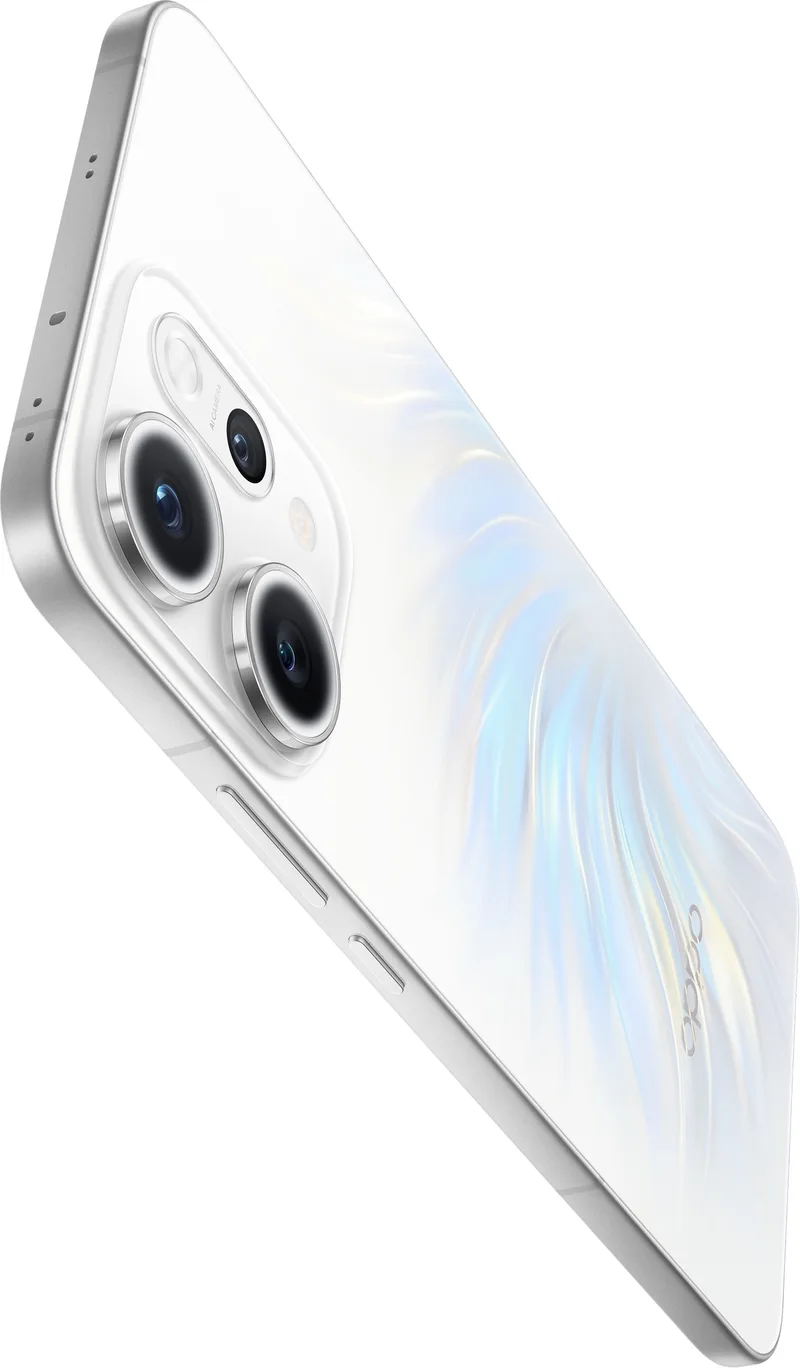
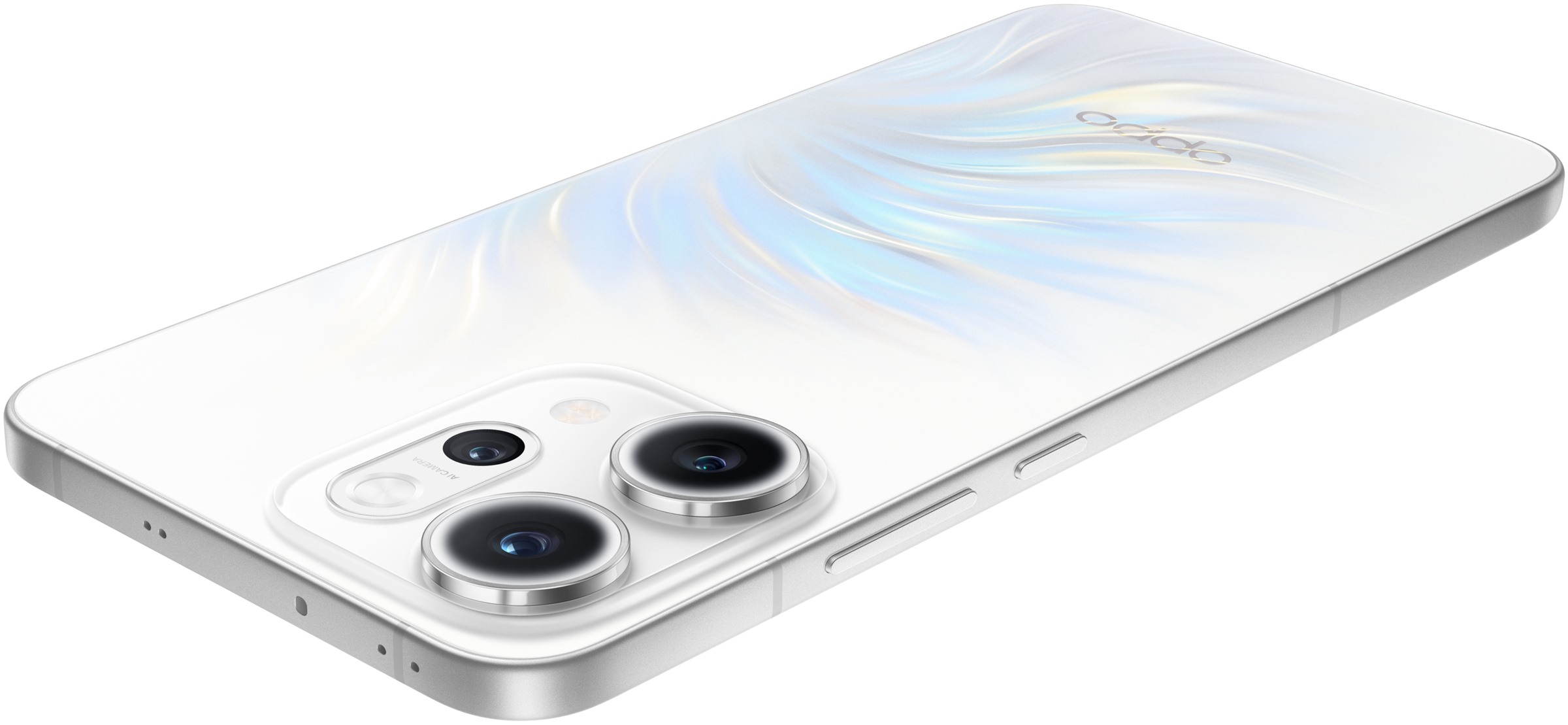
OPPO sells the phone in two colours, Opal White and Titanium Grey. The white version is the showpiece: OPPO says it uses an industry-first Iridescent Glow Process so that the back panel shifts colour as it moves, and it calls the camera island a Gradient Aura Design. The back is described as a velvet glass with a matte, fingerprint-resistant feel, and the frame is an aerospace-grade aluminium alloy according to OPPO. Those are marketing descriptions, but the renders do show a distinctive pearl pattern that sets it apart from plain glass phones.
The screen is a flexible AMOLED with a 1272 x 2800 resolution, roughly 450 pixels per inch. Refresh rate goes up to 120Hz and the panel offers 60, 90 and 120Hz modes. Touch sampling reaches 240Hz at maximum. OPPO lists 600 nits typical brightness and 1200 nits in high-brightness mode, 1.07 billion colours (10-bit) and 100 percent DCI-P3 in its Natural, Pro and Vivid modes. HDR10+ certification and a Splash Touch mode for wet fingers are also on the list, and OPPO adds a glove mode. An in-display optical fingerprint sensor handles biometrics, with face recognition as an alternative.
Performance, cooling and connectivity
The Dimensity 8450 is paired with an Arm G720 MC7 GPU running at 1300 MHz on OPPO's specification page. OPPO's marketing material quotes gains over a previous platform of 41 percent in multi-core CPU peak performance, 24 percent in GPU peak performance and 54 percent in overall NPU experience. Those figures come from OPPO's own comparison and the baseline is not named, so treat them as indicative at best.
Cooling is a visible selling point. OPPO describes an AI Nano Dual-Drive Cooling System with a 5300 mm² vapour chamber and 18755 mm² of graphite. In a footnote, the company says that during Mobile Legends play in a 35 degree environment its front, back and side temperatures stay below 41 degrees, and it claims stable frame rates for about ten hours at room temperature. Gaming extras include AI LinkBoost 3.0 antenna switching, a Wi-Fi booster and a Silent Launch mode for games.
The connectivity list is generous: Wi-Fi 6E with 2x2 MIMO (not available in every market, as OPPO notes for Egypt, Bangladesh, Indonesia and Turkey), Bluetooth 5.4 with LDAC and LHDC 5.0, NFC, USB Type-C and dual SIM with a nano-SIM and an eSIM. There is no memory card slot, so the 256GB or 512GB choice is final.
Software and AI features
The phone runs ColorOS 15.0. OPPO says several AI features may arrive by update rather than being present at launch, and that some depend on region and an internet connection. The list includes AI Recompose, which suggests a better framing; AI Perfect Shot, which swaps a blinking face for an open-eyed one; AI Style Transfer; AI Translate, VoiceScribe transcription and AI Call Summary; AI Mind Space for notes; and a call translator. Google Gemini is integrated with an overlay that can work with what is on the screen, and OPPO adds BeaconLink 2.0 for offline messaging and O+ Connect for sharing with Apple devices. None of these has been independently verified for this page, and their usefulness will vary with language and region.
The camera system in practice
On paper, the camera set is the reason to pick the Pro. The main sensor has an f/1.8 lens, a 1/1.55-inch sensor size according to OPPO and 2-axis optical stabilisation. The telephoto has an f/2.8 lens, a 30 degree field of view, autofocus and stabilisation, and reaches 3.5x optical zoom. The ultra-wide has an f/2.0 lens with a 116 degree field of view and autofocus, which also makes close-up work possible. The front camera is 50MP with f/2.0 and autofocus.
OPPO leans heavily on what it calls AI Flash Photography, with a triple flash design aimed at dark parties and dinners. The company also describes AI Flash Motion Photo, a Motion Photo export that can pull a three-second 4K clip or up to 90 stills, and direct Motion Photo sharing to Instagram (the launch date depends on Instagram updates). Video recording goes up to 4K at 60 fps on the rear and front cameras, with slow motion up to 1080p at 480 fps and dual-view video. Underwater shooting is a listed mode, and OPPO advises a professional waterproof case and a depth of no more than two metres.
Battery and charging
With a 6200 mAh typical capacity, the Reno14 Pro is one of the larger batteries in a phone of this thickness. OPPO supports 80W SUPERVOOC wired charging, which it says takes the phone from 1 to 100 percent in about 47 minutes, and 50W AIRVOOC wireless charging. The phone is also compatible with several lower SUPERVOOC levels and with 33W PPS and 13.5W PD, which is helpful if you carry a third-party charger. As always, these times come from OPPO's laboratory conditions.
Who it is for and what to weigh
The Reno14 Pro suits people who value a long battery, a good telephoto and a large screen more than they care about a flagship chip. It is a sensible choice for travel and social photography, and the combination of IP69, wireless charging and a large battery is uncommon at this level. The trade-offs are size and weight, a chip that is a notch below top-tier processors, no memory card slot and software features that may arrive after launch. Buyers should also remember that the pricing is not stated on the pages we reviewed.
For comparison with other options, see our head-to-head page OPPO Reno14 Pro vs OnePlus 13 for a bigger-budget alternative, or browse the phone rankings to see where the Reno14 Pro lands on battery and camera measures.
Where it ranks
Compare OPPO Reno14 Pro with similar devices
More from OPPO
Frequently asked questions
When was the OPPO Reno14 Pro released?
The OPPO Reno14 Pro was released on 2025-07-01, according to the manufacturer’s published information.
What are the main specs of the OPPO Reno14 Pro?
Headline figures for the OPPO Reno14 Pro: Battery: 6,200 mAh, Refresh rate: 120 Hz, Main camera: 50 MP, RAM: 12 GB. The full specification table is further up this page.
Is the OPPO Reno14 Pro worth buying?
That depends on your priorities. Use the editorial review on this page for our view, check the rankings above to see where the device stands on battery, display and camera, and compare it directly with similar models before you decide.


