Phones
OPPO Reno13 F
OPPO's Reno13 F 5G pairs a 6.67-inch 120Hz AMOLED screen and a 5,800 mAh battery with 45W charging and IP69, IP68 and IP66 protection in a 7.76 mm body.
Key figures at a glance
Gallery

Specifications
- Display
- 6.67" rigid AMOLED, 1080x2400, 60/120Hz, 600 nits typical (1200 nits HBM)
- Chipset
- Qualcomm Snapdragon 6 Gen 1 (model CPH2699, 5G)
- RAM
- 12GB
- Extended RAM
- Up to 12GB of storage usable as virtual RAM
- Storage
- 128GB / 256GB / 512GB (UFS 3.1, storage card supported)
- Rear Camera
- 50MP main (f/1.8, OIS) + 8MP ultra-wide + 2MP macro
- Front Camera
- 32MP
- Battery
- 5,800 mAh (typical), 45W SUPERVOOC wired
- OS
- ColorOS 15.0
- Dimensions
- 162.20 x 75.05 x 7.76 mm (7.82 mm Luminous Blue), 192 g
- Water resistance
- IP69, IP68, IP66
- Connectivity
- 5G, Wi-Fi 5, Bluetooth 5.1, NFC (varies by region), USB-C
The OPPO Reno13 F 5G is the value-oriented member of the Reno13 family: a 6.67-inch AMOLED phone with a Snapdragon 6 Gen 1 chipset, a 5,800 mAh battery with 45W charging, a 50MP main camera with optical stabilisation and a body that carries three dust and water ratings, including IP69. This page is based on the published specifications and manufacturer information, and it explains where the phone sits, what the hardware promises and which compromises come with a price-conscious design.
Place in the lineup
OPPO's global Reno13 family is listed as four tabs on the company's site: Reno13 Pro, Reno13, Reno13 F 5G and a separate Reno13 F. The model covered here is the 5G version, which carries the model number CPH2699. If you shop for a "Reno13 F", check which of the two you are looking at, because the 4G and 5G variants are distinct products with different internals. The higher models in the family are covered on their own pages, for example the OPPO Reno13 and the OPPO Reno13 Pro, and the series has since moved on to models such as the OPPO Reno14 Pro and the OPPO Reno15.
The release date shown for this page, 9 January 2025, is a reference date for the January 2025 launch of the Reno13 range. OPPO's global product pages do not state an on-sale date or a price for the phone, so regional launches and prices can differ, and no US price is listed here.
Design, display and durability
The Reno13 F 5G uses a 6.67-inch rigid AMOLED panel with a 1080 x 2400 resolution, which works out to 394 pixels per inch. OPPO gives a maximum refresh rate of 120Hz with a 60/120Hz switch, a typical brightness of 600 nits and a high-brightness-mode figure of 1,200 nits. The colour modes are described as 100% DCI-P3 in the vivid setting and 100% sRGB in the natural setting, and the panel is a 16.7-million-colour (8-bit) unit. The screen-to-body ratio is quoted at 92.2%, the cover glass is listed as AGC DT STAR2, and touch sampling reaches up to 180Hz. A fixed 120Hz-capable AMOLED is a sensible choice in this segment, but there is no mention of adaptive variable refresh below 60Hz, so battery savings from low-rate scrolling are limited to the simple two-step mode.
Durability is the other headline. OPPO lists IP69, IP68 and IP66 ratings together and says the phone withstands splashes of hot water up to 80 degrees Celsius and immersion to two metres for 30 minutes. IP69 is the most demanding of the three ratings, and it is the main reason to look at this phone over a plainer mid-ranger. OPPO also lists an underwater photography mode among the camera features. The usual caveat applies: water resistance is not covered by warranty in many regions, and the ratings are laboratory results for fresh water, not for the sea or for pool chemicals.
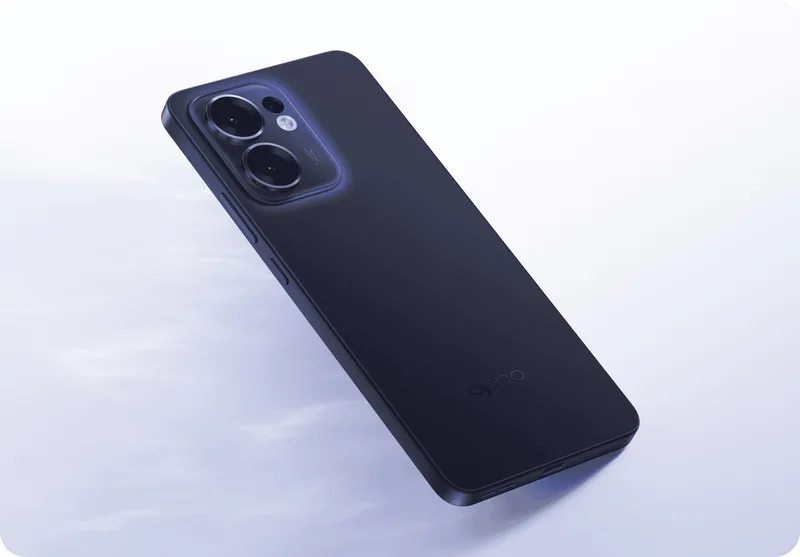
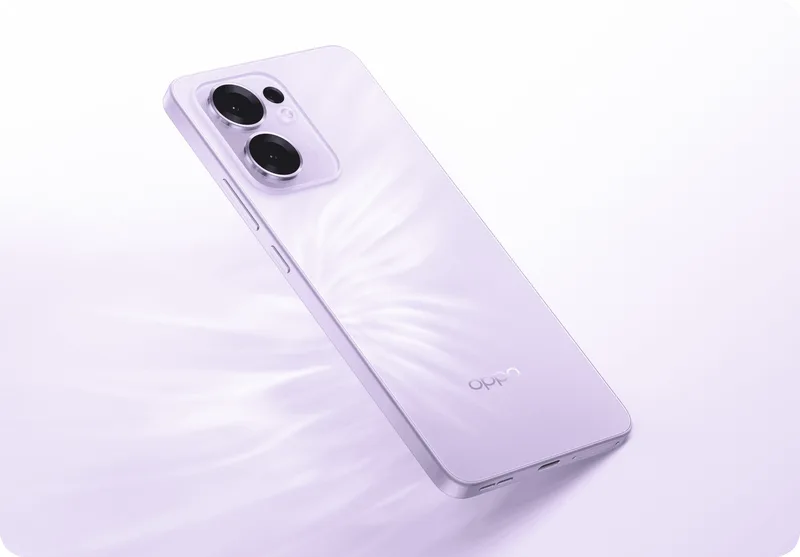
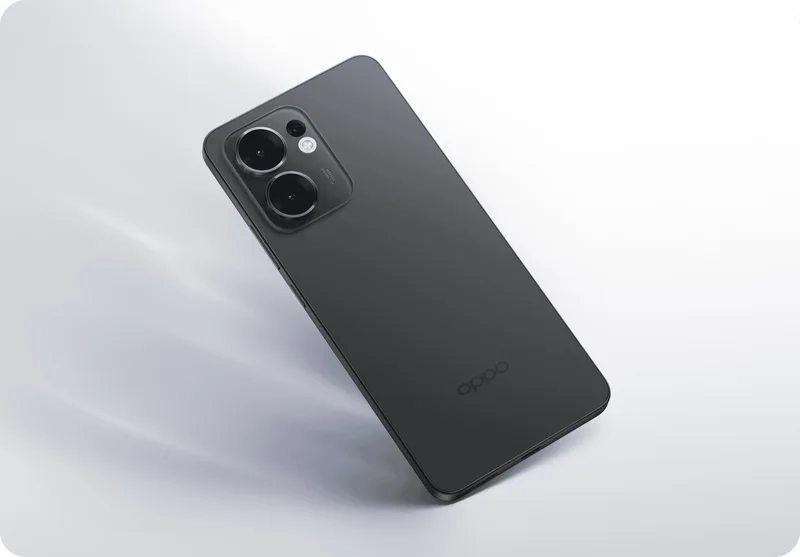
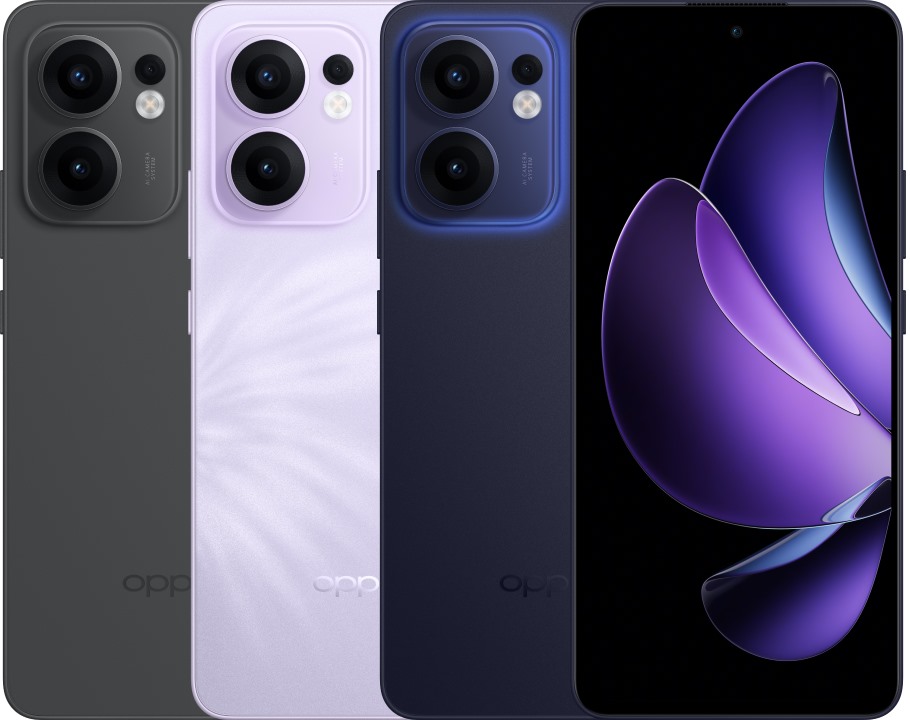
The phone is 7.76 mm thick in Graphite Grey and Plume Purple and 7.82 mm in Luminous Blue, with a width of 75.05 mm, a height of 162.20 mm and a weight of about 192 g. For a battery of this size, that is a reasonably slim and light body. Three colours are listed. Luminous Blue has a glowing ring effect around the camera island, Plume Purple has a light, pearlescent look in OPPO's images and Graphite Grey is a matte dark tone. One small detail from the spec sheet: the light sensor is hidden at the top of the screen, and OPPO warns that coloured or dark screen protectors with poor light transmission can interfere with it, so choose a clear protector.
Performance, memory and software
The chipset is the Qualcomm Snapdragon 6 Gen 1 with an eight-core CPU and an Adreno 710 graphics unit running at 676MHz. It sits in the mid-range tier, where the focus is on smooth everyday use, social apps, streaming and casual to moderate gaming rather than on sustained high-end 3D performance. OPPO does not publish benchmark scores and neither does this page; if you play demanding games at high settings, expect to lower the graphics options.
Memory comes in four combinations: 8GB with 128GB, 8GB with 256GB, 12GB with 256GB and 12GB with 512GB. The RAM is LPDDR4X, which is older and slower than the LPDDR5X used in the faster phones, and storage is UFS 3.1. OPPO adds that up to 12GB of storage can be used as virtual RAM; this is a software feature that helps keep more apps open, but it is not a substitute for physical memory, and it is listed separately from the RAM figure on this page. The phone supports a storage card, which is helpful at the 128GB level, and USB OTG is supported.
The operating system is ColorOS 15.0, as stated on the spec sheet; OPPO's page does not give the underlying Android version, so we do not state one. Software features OPPO highlights include AI LinkBoost 2.0, which is meant to improve signal handling, and BeaconLink, a feature for communicating without a mobile network. Both are manufacturer claims whose real-world benefits depend on your carrier and surroundings. Connectivity on the spec sheet is Wi-Fi 5, Bluetooth 5.1, a USB-C port, NFC (OPPO notes that NFC depends on the region) and single-band satellite positioning, with support for GPS, GLONASS, Galileo, BeiDou and QZSS. Audio codecs include SBC, AAC, aptX, aptX-HD and LDAC, and the phone has dual stereo speakers. Wi-Fi 6 is not listed, so people with very fast home networks may be limited to Wi-Fi 5 speeds.
Camera system
The rear setup has three elements: a 50MP main camera with an f/1.8 aperture, a 78-degree field of view and optical image stabilisation; an 8MP ultra-wide camera with an f/2.2 aperture and a 112-degree field of view; and a 2MP macro camera at f/2.4. In practice the main camera does nearly all of the work. The 2MP macro sensor is a low-resolution add-on that is best seen as a convenience feature, and there is no telephoto lens, so zoom beyond the main camera relies on cropping and processing.
Video is capped at 4K at 30 frames per second on the rear camera, with 1080p at 60 or 30 and 720p options. Stabilised video (EIS or OIS) is listed at up to 1080p at 60 frames per second, which means the sharpest 4K clips are not stabilised in the same way. Slow motion reaches 720p at 240 frames per second, and there is a dual-view video mode. The front camera is a 32MP unit with an f/2.4 aperture and an 82-degree field of view, which is a high resolution for a phone in this class and should suit selfies and video calls. OPPO lists a long set of shooting modes, including portrait, night, pro, panorama, time-lapse, underwater and a document scanner. The quality of the results depends heavily on OPPO's processing, and we cannot judge it from specifications alone.
Battery and charging
The battery has a typical capacity of 5,800 mAh and a rated capacity of 5,640 mAh. Charging is up to 45W using OPPO's SUPERVOOC system, and the phone also supports VOOC 3.0, PD, QC and PPS protocols, which makes it easier to use third-party chargers. OPPO claims the battery keeps more than 80% of its capacity after four years of use, based on its own laboratory simulation. That is a manufacturer claim and the actual ageing depends on temperature, charge habits and use. A 5,800 mAh cell combined with a power-efficient 6 Gen 1 chipset and an AMOLED panel should give comfortable all-day use for most people. The box contents on the spec sheet include a charger, a cable and a protective case, though contents can vary by market.
Who the phone is for
The Reno13 F 5G fits people who want a phone that is hard to break in daily life: commuters, parents, outdoor users and anyone who is tired of worrying about spills, rain or dust. It also suits buyers who value a large battery, a bright AMOLED screen and a sharp 32MP front camera, and those who would like expandable storage. Because the phone offers up to 12GB of RAM and 512GB of storage, it can also work for people who keep a large photo library locally.
If you compare it with the competition, the natural rival in the same price range is Samsung's A-series; see how the two stack up in our OPPO Reno13 F vs Galaxy A56 comparison, and check the overall phone rankings to see where it places on the data we track.
Compromises to weigh
- Mid-range chipset: the Snapdragon 6 Gen 1 is built for efficiency, not for the highest frame rates in demanding games.
- Older memory type: LPDDR4X RAM and Wi-Fi 5 are a step behind the latest mid-range parts. The extended RAM option is virtual and does not replace real memory.
- Limited zoom: there is no telephoto camera, and the 2MP macro sensor adds little beyond novelty.
- Video: rear 4K recording stops at 30 frames per second, and stabilised video tops out at 1080p.
- Regional variation: NFC support, accessories, storage options and pricing differ by market, and the 4G Reno13 F is a different product.
- Unstated details: OPPO's page does not list the Android version, the software update commitment or a price, so confirm those with your local OPPO site before buying.
In short, the OPPO Reno13 F 5G trades top-tier speed for toughness, battery capacity and a good front camera. If those are your priorities and your budget is moderate, it deserves a place on the shortlist; if you want a fast chipset, the newer Wi-Fi standard or a zoom lens, look further up the Reno range.
Where it ranks
Compare OPPO Reno13 F with similar devices
More from OPPO
Frequently asked questions
When was the OPPO Reno13 F released?
The OPPO Reno13 F was released on 2025-01-09, according to the manufacturer’s published information.
What are the main specs of the OPPO Reno13 F?
Headline figures for the OPPO Reno13 F: Battery: 5,800 mAh, Refresh rate: 120 Hz, Main camera: 50 MP, RAM: 12 GB. The full specification table is further up this page.
Is the OPPO Reno13 F worth buying?
That depends on your priorities. Use the editorial review on this page for our view, check the rankings above to see where the device stands on battery, display and camera, and compare it directly with similar models before you decide.


