Phones
Huawei Mate XT
Huawei's Mate XT is a tri-fold phone: a 6.4-inch single screen unfolds to 7.9 and 10.2 inches (up to 90Hz), with 16GB RAM, a 50MP variable-aperture camera, a 5,600 mAh battery and 66W charging.
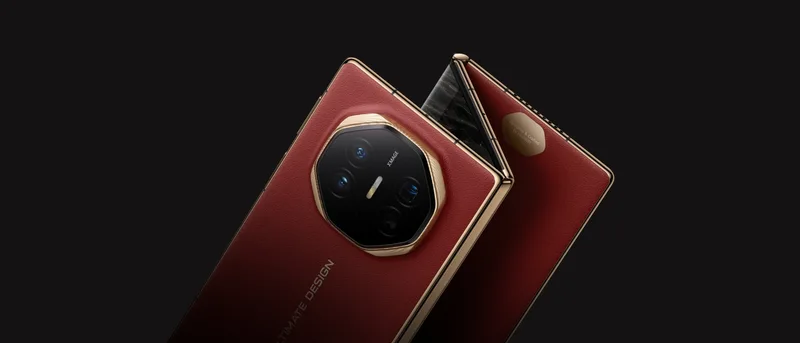
Key figures at a glance
Gallery
Specifications
- Display
- Tri-fold OLED, up to 90Hz adaptive refresh (Huawei lists one figure for the whole display): single screen 6.4" (2232 x 1008), up to 90Hz; dual screen 7.9" (2232 x 2048), up to 90Hz; triple screen 10.2" (2232 x 3184, 3K), up to 90Hz; 382 ppi, 1.07 billion colors, 1440Hz PWM dimming, up to 240Hz touch sampling, 92% screen-to-body ratio (Huawei figure)
- RAM
- 16GB
- Storage
- 512GB / 1TB, no external memory support
- Rear Camera
- 50MP main (Ultra Aperture, adjustable F1.4-4.0 physical aperture, OIS) + 12MP ultrawide (F2.2) + 12MP periscope telephoto (F3.4, OIS), about 5.5x optical zoom, 50x digital zoom, 4K video
- Front Camera
- 8MP (F2.2), 4K video
- Battery
- 5,600 mAh typical (5,500 mAh rated), silicon-anode, 66W wired HUAWEI SuperCharge, 50W wireless
- OS
- HarmonyOS 4.2 (EMUI 14.2)
- Dimensions
- Height 156.7 mm; width 73.5 mm single / 143.0 mm dual / 219.0 mm triple screen; thickness 12.8 mm folded, 3.6 / 3.6 / 4.75 mm unfolded (Huawei figures)
- Weight
- About 298 g (306 g with screen protector)
- Durability
- Not water or dust resistant (IPX8 not supported); hinge core components in ultra-high strength steel (1900 MPa, Huawei claim)
- Connectivity
- Dual SIM; 2G/3G/4G band lists on the spec page; Wi-Fi 802.11 a/b/g/n/ac/ax; Bluetooth 5.2 (LDAC, L2HC); NFC; USB-C 3.1 Gen1; GPS (L1+L5), GLONASS, BeiDou, Galileo, QZSS, NavIC
- Audio
- HUAWEI Histen stereo sound, USB-C digital audio
- Colors
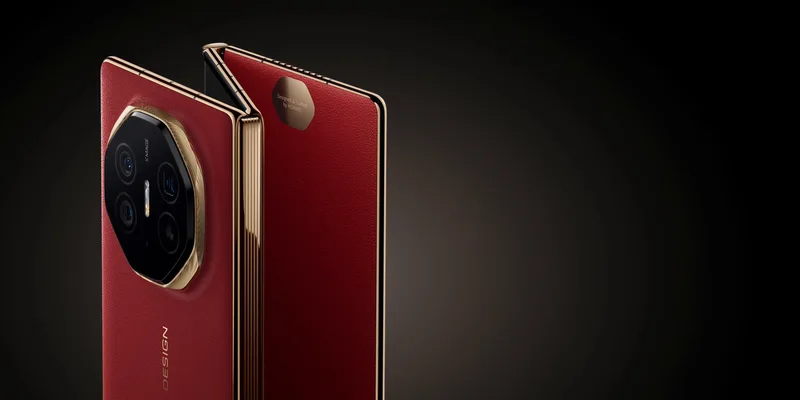
- Red, Black (vegan leather finish)
The Huawei Mate XT (sold by Huawei as the Mate XT ULTIMATE DESIGN) is one of the first mass-produced tri-fold phones: a device with two hinges and a single continuous OLED screen that works as a 6.4-inch phone, a 7.9-inch dual-screen device or a 10.2-inch tablet-sized display. This review is based on the published specifications and manufacturer information from Huawei's global product and specification pages. Huawei's statements are marked as claims, and the lab figures it quotes are not independent measurements.
Where the Mate XT fits in Huawei's lineup
Huawei positions the Mate XT as a showpiece for what the company can do with a triple screen and a very thin body, and it carries the Mate name. Within the broader foldable market, its closest relatives are the later book-style Huawei Mate X6 and Huawei Mate X7, which fold once, and the later three-panel Samsung Galaxy Z TriFold. The comparison pages Mate XT versus Mate X6 and Mate XT versus Galaxy Z TriFold put the published numbers side by side, and the rankings page shows how the phone scores on its published data.
Design, hinges and the three screen modes
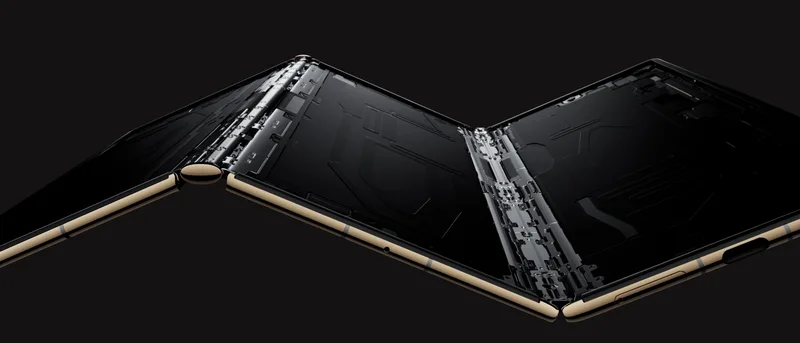
Huawei describes a tri-fold with one inward-folding and one outward-folding hinge, so that when the phone is closed a 6.4-inch single screen remains usable on the outside. The specifications list three states. In single-screen mode the phone is 156.7 mm tall, 73.5 mm wide and 12.8 mm thick. Folded once into dual-screen mode it is 143.0 mm wide and about 7.45 mm and 4.75 mm thick in its two sections, and fully unfolded it is 219.0 mm wide with sections that are 3.6 mm, 3.6 mm and 4.75 mm thick. The weight is about 298 g, or 306 g with the pre-applied screen protector.
The mechanism is a pair of different hinges: Huawei says the inward hinge contains a sliding track while the outward hinge has its own structure, and the two work together. In its marketing, the company mentions a multi-drive system that calibrates 26 precision cams based on the force applied, and hinge core components made of steel with a strength of 1900 MPa. These are Huawei laboratory claims. The back is vegan leather in red or black with a gold-tone frame; Huawei says the finish called Eonic Curves involves 78 processes and 80 layers of steel, which is a design story and not something that can be verified from the spec sheet.
Display
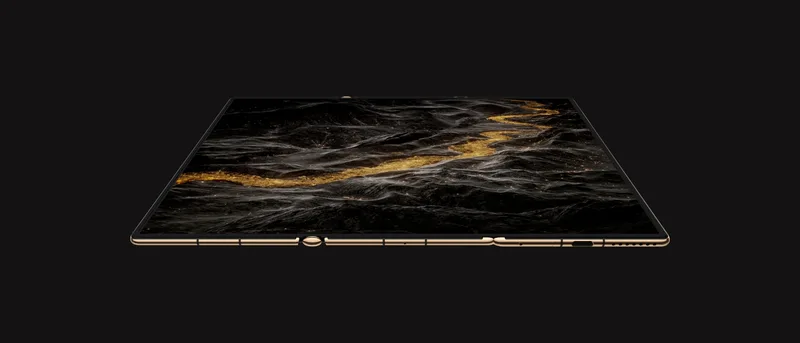
When fully unfolded, the display measures 10.2 inches diagonally with a resolution of 2232 x 3184 pixels, which Huawei calls 3K, and a 16:11 aspect ratio. The dual-screen mode is 7.9 inches at 2232 x 2048 and the single-screen mode is 6.4 inches at 2232 x 1008. The panel is OLED with a density of 382 ppi and 1.07 billion colours. The refresh rate is listed as an adaptive range of up to 90Hz, which is lower than the 120Hz found on most current flagships; Huawei gives a single figure and does not break it out by mode. PWM dimming runs at 1440Hz and touch sampling goes up to 240Hz.
On durability, Huawei says the multi-directional flexible material is 25% more bend-resistant and that a composite structure with non-Newtonian fluid materials and large ultra-thin glass makes the screen 30% more impact-resistant. Both numbers come from Huawei labs. Huawei also stresses practical care: a slight crease at the fold is described as normal, the factory screen film should not be removed, sharp objects should be kept away, and the hinge should not be folded or unfolded at ambient temperatures of -5°C or below.
Performance and software
The specification page lists the memory as 16GB of RAM with 512GB or 1TB of storage and states that external memory is not supported. It does not name the processor, and so we do not either. The software is HarmonyOS 4.2, which Huawei also labels EMUI 14.2, and the company showcases single, dual and triple-screen interface modes, where apps can be laid out across the larger canvas for reading, video, document work or multitasking. As Huawei's marketing images note, the interface may vary from product to product, and some features depend on the region. The page lists AppGallery and Huawei Mobile Services as the services layer and does not mention Google Mobile Services, which is a key consideration for anyone who depends on Google apps.
Connectivity includes Wi-Fi 802.11 a/b/g/n/ac/ax, Bluetooth 5.2 with LDAC and L2HC audio codecs, NFC, and a USB-C 3.1 Gen1 port, although the supplied cable supports USB 2.0 only. Satellite positioning covers GPS (L1+L5), GLONASS, BeiDou, Galileo, QZSS and NavIC. The network section of the page lists 2G, 3G and 4G LTE bands for a dual-SIM model; it does not list 5G bands, so check regional model details before buying.
Camera
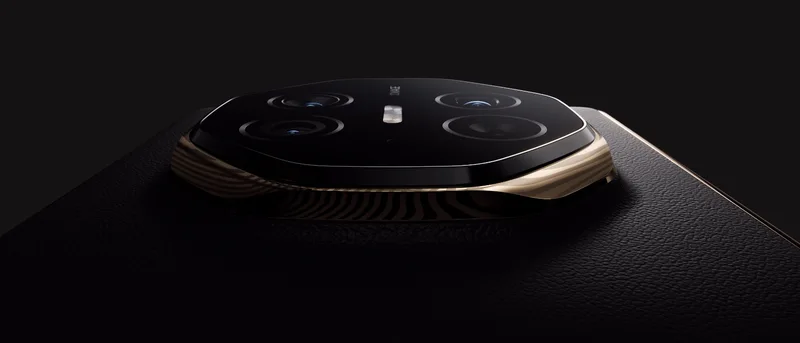
The rear camera has three sensors: a 50MP main camera that Huawei calls the Ultra Aperture camera, with a physical aperture that is adjustable across F1.4 to F4.0 (the marketing page speaks of ten adjustable sizes) and optical stabilisation; a 12MP ultrawide camera at F2.2; and a 12MP periscope telephoto at F3.4 with stabilisation. The zoom is about 5.5x optical, based on equivalent focal lengths of 24 mm, 13 mm and 125 mm, and up to 50x digital. Video goes up to 3840 x 2160 pixels. The front camera is an 8MP unit at F2.2, which is modest next to rivals, and the list of rear camera modes includes a Mirror Shooting mode.
Because the module is mounted on a very thin body, Huawei has to pack the lenses into a raised octagonal island. Image quality claims such as "Full Focal HD Photography" are marketing terms; independent testing is the best guide to how the processing performs.
Battery and charging
Huawei lists a typical battery capacity of 5,600 mAh and a rated capacity of 5,500 mAh, and says it uses an ultra-thin silicon-anode battery only 1.9 mm thick. Wired charging is HUAWEI SuperCharge at up to 66W, and wireless charging goes up to 50W with a compatible Huawei charger; the charger in the box depends on the market. Huawei does not publish a battery-life figure in hours, so the real endurance with a 10.2-inch display running at up to 90Hz is best checked in reviews that measure it.
Who it is for
The Mate XT is a device for early adopters who want a screen that grows from phone to tablet size and who accept the trade-offs of a new category. It suits people who read, work with documents or watch video on the go and want a large canvas that folds down to fit a pocket. It also suits enthusiasts who simply want the most engineered foldable on the market.
Compromises
- No water or dust resistance: the spec page lists IPX8 as not supported and warns against liquids and sand.
- Fragility and care rules: a visible crease, a warning on cold temperatures and a protective film that must not be removed.
- Software ecosystem: HarmonyOS 4.2 with Huawei Mobile Services; Google Mobile Services are not mentioned.
- Refresh rate: up to 90Hz, below many current flagships.
- Front camera: only 8MP.
- Network details: no 5G band list on the specification page and no stated chipset.
- Price and availability: no US list price is published on the pages used here, and availability varies by region.
In short, the Huawei Mate XT is a statement product: a large, thin and technically impressive tri-fold that comes with the compromises of a first-generation form factor. If you prefer a single-fold design, begin with the Mate X6 page.
Where it ranks
Compare Huawei Mate XT with similar devices
More from Huawei
Frequently asked questions
When was the Huawei Mate XT released?
The Huawei Mate XT was released on 2024-09-20, according to the manufacturer’s published information.
What are the main specs of the Huawei Mate XT?
Headline figures for the Huawei Mate XT: Battery: 5,600 mAh, Refresh rate: 440 Hz, Main camera: 50 MP, RAM: 16 GB. The full specification table is further up this page.
Is the Huawei Mate XT worth buying?
That depends on your priorities. Use the editorial review on this page for our view, check the rankings above to see where the device stands on battery, display and camera, and compare it directly with similar models before you decide.


