Phones
OPPO Reno12
The OPPO Reno12 keeps the Reno12 Pro's 6.7-inch 120Hz AMOLED, Dimensity 7300-Energy chip, 5,000 mAh battery and 80W charging, with a 32MP selfie camera and no telephoto.
Key figures at a glance
Gallery


Specifications
- Display
- 6.7" 3D flexible AMOLED with two curved edges, 2412x1080 (394 ppi), up to 120Hz (60/90/120Hz), 1200 nits in sunlight, HDR10+, Gorilla Glass 7i
- Chipset
- MediaTek Dimensity 7300-Energy (4nm, octa-core)
- RAM
- 12GB
- Storage
- 256GB / 512GB
- Rear Camera
- 50MP main (f/1.8, OIS) + 8MP ultrawide (f/2.2) + 2MP macro (f/2.4)
- Front Camera
- 32MP (f/2.0, autofocus)
- Battery
- 5,000 mAh (typical; 4,880 mAh rated), 80W SUPERVOOC wired
- OS
- ColorOS 14.1
- Weight
- 177 g
- Dimensions
- 161.4 x 74.1 x 7.57 mm
- Water Resistance
- IP65
- Memory type
- LPDDR4X RAM, UFS 3.1 storage
- Extended RAM
- Up to 12GB of storage can be used as temporary RAM
- Connectivity
- Wi-Fi 6, Bluetooth 5.4, NFC, USB Type-C
- Colors
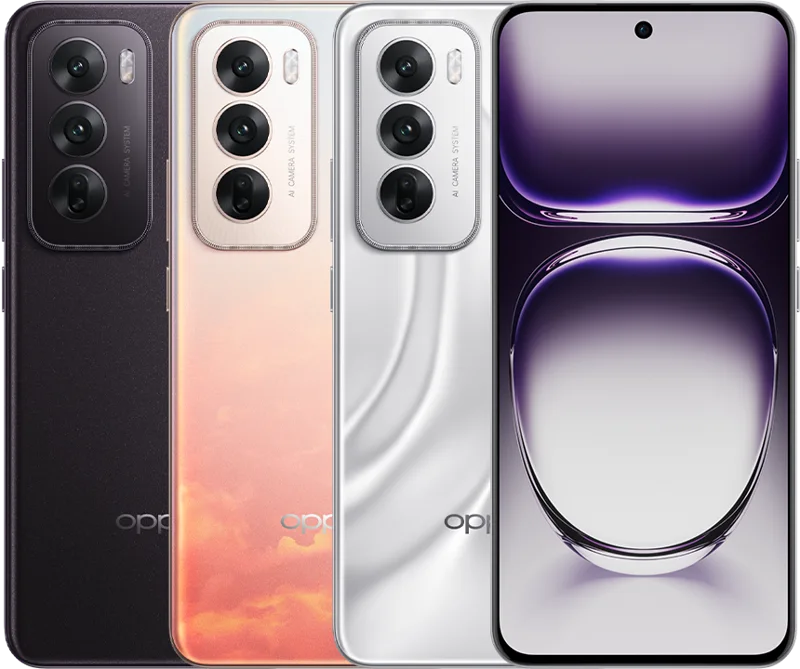
- Astro Silver, Sunset Pink, Matte Brown
If the Reno12 Pro is the camera-first phone of the 2024 Reno12 generation, the OPPO Reno12 is the one most people will actually weigh up: the same 6.7-inch 120Hz AMOLED size, the same efficient Dimensity 7300-Energy chip and the same large battery, but a simpler camera set and a slightly lighter body. OPPO presented the Reno12 and Reno12 Pro together on 18 June 2024 for European markets and launched them in India on 12 July 2024. This review is written from the published specification sheet and manufacturer material, which means the strengths and weaknesses below come from the numbers and from OPPO's own claims rather than from personal testing.
Standard model, middle position
Within the family the Reno12 sits between the Reno12 Pro above and the Reno12 F below. It inherits the processor, the battery and the 80W charging of the Pro, and gives up the telephoto lens, the 50MP selfie camera, the four-edge curved screen and the tougher Gorilla Glass Victus 2. Later generations introduced the Reno13 and the Reno15, which makes the Reno12 an established, older model whose appeal is that it still delivers a large screen and quick charging. OPPO did not state a US price on the pages consulted, so no price appears here.
Design: lighter and simpler
The Reno12 weighs about 177 g and measures 161.4 x 74.1 mm with a thickness of about 7.57 mm. That is 3 g less than the Reno12 Pro, although the body is slightly thicker. The screen is curved on two edges only, which OPPO describes as a 3D flexible AMOLED with two curved edges of equal height. The cover is Corning Gorilla Glass 7i, and OPPO states an IP65 rating for dust and splashes. The company also talks about a high-strength alloy frame and a sponge-like internal cushioning layer meant to absorb drops. These are lab-test descriptions and not a guarantee against damage.
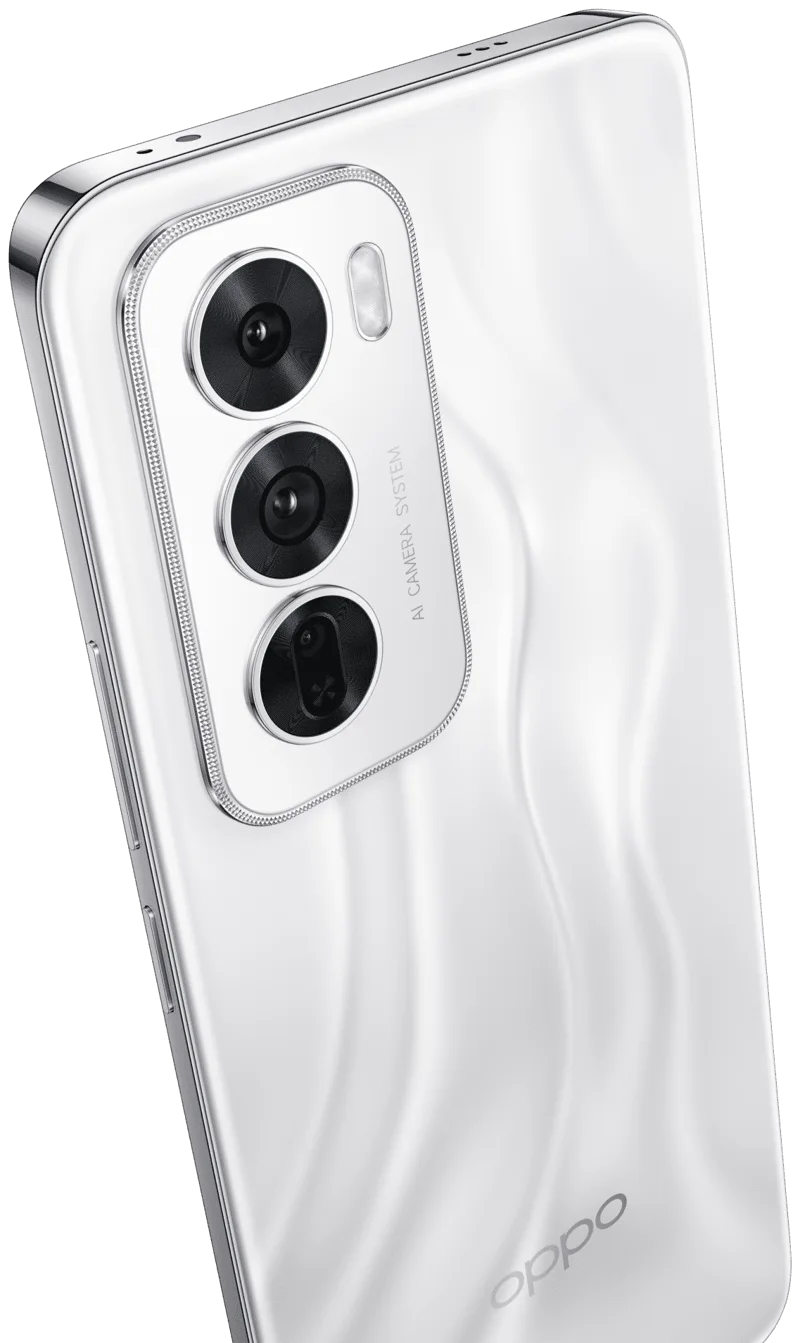
The back panel carries what OPPO calls Fluid Ripple Texture, a pattern that creates a rippling water effect as light moves across it. Three colours are offered. Astro Silver is the space-age finish used across the series. Sunset Pink uses a graphic liquid-crystal process and is OPPO's take on the 2024 colour of the year, Peach Fuzz. Matte Brown is a cocoa shade with a finish designed to resist fingerprints. For people who find the Pro's two-tone design too busy, the plain back of the standard model is easier to live with.
The display in daily use
The panel is 6.7 inches with a resolution of 2412 x 1080, about 394 pixels per inch and a screen-to-body ratio of 93.2%. The refresh rate can be set to 60, 90 or 120 Hz, touch sampling reaches 240 Hz, and brightness reaches 600 nits in the configurable maximum and 1,200 nits in direct sunlight. The screen shows 1.07 billion colours, supports HDR10+ and includes hardware-level blue-light reduction. Splash Touch is intended to keep input working with wet hands. For video, the 120Hz panel and HDR10+ support are the main attractions.
Cameras: three lenses, one that matters
The rear camera system has a 50MP main camera (f/1.8, optical stabilisation, autofocus), an 8MP ultrawide camera (f/2.2) and a 2MP macro camera (f/2.4). In everyday photography the main camera does nearly all of the work; the macro sensor is a low-resolution add-on that is helpful mainly for close-up objects in good light. The front camera is a 32MP unit with autofocus and a 90 degree field of view, which is ample for selfies and video calls.
Video recording reaches 4K at 30 fps on both the rear and front cameras, with slow motion up to 1080p at 480 fps and 720p at 960 fps listed on the specification page. OPPO also lists a Pro Portrait Mode with cinematic background blur and a skin-tone approach it calls Natural Tone. The AI tools are the same family as on the Pro, including AI Eraser 2.0, AI Clear Face, AI Best Face and AI Smart Image Matting 2.0, with the usual note that availability can differ between regions and software versions.
Performance and everyday software
The Dimensity 7300-Energy is built on a 4nm process, and the memory arrangement is LPDDR4X with UFS 3.1 storage. The specification page lists 12GB of RAM with 256GB or 512GB of storage. According to MediaTek's own comparison, quoted by OPPO, the chip lowers CPU power draw by up to 30% and GPU power draw by up to 46% compared with the previous generation, but those are manufacturer claims. RAM Expansion lets the phone use up to 12GB of storage as extra memory when needed.
ColorOS 14.1 supplies the software. Aqua Dynamics collects notifications and live services at the top of the screen, File Dock offers a drag-and-drop shelf for text and images, and Holo Audio adds spatial sound. The phone supports Wi-Fi 6, Bluetooth 5.4, NFC and USB Type-C, and it takes two nano-SIM cards. The BeaconLink feature allows voice calls over boosted Bluetooth when there is no mobile signal, with a stated range of about 200 metres in open areas.
Battery and charging
The typical battery capacity is 5,000 mAh (4,880 mAh rated). With the 80W SUPERVOOC charger, OPPO's product page states a full charge in about 47 minutes and says ten minutes can supply 8.55 hours of calls or 6.16 hours of video, while the launch release quotes 46 minutes and 1% to 32% in ten minutes. OPPO claims up to 2.07 days of typical use and 25 days of standby, plus more than 80% capacity left after four years of simulated daily charging. As ever, treat these as lab figures: the 120 Hz screen and weak signal both shorten real-life endurance.
Who it suits
The Reno12 suits buyers who want a big, smooth screen, fast charging and a modern look without paying for a telephoto lens they might not use. It is a sensible choice for streaming, messaging, social media and casual photography. If photo quality in portraits is a priority, the Pro is the better fit, and if the budget is tight the F model is cheaper. Rivals such as the Nothing Phone (3a) are worth a look through the Reno12 vs Nothing Phone (3a) page, and the rankings collect more options.
Compromises
- No telephoto lens, and the 2MP macro camera adds little.
- The cover glass is Gorilla Glass 7i, a step below the Pro's Victus 2.
- IP65 resists splashes only; it is not designed for submersion.
- The processor is aimed at efficiency, not top-end gaming.
- Some AI features depend on region and an internet connection.
The Reno12 is therefore a balanced mid-range phone: 80W charging, a large 120Hz screen and a lighter body at the cost of the Pro's camera extras.
Where it ranks
Compare OPPO Reno12 with similar devices
More from OPPO
Frequently asked questions
When was the OPPO Reno12 released?
The OPPO Reno12 was released on 2024-07-12, according to the manufacturer’s published information.
What are the main specs of the OPPO Reno12?
Headline figures for the OPPO Reno12: Battery: 5,000 mAh, Refresh rate: 120 Hz, Main camera: 50 MP, RAM: 12 GB. The full specification table is further up this page.
Is the OPPO Reno12 worth buying?
That depends on your priorities. Use the editorial review on this page for our view, check the rankings above to see where the device stands on battery, display and camera, and compare it directly with similar models before you decide.


