Phones
Samsung Galaxy S24 Ultra
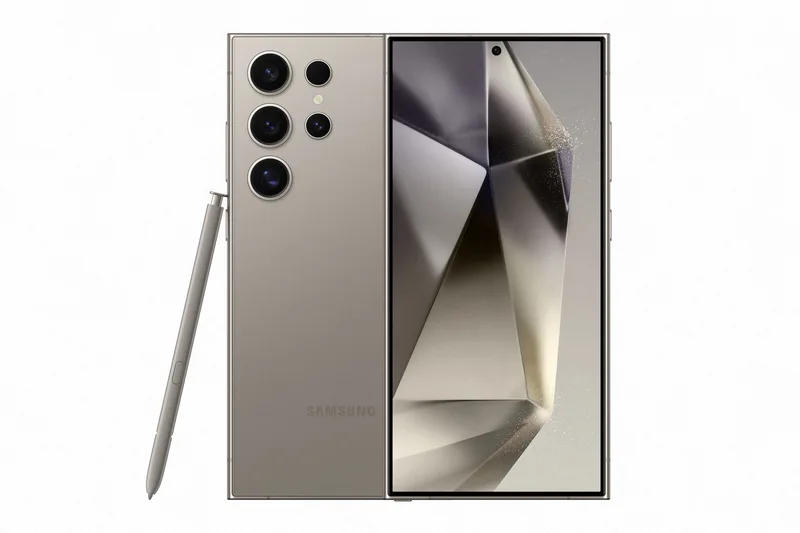
Samsung's 2024 flagship adds a titanium frame, a flat 6.8-inch 120Hz QHD+ screen, a 200MP camera with 5x zoom and a built-in S Pen, with seven years of updates.
Key figures at a glance
Gallery
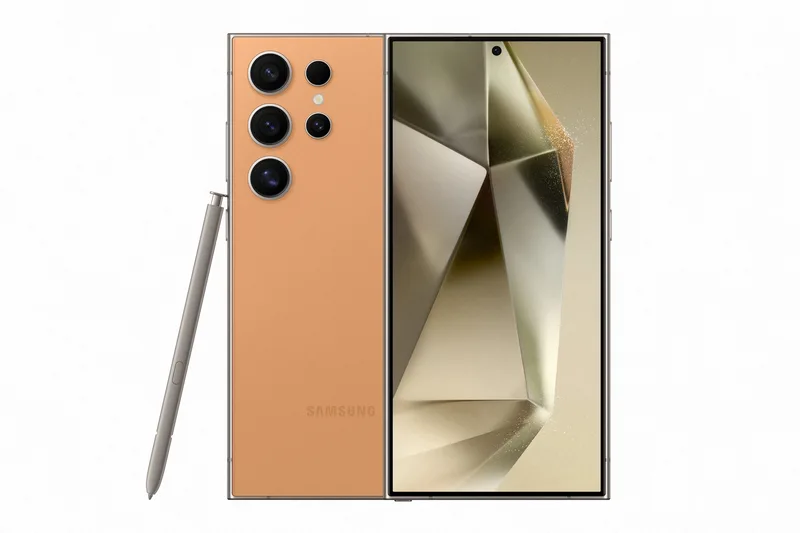
Specifications
- Display
- 6.8" Dynamic LTPO AMOLED 2X, 3120x1440, 1-120Hz, 2600 nits peak
- Chipset
- Snapdragon 8 Gen 3 for Galaxy
- RAM
- 12GB
- Storage
- 256GB / 512GB / 1TB
- Rear Camera
- 200MP main + 12MP ultrawide + 10MP telephoto 3x + 50MP periscope 5x
- Front Camera
- 12MP
- Battery
- 5,000 mAh, 45W wired, 15W wireless
- OS
- Android 14, One UI 6.1
- Dimensions
- 162.3 x 79.0 x 8.6 mm, 232 g
- Durability
- IP68, titanium frame, Gorilla Armor front glass
The Galaxy S24 Ultra is the top model of Samsung's 2024 Galaxy S family and the phone that introduced a titanium frame to the Galaxy line. It combines a 6.8-inch QHD+ screen, a quad-camera system built around a 200MP main sensor, a built-in S Pen and a 5,000 mAh battery, and it was also the first Galaxy S generation marketed around the Galaxy AI feature set. This page is a review based on the published specifications and manufacturer information. It covers where the phone sits in the lineup, its materials and display, performance and software, the cameras, battery and charging, who it suits and where it compromises.
Where it sits in the lineup
Samsung introduced the Galaxy S24, S24+ and S24 Ultra at Galaxy Unpacked in San Jose on 17 January 2024, and the three phones went on sale on 31 January 2024. In the United States the Ultra started at $1,299.99 for 256GB, with 512GB and 1TB versions above it, while the S24+ started at $999.99 and the S24 at $799.99. The Ultra is the only member of the family with a titanium frame, a flat display, the S Pen and a periscope zoom camera. Its direct predecessor was the Galaxy S23 Ultra, and its successor is the Galaxy S25 Ultra, which Samsung introduced a year later with rounder corners and a newer chip. The smaller siblings are the Galaxy S24+ and the Galaxy S24. Samsung's later flagship, the Galaxy S26 Ultra, shows how far the line has moved since. The page Galaxy S24 Ultra vs Galaxy S25 Ultra lays the two generations out side by side.
Design and display
The S24 Ultra uses a titanium frame, and Samsung states that the volume and side keys are not part of that frame. The front glass is Corning Gorilla Armor, which Samsung says reduces reflections by up to 75 percent compared with the previous generation. That is a claim worth keeping in mind: reflections depend on the ambient light and the viewing angle, but the practical aim is clearly better legibility outdoors. The phone is IP68 rated, which Samsung specifies as protection in up to 1.5 metres of fresh water for up to 30 minutes. It measures roughly 162.3 x 79.0 x 8.6 mm and weighs about 232 g, so it is a large and heavy phone by any standard, even though the titanium frame helps keep it from feeling heavier than it is.
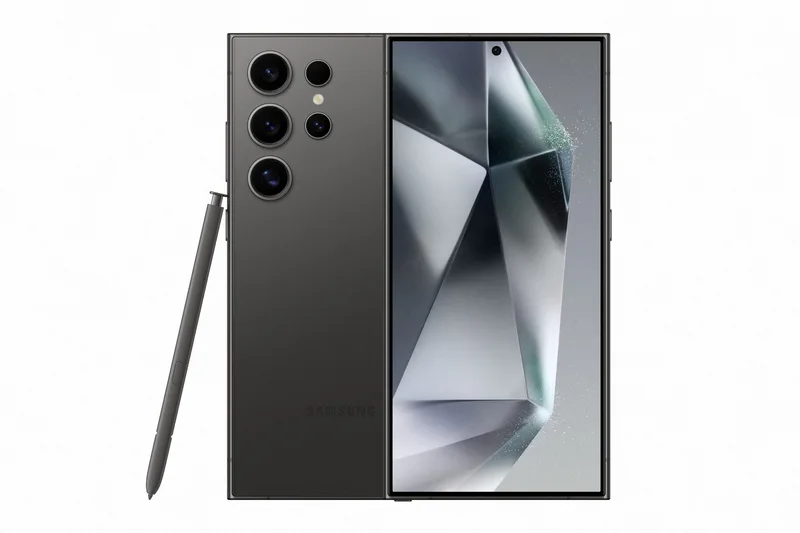
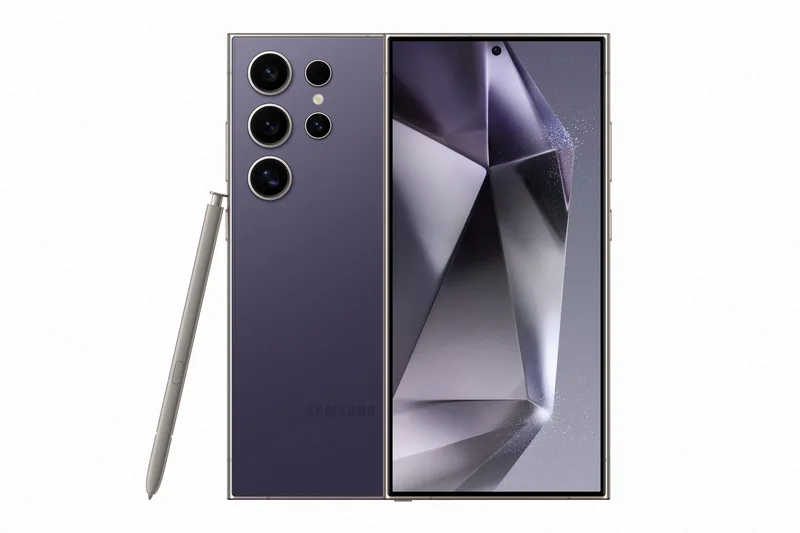
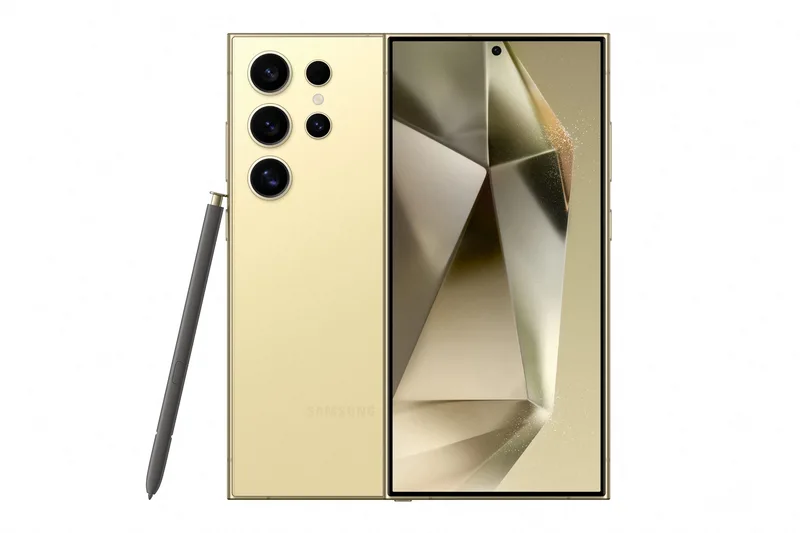
The display is a 6.8-inch Dynamic AMOLED 2X panel with QHD+ resolution (3120 x 1440) and an adaptive refresh rate from 1Hz to 120Hz. Samsung quotes a peak brightness of 2,600 nits and calls its brightness-boosting mode Vision Booster. Unlike the S23 Ultra, the S24 Ultra has a flat screen rather than one that curves at the edges, which makes the S Pen easier to use near the borders and reduces accidental touches. Colours offered in most markets are Titanium Gray, Titanium Black, Titanium Violet and Titanium Yellow, with Titanium Green, Titanium Blue and Titanium Orange sold only through Samsung's own online store. Availability of the extra colours depends on the market.
Performance and software
All S24 Ultra models use the Snapdragon 8 Gen 3 for Galaxy, a Qualcomm chip with an overclocked prime core that Samsung tuned for this phone. This is a point of difference from the S24 and S24+, which use Exynos 2400 in many regions outside the United States. The Ultra comes with 12GB of RAM and 256GB, 512GB or 1TB of storage, and the storage is not expandable. Samsung does not publish synthetic benchmark scores, and this page does not invent any; what can be said from the specification is that the chip was the fastest Android platform available at launch and that cooling was increased with a larger vapour chamber, according to Samsung.
The phone launched with Android 14 and One UI 6.1, and Samsung promises seven generations of operating-system upgrades and seven years of security updates. That promise is the most consequential software fact for a buyer: it means the phone is supported into the early 2030s, which is longer than most Android competitors offered at the time. Galaxy AI features introduced with this phone include Circle to Search with Google, Live Translate for phone calls, Interpreter, Note Assist, Chat Assist and Generative Edit for photos. Samsung said that Galaxy AI features would be free until the end of 2025; buyers should check the current terms in their region. The S Pen is stored inside the body and supports handwriting, notes and remote camera control.
Camera system
The rear camera is the most distinctive part of the phone. It has a 200MP main sensor (f/1.7, optical stabilisation), a 12MP ultrawide camera (f/2.2, 120-degree field of view), a 10MP telephoto lens with 3x optical zoom (f/2.4) and a 50MP periscope telephoto with 5x optical zoom (f/3.4). The 5x module replaced the 10x lens of the S23 Ultra, and Samsung states that it delivers 10x zoom at optical quality through sensor cropping. The front camera is 12MP. In practical terms the lens set covers 0.6x to 5x with real optics at every common focal length, while the 200MP sensor is normally used to produce pixel-binned 12MP images, with full-resolution mode available when more detail is wanted.
Video recording goes up to 8K in the specification. As with any phone, image-quality statements from Samsung, such as the brighter low-light output of the Nightography system, are manufacturer claims and depend on software processing that Samsung can change through updates. The cameras are the main reason to choose this phone over the S24+, and the 5x telephoto is the clearest reason to prefer it over the standard S24 and S24+, which stop at 3x.
Battery and charging
The battery has a typical capacity of 5,000 mAh, with a rated minimum of 4,855 mAh. Wired charging is limited to 45W, and Samsung states that it reaches about 65 percent in around 30 minutes with its 45W adapter, which is sold separately in most regions. Wireless charging follows the Qi standard at up to 15W under Samsung's Fast Wireless Charging 2.0, and Wireless PowerShare lets the phone charge a small accessory such as earbuds from its back. Compared with competitors from Chinese brands that offer 80W to 100W wired charging, this is slow, and it is one of the phone's clearest trade-offs. Samsung has chosen long-term battery health and a conservative approach over headline speed. The phone has no built-in magnetic ring for magnetic charging accessories.
Who it is for
The S24 Ultra suits people who want a single phone to do almost everything: those who value a stylus, who take photos at a range of zoom levels, who use a big screen for reading and productivity and who plan to keep the device for five or more years. It also suits buyers who want a flat display, because many competitors have moved to curved or semi-curved edges. Because it is now a previous-generation phone, it is often sold at a significant discount compared with its launch price, and this can make it better value than the newest model. The cost of choosing it is the lack of newer chip, camera and charging improvements from the S25 Ultra.
Compromises
The phone's size and weight are the first drawback; at 232 g it is among the heaviest flagships, and one-handed use is difficult. The 45W charging is slower than many rivals, and no charger is supplied in the box. The price at launch was high, and the storage tiers rise steeply, with the 1TB model costing well above the entry version. Regional chip differences affect the S24 and S24+, but not the Ultra, which is helpful for consistency. Galaxy AI features that rely on cloud processing need an internet connection and a Samsung account for some functions, and the pricing of these features after the introductory period is something Samsung can change.
For buyers comparing within the family, the Galaxy S24 FE offers a similar software experience at a much lower price, but with a smaller battery, no stylus and weaker cameras. Anyone deciding between the Ultra and a rival should consider the ecosystem and software-support promise first, since the hardware gap is smaller than the gap in updates. Overall, the Galaxy S24 Ultra remains a complete, durable and long-supported flagship whose main weaknesses are weight, charging speed and a price that was always at the top of the market.
Where it ranks
Compare Samsung Galaxy S24 Ultra with similar devices
More from Samsung
Frequently asked questions
When was the Samsung Galaxy S24 Ultra released?
The Samsung Galaxy S24 Ultra was released on 2024-01-31, according to the manufacturer’s published information.
How much does the Samsung Galaxy S24 Ultra cost?
The estimated range for the Samsung Galaxy S24 Ultra is $1169 to $1429 in US dollars, based on the launch list price. Actual prices vary by country, retailer and storage option.
What are the main specs of the Samsung Galaxy S24 Ultra?
Headline figures for the Samsung Galaxy S24 Ultra: Battery: 5,000 mAh, Refresh rate: 120 Hz, Main camera: 200 MP, RAM: 12 GB. The full specification table is further up this page.
Is the Samsung Galaxy S24 Ultra worth buying?
That depends on your priorities. Use the editorial review on this page for our view, check the rankings above to see where the device stands on battery, display and camera, and compare it directly with similar models before you decide.


