Phones
ASUS ROG Phone 9 Pro
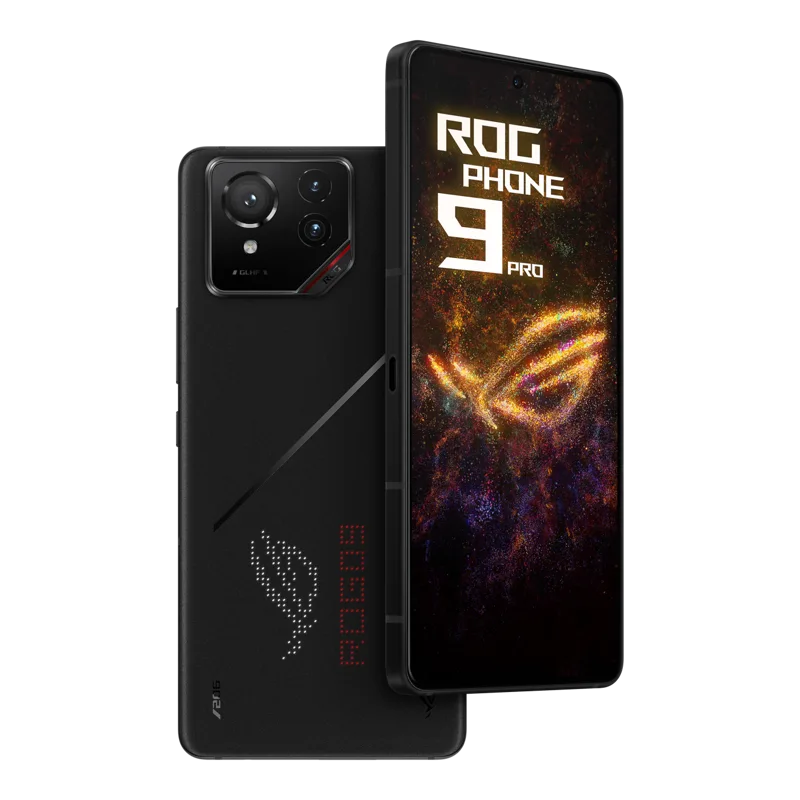
ASUS's top gaming phone offers a Snapdragon 8 Elite, up to 24GB of RAM, a 5,800 mAh battery, a 165Hz display option and the AniMe Vision rear display.
Key figures at a glance
Gallery
Specifications
- Display
- 6.78" Samsung Flexible AMOLED, 2400x1080, LTPO 1-120Hz (up to 165Hz in settings, 185Hz in Game Genie), 2,500 nits peak, HDR10
- Chipset
- Snapdragon 8 Elite (3nm)
- RAM
- 16GB / 24GB
- Storage
- 512GB / 1TB
- Rear Camera
- 50MP main + 13MP ultrawide + 32MP telephoto 3x
- Battery
- 5,800 mAh (typical), 65W wired, 15W wireless
- OS
- Android 15
- Weight
- 227 g
- Dimensions
- 163.8 x 77 x 8.9 mm
- Water Resistance
- IP68
- Glass
- Corning Gorilla Glass Victus 2
The ASUS ROG Phone 9 Pro is the top model of ASUS's 2024 gaming phone generation. It pairs the Snapdragon 8 Elite chip with up to 24GB of memory, a 6.78-inch display that can run at up to 165Hz, a 5,800 mAh battery and a rear panel with a dot-matrix light display called AniMe Vision. This page is based on the published specifications and manufacturer information. It explains how the Pro fits into the ROG Phone 9 range, what the hardware offers for gaming and for everyday use, and where a gaming-first phone makes compromises that a mainstream flagship does not.
Place in the ROG Phone 9 lineup
ASUS introduced the ROG Phone 9 family in November 2024. The range has a standard ROG Phone 9 and the ROG Phone 9 Pro, and the Pro is offered in two memory configurations: a standard Pro with 16GB of RAM and 512GB of storage, and a Pro Edition with 24GB of RAM and 1TB of storage. According to ASUS's specification page the two Pro variants differ only in memory, storage and the contents of the box. The wider family shares the same chip and display design.
That positioning makes the Pro the choice for people who want the most complete ROG hardware. Compared with a general-purpose flagship such as the Galaxy S25 Ultra, which uses the same Snapdragon 8 Elite platform, the ROG phone shifts the priorities: more cooling, a faster screen option, physical shoulder triggers and a bigger battery, in exchange for a thicker and heavier body and a less refined camera system. The ROG Phone 9 Pro vs Galaxy S25 Ultra comparison puts the two approaches side by side.
Design and display
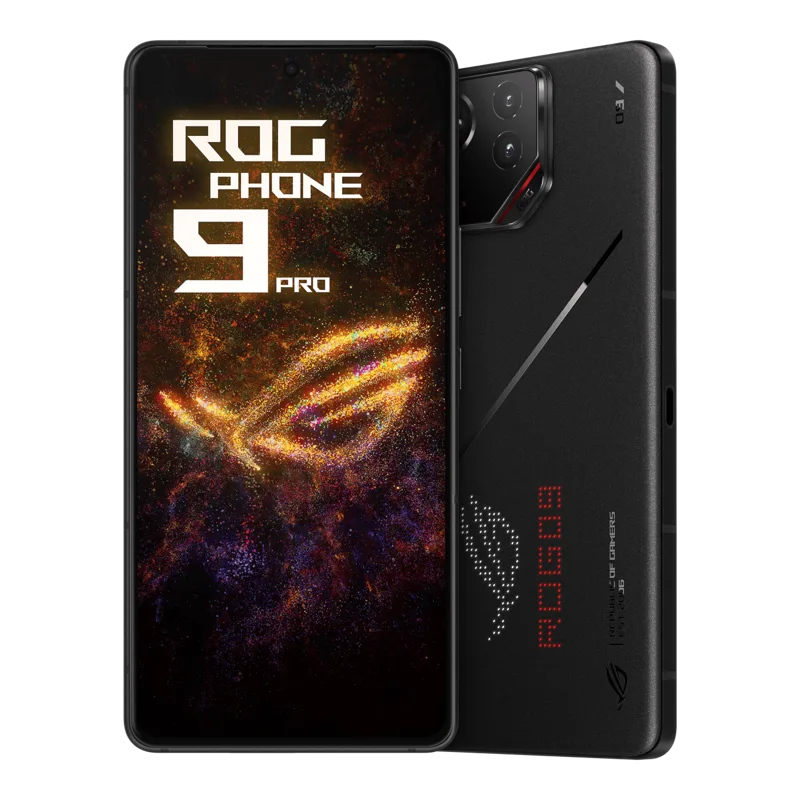
ASUS lists the phone at 163.8 x 77 x 8.9 mm and 227 g, which is heavy and fairly thick by current standards, although the weight is spread across a large 6.78-inch body that is designed to be held sideways for long sessions. The glass is Corning Gorilla Glass Victus 2, and the phone is rated IP68 for dust and water resistance, which is uncommon among gaming phones. Phantom Black is the colour listed on the ASUS page for this model.
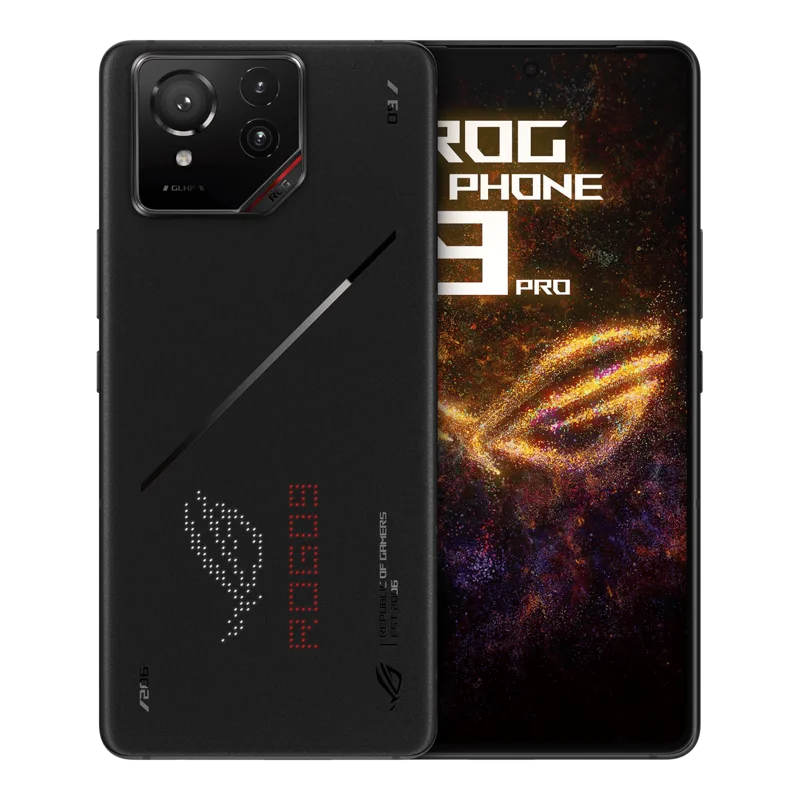
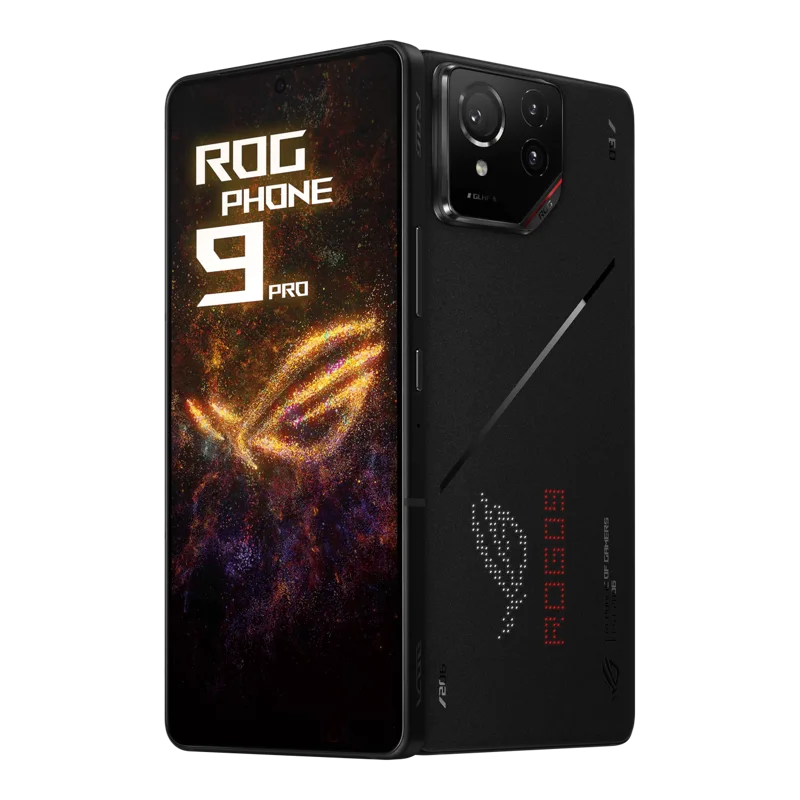
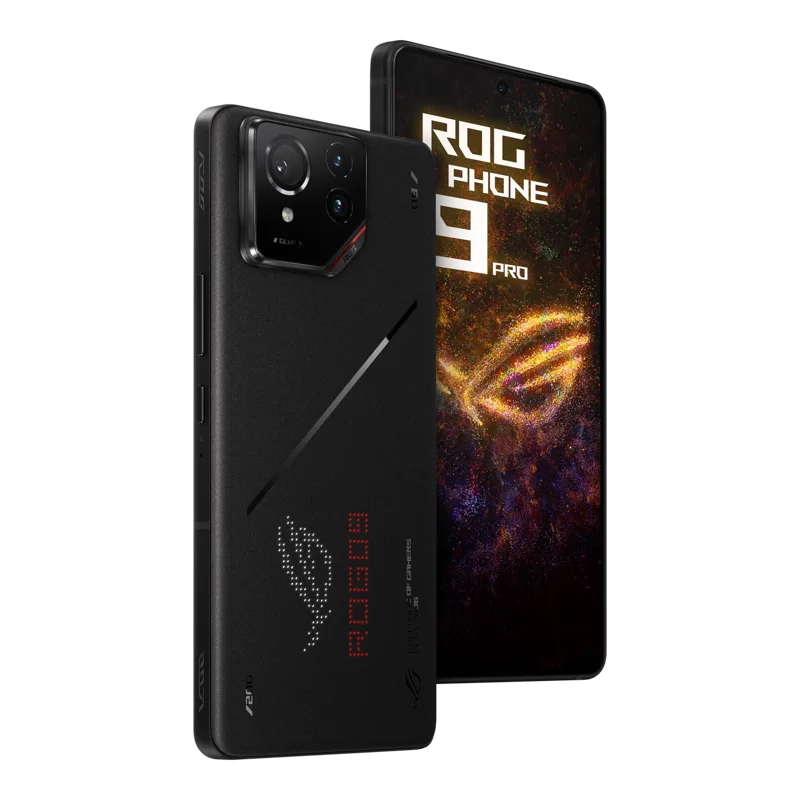
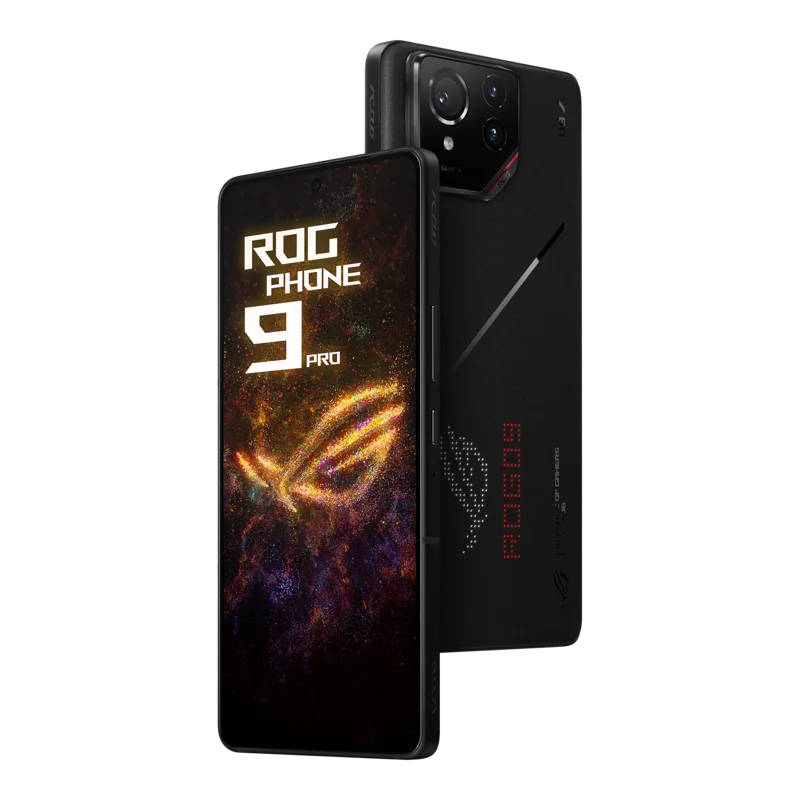
The back panel is the signature feature. The Pro carries AniMe Vision, a matrix of small LEDs under the surface that can show animations, notifications and the ROG logo, and that is visible in ASUS's press images. It is decoration and a notification light more than a function that changes how the phone performs, and it will matter to some buyers and not to others. The camera module sits in the top left of the back, with a distinct square shape and a red accent line that identifies the series.
The display is a 6.78-inch Samsung Flexible AMOLED panel with a resolution of 2400 x 1080 pixels. It is an LTPO panel with an adaptive refresh rate from 1Hz to 120Hz, and ASUS says the rate can be raised to 165Hz in the system settings and to 185Hz in games supported through its Game Genie overlay. Peak brightness is stated as 2,500 nits, with 1,600 nits in high-brightness mode, and the panel supports HDR10. A 1080p resolution is lower than the QHD panels on some rivals, but on a screen this size it keeps the power draw down and leaves headroom for high frame rates.
Performance, cooling and software
The processor is the Qualcomm Snapdragon 8 Elite, an octa-core 3nm chip with a peak clock of up to 4.3GHz and an Adreno 830 GPU. Memory is LPDDR5X, 16GB in the standard Pro and 24GB in the Pro Edition, and storage is UFS 4.0 with 512GB or 1TB. For most apps and games 16GB is already more than needed, so the 24GB option is mainly for heavy multitasking.
What separates a gaming phone is how long it can sustain that performance. ROG phones are built around a dedicated cooling design and an optional clip-on active-cooling accessory, and the frame carries shoulder-trigger controls for games. ASUS does not publish independent sustained-performance numbers, so this page makes no claim about frame-rate stability beyond the hardware list. The cooling system is, however, the main reason to consider the phone over a thinner flagship with the same chip.
The software is Android 15 with ASUS's ROG interface. Game Genie, mentioned on the specification page, is an overlay that lets players adjust refresh rate, performance modes, macros and notifications without leaving the game. Update policy should be checked against ASUS's regional pages, as this page does not state a guaranteed number of years.
Cameras
The ROG Phone 9 Pro uses a triple rear camera. The main camera is a 50MP Sony Lytia 700 sensor with a 1/1.56-inch size, an f/1.9 aperture and gimbal-style optical image stabilisation. The ultrawide camera is 13MP with a 120-degree field of view, and there is a 32MP telephoto camera with an f/2.4 aperture, optical stabilisation and 3x optical zoom. Video is listed up to 8K at 30fps on the main camera and 4K at 30 or 60fps. ASUS does not list a front camera resolution on the specification page used for this review, so none is given here.
The inclusion of a real 3x telephoto lens is a clear step up from gaming phones that rely on a secondary macro sensor. Even so, the camera set is a supporting feature and not the reason to buy the phone. Anyone whose priority is photography, long zoom or advanced video processing will find stronger systems in dedicated camera flagships, including phones such as the Pixel 10 Pro.
Battery and charging
The battery is rated at 5,800 mAh (typical), described by ASUS as an equivalent figure because the cell is split into two parts to speed up charging. Wired charging is compatible with up to 65W using Quick Charge 5.0 and USB Power Delivery 3.0, and wireless charging goes up to 15W under the Qi 1.3 standard. The phone has two USB-C ports, one on the side and one at the bottom, so it can charge while being held in landscape without the cable getting in the way of the hand. The rated battery size is larger than that of most mainstream flagships, which helps when gaming sessions run for hours, though real endurance depends on refresh rate and brightness settings.
Who it is for
The ROG Phone 9 Pro suits players of demanding mobile games and emulation who want sustained performance, a very fast display and a large battery, and people who enjoy the ROG look. It is also a good fit for buyers who want top-tier memory for heavy multitasking, and for those who value IP68 protection and a real telephoto lens in a gaming phone.
It is less suited to people who want a slim, light phone, a premium camera system, or a conservative design. The rankings on the phone rankings page show where its specifications sit relative to other models.
Compromises to consider
- Weight and thickness: at 227 g and 8.9 mm it is noticeably heavier than most flagships.
- Camera system: good for a gaming phone, but without the processing depth or zoom range of the best camera phones.
- Design: the gamer styling and the AniMe Vision panel are not to everyone's taste.
- Display resolution: 2400 x 1080 pixels is lower than the QHD resolution of some rivals.
- Wireless charging: 15W is slow compared with the wired speed and with some rivals.
In short, the ROG Phone 9 Pro is a focused device. If you play games for long periods and want the most capable hardware available in an Android phone, it is one of the strongest options. If you want an all-round phone with the best cameras, a lighter body and the longest update promise, a mainstream flagship is a better match.
Where it ranks
Compare ASUS ROG Phone 9 Pro with similar devices
More from ASUS
Frequently asked questions
When was the ASUS ROG Phone 9 Pro released?
The ASUS ROG Phone 9 Pro was released on 2024-11-19, according to the manufacturer’s published information.
What are the main specs of the ASUS ROG Phone 9 Pro?
Headline figures for the ASUS ROG Phone 9 Pro: Battery: 5,800 mAh, Refresh rate: 185 Hz, Main camera: 50 MP, RAM: 24 GB. The full specification table is further up this page.
Is the ASUS ROG Phone 9 Pro worth buying?
That depends on your priorities. Use the editorial review on this page for our view, check the rankings above to see where the device stands on battery, display and camera, and compare it directly with similar models before you decide.


