Tablets
Apple iPad Air (M4)
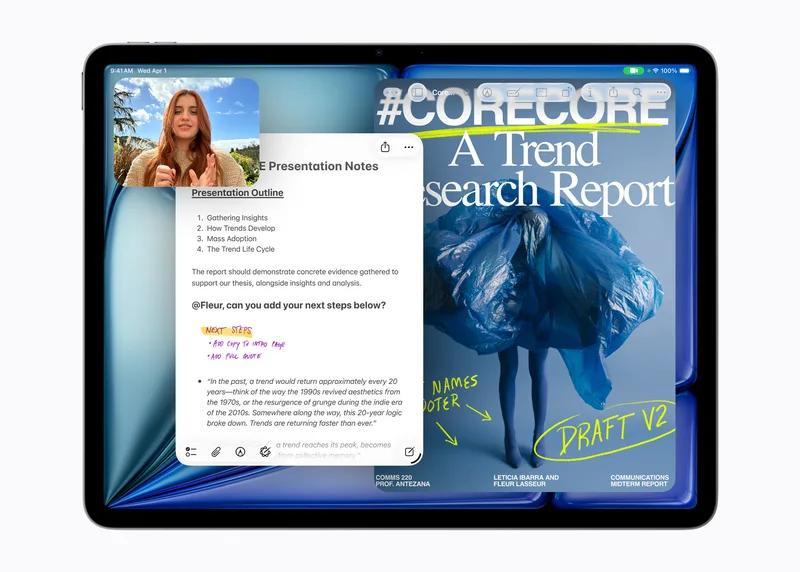
The iPad Air with M4 adds Apple's M4 chip, 12GB of memory and Wi-Fi 7 to the 11- and 13-inch Air, at the same $599 starting price as its predecessor.
Key figures at a glance
Gallery
Specifications
- Display
- 11-inch: 10.86" Liquid Retina IPS, 2360x1640 (264 ppi), 500 nits; 13-inch: 12.9", 2732x2048 (264 ppi), 600 nits
- Chipset
- Apple M4 (8-core CPU, 9-core GPU, 16-core Neural Engine)
- RAM
- 12GB
- Storage
- 128GB / 256GB / 512GB / 1TB
- Rear Camera
- 12MP main (f/1.8)
- Front Camera
- 12MP Center Stage (f/2.0, landscape)
- Battery
- 28.93 Wh (11-inch) / 36.59 Wh (13-inch), up to 10 hours on Wi-Fi, USB-C charging, 20W adapter in box
- OS
- iPadOS 26
- Dimensions
- 11-inch: 247.6 x 178.5 x 6.1 mm, 464 g; 13-inch: 280.6 x 214.9 x 6.1 mm, 616 g
- Connectivity
- Wi-Fi 7, Bluetooth 6, optional 5G (eSIM only)
- Stylus
- Apple Pencil Pro and Apple Pencil (USB-C) supported
- Colors
- Blue, Purple, Starlight, Space Gray
The iPad Air with M4 is Apple's March 2026 update to its mid-range premium tablet. Announced on 2 March 2026 and in stores from 11 March, it keeps the familiar 11-inch and 13-inch designs but moves from the M3 chip to the M4, raises memory to 12GB, and adds Apple's own N1 wireless chip for Wi-Fi 7 and, on cellular models, the C1X modem. The starting price in the United States stayed at $599 for the 11-inch Wi-Fi model. This page is based on the published specifications and manufacturer information. It covers where the tablet sits among Apple's iPads, what has really changed, and which compromises remain for anyone choosing it over a Pro model or an Android rival.
Place in the lineup
The iPad Air sits between the entry-level iPad and the iPad Pro. It is sold in two sizes, 11 and 13 inches, in four colours (Blue, Purple, Starlight and Space Gray) and in 128GB, 256GB, 512GB and 1TB configurations. Apple's US launch prices are $599 for the 11-inch Wi-Fi model, $749 for 11-inch with cellular, $799 for the 13-inch Wi-Fi model and $949 for the 13-inch with cellular. Pre-orders started on 4 March 2026. Readers who are weighing it against its predecessor can use the iPad Air M3 page and the direct comparison iPad Air M4 vs iPad Air M3. Those who want the strongest iPad can look at the iPad Pro M5, and those on a tighter budget can see the iPad A16.
Design and display
The Air keeps its slim aluminium body, 6.1 mm thick. The 11-inch model measures 247.6 x 178.5 mm and weighs 464 g (465 g with cellular); the 13-inch model measures 280.6 x 214.9 mm and weighs 616 g (617 g with cellular). Apple says the enclosure is made from 100 percent recycled aluminium. Both sizes use a Liquid Retina IPS LED display with a P3 wide colour gamut, True Tone, an anti-reflective coating and full lamination. The 11-inch panel measures 10.86 inches diagonally at 2360 x 1640 pixels and reaches 500 nits; the 13-inch panel measures 12.9 inches at 2732 x 2048 pixels and reaches 600 nits. Both have 264 ppi. Apple's specification page does not list a refresh rate, and the Air does not use the OLED screen of the iPad Pro, so readers who want a very high refresh rate or deep OLED blacks should look at that model instead. Touch ID sits in the top button, and the landscape stereo speakers are better on the larger model, as Apple itself notes in its release.
Performance and software
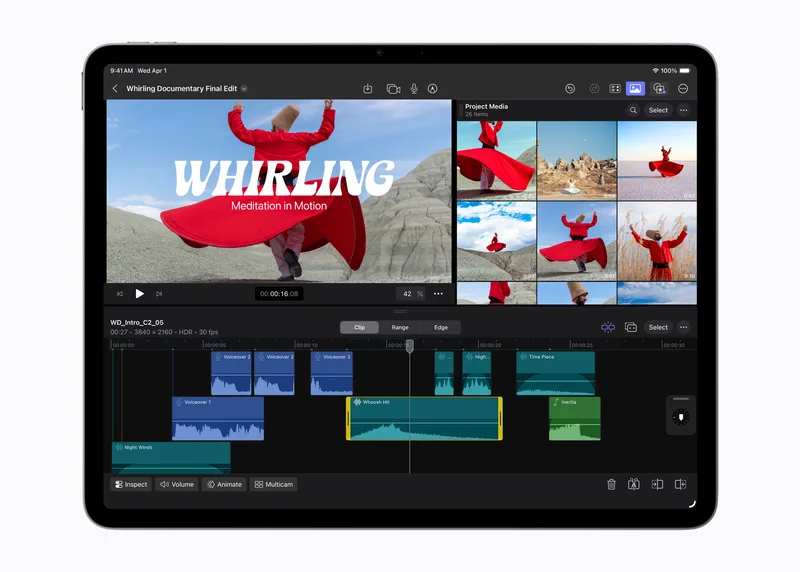
The M4 chip has an 8-core CPU with three performance and five efficiency cores, a 9-core GPU with hardware-accelerated ray tracing and mesh shading, and a 16-core Neural Engine. Apple states that it is up to 30 percent faster than the M3 iPad Air and up to 2.3 times faster than the M1 iPad Air, and that ray-traced 3D rendering is more than four times faster than on the M1. These are Apple's own comparisons. The more practical change is memory: 12GB of unified memory with 120GB/s bandwidth is a 50 percent increase over the previous Air, which helps with large projects in apps like Final Cut Pro, with heavy multitasking and with on-device Apple Intelligence features, which Apple still labels as beta and supports in 16 languages.
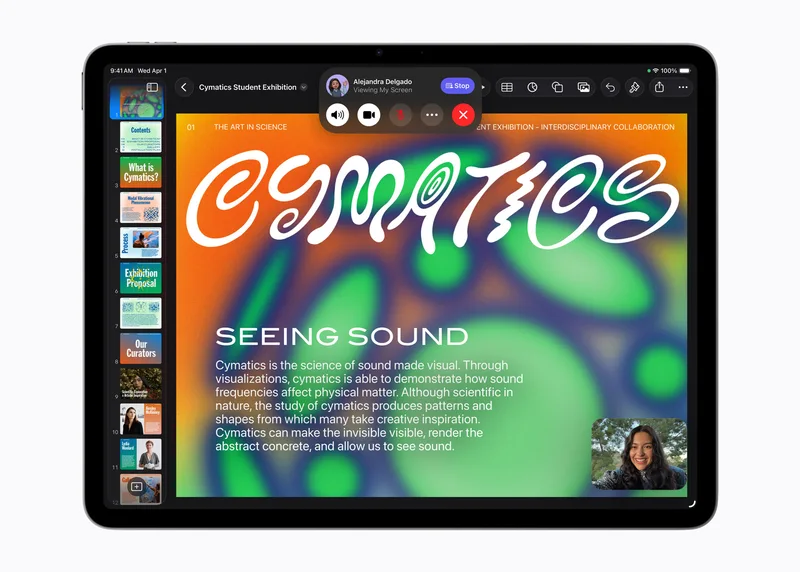
The tablet runs iPadOS 26, which brings the Liquid Glass design, a new windowing system that lets you resize and overlap apps, a menu bar, an updated Files app with folders in the Dock, and Background Tasks. For many buyers the greatest appeal is the app ecosystem: tablet-optimised creative and note-taking apps are more plentiful on iPad than on Android. Compared with Samsung's DeX-style desktop mode on the Galaxy Tab S11, iPadOS windowing is now closer to a real multi-window environment, but it is still not a full desktop operating system.
Cameras and connectivity
The rear camera is a single 12MP wide camera with an f/1.8 aperture, up to 5x digital zoom and 4K video at up to 60 frames per second. The front camera is a 12MP Center Stage unit with an f/2.0 aperture, placed on the landscape edge so that you look at the camera naturally during video calls with the tablet in a keyboard case. The N1 chip enables Wi-Fi 7 with 2x2 MIMO, Bluetooth 6 and Thread, and Apple says it improves 5GHz Wi-Fi performance, Personal Hotspot and AirDrop. On cellular models, the C1X modem supports sub-6 GHz 5G and gigabit LTE, with eSIM only (there is no physical SIM tray). Apple claims up to 50 percent faster cellular data and up to 30 percent less modem energy than the M3 Air. The USB-C port supports DisplayPort and USB 3 transfers of up to 10Gb/s.
Battery and charging
Apple does not publish a milliamp-hour figure. It gives battery capacities of 28.93 Wh for the 11-inch model and 36.59 Wh for the 13-inch model, and says to expect up to 10 hours of web browsing or video on Wi-Fi and up to 9 hours of web browsing on cellular. These are manufacturer figures for typical use. A 20W USB-C power adapter and a 1-metre USB-C cable are included in the box. Apple's specification page does not list wireless charging, so the USB-C port is the way to charge it.
Accessories and who it is for
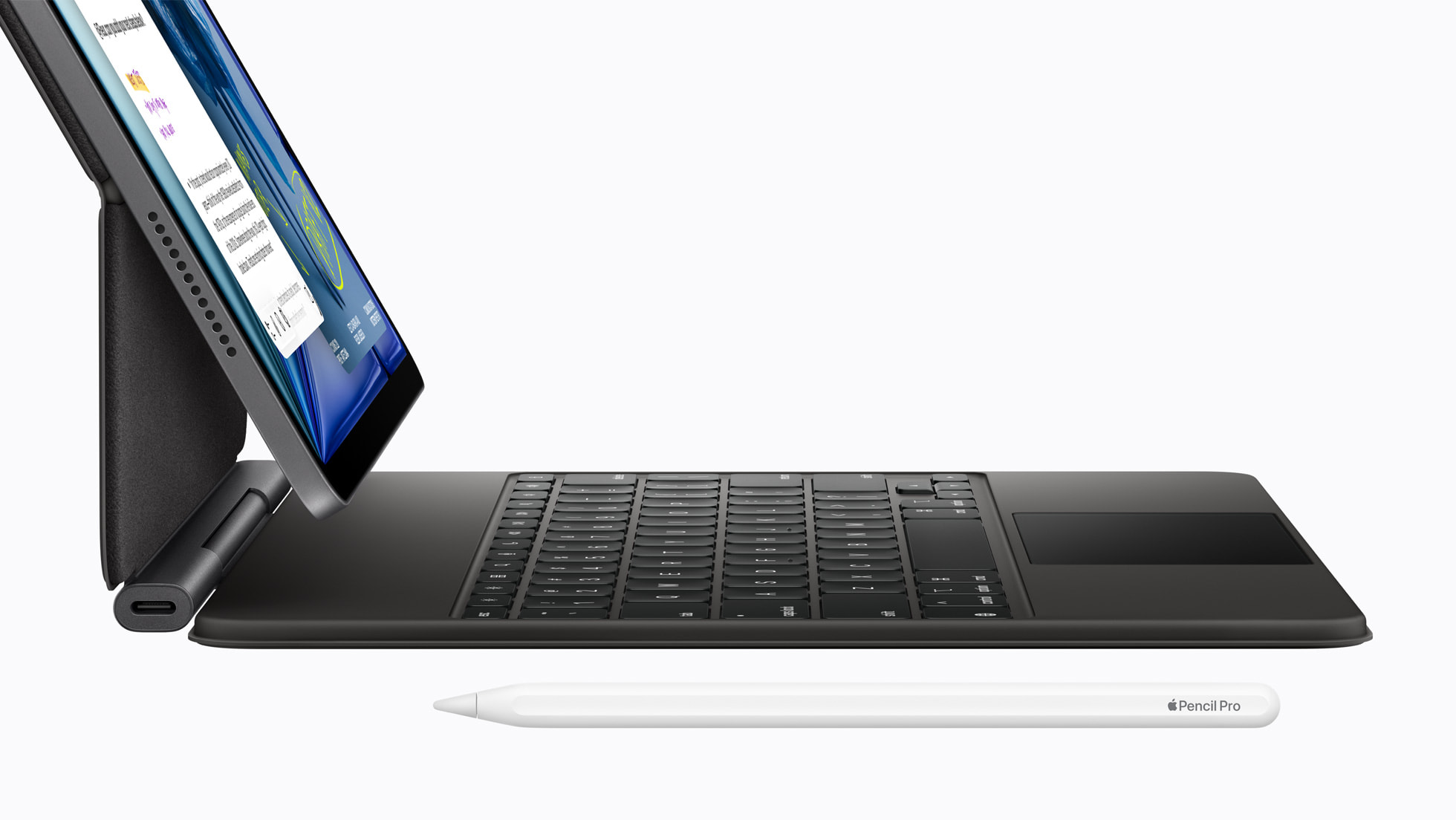
The Air supports the Apple Pencil Pro, priced at $129 and offering squeeze, barrel roll and Find My, and the Apple Pencil (USB-C) at $79. The Magic Keyboard in black or white adds a trackpad and a 14-key function row, costing $269 for the 11-inch model and $319 for the 13-inch model. The pencil and keyboard are sold separately, so a full laptop-style setup costs substantially more than the tablet. The Air suits students, creatives, professionals and general users who want a premium tablet with a long software support record and a large app selection. The 13-inch size is a sensible choice for people who annotate documents, sketch or use split screens a lot, whereas the 11-inch model is easier to carry and cheaper.
Compromises
The main compromises are familiar. The display is an LCD without a stated high refresh rate, which makes it less fluid than the iPad Pro or Android tablets with 120Hz or 144Hz panels such as the OnePlus Pad 3. The rear camera is basic and there is no Face ID, only Touch ID. Storage starts at 128GB, which fills quickly with video, and there is no microSD slot. Accessories add a lot to the cost; a Pencil Pro and Magic Keyboard together add 48 to the 13-inch model, more than half of its starting price. Finally, compared with Android rivals that include a pen in the box, Apple's choice to sell the pencil separately makes the effective price higher. For readers deciding between platforms, the iPad Air M4 vs Galaxy Tab S11 comparison is a good place to start.
Where it ranks
Compare Apple iPad Air (M4) with similar devices
More from Apple
Frequently asked questions
When was the Apple iPad Air (M4) released?
The Apple iPad Air (M4) was released on 2026-03-11, according to the manufacturer’s published information.
How much does the Apple iPad Air (M4) cost?
The estimated range for the Apple iPad Air (M4) is $539 to $659 in US dollars, based on the launch list price. Actual prices vary by country, retailer and storage option.
What are the main specs of the Apple iPad Air (M4)?
Headline figures for the Apple iPad Air (M4): Main camera: 12 MP, RAM: 12 GB. The full specification table is further up this page.
Is the Apple iPad Air (M4) worth buying?
That depends on your priorities. Use the editorial review on this page for our view, check the rankings above to see where the device stands on battery, display and camera, and compare it directly with similar models before you decide.