Smartwatches
Huawei Band 11 Pro
Huawei's slim 2026 fitness band adds independent GNSS and a 2,000-nit 1.62-inch AMOLED display, with up to 14 days of battery life and 5 ATM water resistance.
Key figures at a glance
Gallery

Specifications
- Display
- 1.62-inch AMOLED, 286x482 pixels (347 ppi), 60 Hz, up to 2000 nits peak brightness, touchscreen with Always-On Display
- Body
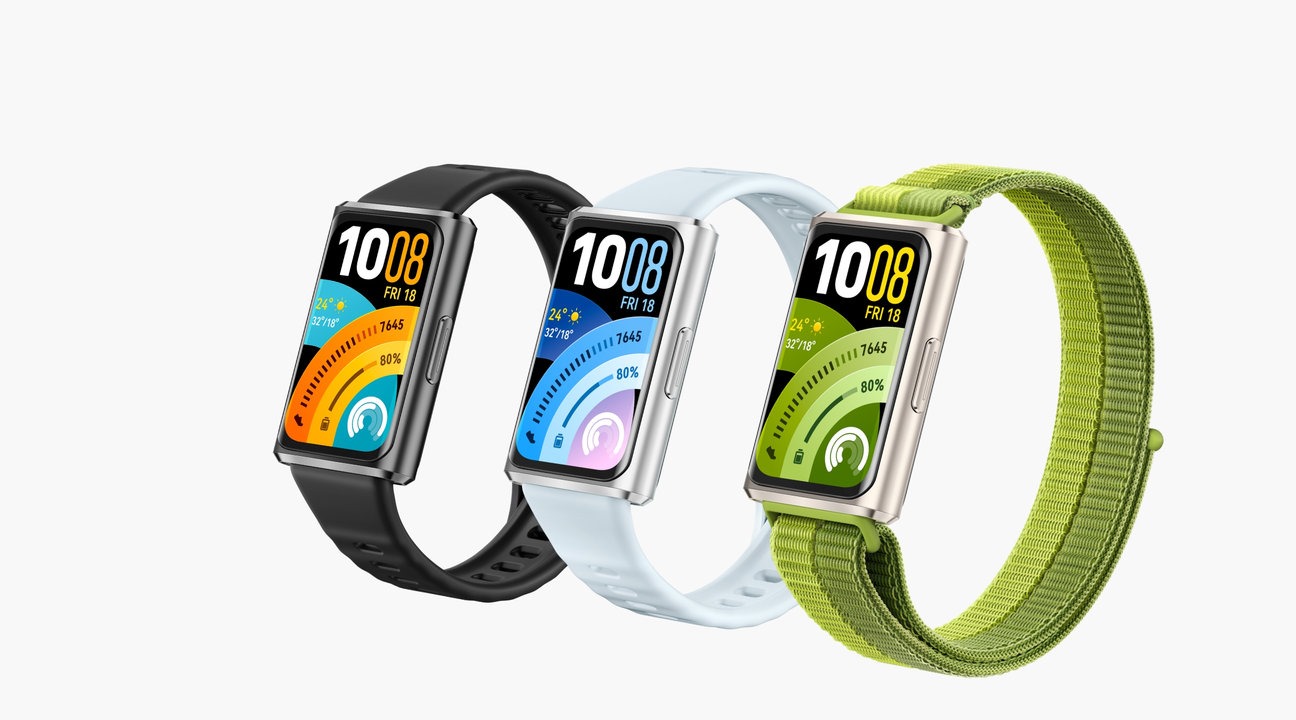
- CNC-cut aluminium alloy case in green, blue or black; 43.5 x 28.2 x 8.99 mm (thickness measured at thinnest point, excluding sensor area); about 18 g without strap; green with woven nylon strap, blue and black with fluoroelastomer strap; fits 130-210 mm wrists
- Battery
- Up to 14 days (light use), up to 8 days (typical use), up to 3 days with Always-On Display; 300 mAh, magnetic charging (5V/1A)
- Positioning
- Independent GNSS positioning for outdoor running and cycling
- Sensors
- Optical heart-rate sensor, 9-axis IMU (accelerometer, gyroscope, magnetometer), ambient light sensor
- Connectivity
- Bluetooth 6.0 and BLE, 2.4 GHz
- Durability
- 5 ATM water resistance (ISO 22810:2010)
- Health
- 24/7 heart rate, SpO2, HRV monitoring, TruSleep sleep tracking, Sleep Breathing Awareness, pulse wave arrhythmia analysis (region dependent), emotional wellbeing and stress tools, cycle calendar; not a medical device
- Sports
- Around 100 workout modes including indoor, outdoor and track running, race prediction, running form analysis and cycling auto-pause detection
- Compatibility
- Huawei Health app; Android 9.0 or later and iOS 13.0 or later
The Huawei Band 11 Pro is a slim fitness band that sits at the top of Huawei's 2026 Band line. It is a band rather than a full smartwatch: a rectangular 1.62-inch AMOLED screen on a strap, with a thin aluminium-alloy case, a rated battery life of up to 14 days, 5 ATM water resistance and, the feature that separates it from the plain Band 11, Huawei's own independent GNSS positioning for recording outdoor runs and rides. This page is based on the published specifications and manufacturer information, and it explains where the band sits in the range, what the design and display offer, how the sports and health features are described, what the battery figures really mean, and which compromises come with a device this small. Huawei's global site gives no on-sale date or price for the product, so none is quoted here.
Place in the lineup
Huawei sells its wearables in three broad tiers. The Band series is the lightest and cheapest, aimed at people who want step, sleep and heart-rate tracking in a comfortable strap. Above it, the Watch Fit models are rectangular smartwatches with a larger screen and more apps, such as the Huawei Watch Fit 5 and the Huawei Watch Fit 5 Pro, and the round Watch GT line, for example the Huawei Watch GT 7, caters to those who prefer a classic watch design with longer battery life and more sports depth. Inside the Band 11 family there are two models: the Huawei Band 11 and the Band 11 Pro covered here. They share the same screen size, sensors, battery figures and water rating; the Pro adds built-in GNSS, a brighter screen and a nylon strap option. If you are deciding between a band and a Fit watch, the Band 11 Pro vs Watch Fit 5 page sets the numbers side by side.
Design and display
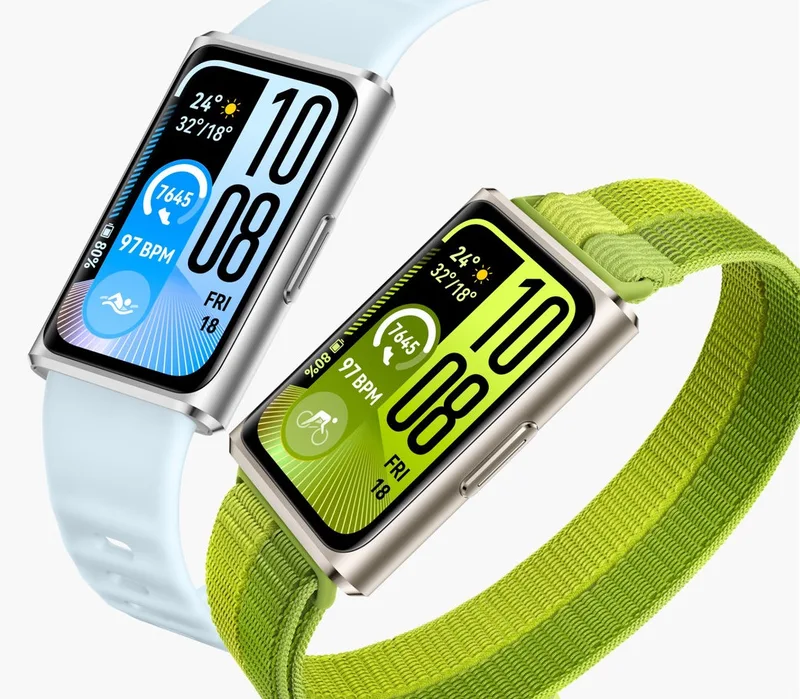
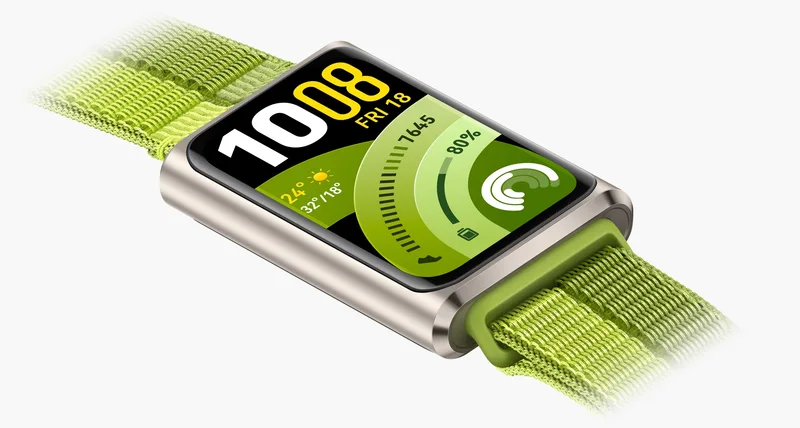
The Band 11 Pro measures 43.5 x 28.2 mm, and Huawei quotes a thickness of 8.99 mm measured at its thinnest point, which does not include the sensor area on the back. The weight is about 18 g without the strap. The case is CNC-cut aluminium alloy with polished finishes and comes in green, blue and black. The green model is paired with a double-toned woven nylon strap, while the blue and black ones have breathable fluoroelastomer straps. Huawei lists a wrist circumference of 130 to 210 mm, and the band is charged through a magnetic charging port with a 5 V / 1 A charger; a charging cable is included in the box.
The display is a 1.62-inch AMOLED touchscreen with 286 x 482 pixels (347 ppi). Huawei states a 60 Hz refresh rate and a peak brightness of up to 2,000 nits for the Pro, and says the screen is 27 percent larger than that of the previous Band 10. The brighter panel is the sort of upgrade that matters outdoors, where a dim band screen is hard to read in direct sun. Navigation uses the touchscreen with a side button, and an Always-On Display is available, though it has a visible effect on battery life as described below. More than 100 watch faces are offered, some of them from the Watch Face Store, and Huawei notes that some of these are paid.
Sports tracking and GNSS
The headline change over the standard Band 11 is independent GNSS positioning. Huawei describes it as a major step forward in precision for tracking distance, route and speed in running, cycling and other outdoor activities, and the practical benefit is that you can leave the phone at home and still get a recorded route. The company does not publish a list of satellite systems or an accuracy figure on the pages used for this review, so no technical details are given here. Running gets the most attention: modes include indoor run, outdoor run and track run, a race-prediction feature estimates your best performance over typical race distances from your training records, and running form analysis reports metrics such as contact time balance to help you adjust posture. In cycling mode the band detects riding pauses automatically and records only the active time. Around 100 workout types are listed, from yoga and strength training to rope skipping, and the app can generate shareable posters and award achievement badges. These are consumer fitness features, and the accuracy of any wrist-based metric depends on the fit of the band and on conditions.
Health and sleep features
The optical heart-rate sensor works together with a 9-axis motion sensor (accelerometer, gyroscope and magnetometer) and an ambient-light sensor. Huawei's software uses them for 24-hour heart rate, blood oxygen (SpO2) readings and heart-rate variability monitoring, and the band can alert you when a value leaves your personal range. Sleep tracking is described in some detail: TruSleep monitors sleep stages and consistency, the average sleep HRV is used as a recovery indicator, and a Sleep Breathing Awareness feature is designed to detect breathing disruptions. An emotional-wellbeing feature presents your state through twelve floral states on the watch face, and there are guided breathing exercises for stressful moments. A pulse-wave arrhythmia analysis feature offers prompts about possible atrial fibrillation; Huawei says the app has obtained TUV Rheinland CE MDR certification, but also states that availability varies by country or region. Huawei is explicit that the product is not a medical device and that results are for reference only. A cycle calendar and a family-sharing function, with which up to 10 people can be followed in the Huawei Health app, round out the list.
Smart features and compatibility
On the smart side, the Band 11 Pro keeps things simple. It shows notifications for messages and calls, lets you decline a call or reply with a preset message from the wrist, displays calendar reminders if you enable sync in the Huawei Health app, and includes a remote shutter for the phone camera, a calculator, a compass and weather. There is no mention of a speaker, microphone, cellular connection or third-party app store on the pages used, so treat it as a companion device for your phone. Connectivity is Bluetooth 6.0 with BLE and 2.4 GHz. It works with Android 9.0 or later and iOS 13.0 or later, via the Huawei Health app, and Huawei notes that some features depend on the phone model and operating system.
Battery and charging
The band has a 300 mAh battery. Huawei lists three figures, all from its own laboratory tests: up to 14 days in a light-use scenario (heart-rate monitoring on, TruSleep off at night, 30 minutes of exercise a week, 200 screen wakes a day and notifications for 50 messages, 6 calls and 3 alarms), up to 8 days of typical use with TruSleep, continuous SpO2 monitoring and emotion tracking on and 60 minutes of exercise a week, and up to 3 days with the Always-On Display enabled. The spread between 3 and 14 days shows how much the settings matter. Heavy use of GNSS during workouts will also consume more power than the figures suggest, because the typical profiles assume only a modest amount of exercise.
Who it is for
The Band 11 Pro suits runners and cyclists who want to track outdoor workouts without carrying a phone, but do not want or need the bulk of a full sports watch. It is also a good fit for people who want a light device for sleep tracking, since an 18 g band with a narrow case is easy to wear overnight. If you want a larger screen, a speaker for calls and a richer app environment, the Watch Fit models are the logical step up. If you only need basic activity tracking, the standard Band 11 gives you the same screen size and battery figures for less money (Huawei does not publish prices on its global pages, so check local listings).
Compromises
- Not a smartwatch. There is no mention of voice calls, app installation or contactless payment on the product pages.
- Small screen and limited controls. The 1.62-inch display and one side button are fine for glances but slower for menus than a larger watch.
- Battery depends on settings. The 14-day figure uses a light-use profile; the Always-On Display cuts the quoted life to about 3 days.
- Health features vary by region. Features such as arrhythmia prompts are not available everywhere and are not medical diagnostics.
- Paid watch faces. Some faces in the store are paid, and Huawei says faces can be removed or changed.
- Manufacturer claims. Battery life, brightness and GNSS precision are Huawei's own statements; no independent measurements are reported here.
Where it ranks
Compare Huawei Band 11 Pro with similar devices
More from Huawei
Frequently asked questions
When was the Huawei Band 11 Pro released?
The Huawei Band 11 Pro was released on 2026-02-26, according to the manufacturer’s published information.
What are the main specs of the Huawei Band 11 Pro?
Headline figures for the Huawei Band 11 Pro: Refresh rate: 60 Hz, Battery life: 14 days. The full specification table is further up this page.
Is the Huawei Band 11 Pro worth buying?
That depends on your priorities. Use the editorial review on this page for our view, check the rankings above to see where the device stands on battery, display and camera, and compare it directly with similar models before you decide.