Phones
Huawei nova 13 Pro
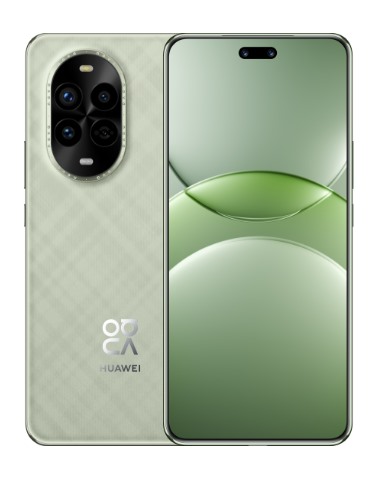
The Huawei nova 13 Pro is a portrait-focused phone with a 6.76-inch LTPO OLED screen, a 60MP plus 8MP front camera pair, a 50MP variable-aperture main camera, a 3x telephoto and 100W charging.
Key figures at a glance
Gallery


Specifications
- Display
- 6.76-inch OLED, 2776 x 1224 (FHD+), 1-120Hz LTPO adaptive refresh rate, up to 300 Hz touch sampling, 1.07 billion colours, 2160 Hz PWM dimming, quad-curved edges
- Chipset
- Kirin 8000 octa-core
- Storage
- 256GB / 512GB
- Rear Camera
- 50MP main (F1.4-F4.0 adjustable physical aperture, OIS, RYYB) + 12MP telephoto portrait (3x optical zoom, F2.4, OIS, RYYB) + 8MP ultrawide/macro (112-degree, 2 cm macro)
- Front Camera
- 60MP ultra-wide autofocus (F2.4, 100-degree) + 8MP close-up portrait (F2.2, 2x optical zoom)
- Battery
- 5,000 mAh (typical; rated 4,900 mAh), 100W HUAWEI SuperCharge Turbo wired charging (official charger and cable required)
- OS
- EMUI 14.2
- Dimensions
- 163.4 x 74.9 x 7.82 mm
- Weight
- About 209 g
- Connectivity
- Wi-Fi 6 (802.11ax), Bluetooth 5.2 (LDAC, L2HC), NFC, USB Type-C (USB 2.0), dual SIM, 4G LTE band list
- Video
- Up to 4K (3840 x 2160)
- Colors
- Loden Green, White, Black
The Huawei nova 13 Pro is the camera-first member of the nova 13 pair. It combines a 6.76-inch LTPO OLED screen with quad-curved edges, a front camera pair made of a 60MP ultra-wide autofocus lens and an 8MP close-up portrait lens, a 50MP rear camera with a physically adjustable aperture, a 12MP 3x telephoto portrait lens, a 5,000 mAh battery and 100W wired charging. This is a specification-and-information review based on the published specifications and manufacturer information from Huawei's Saudi Arabia product pages, so lab figures, charging times and camera descriptions are Huawei's claims and not independent measurements. Below we cover the place in the lineup, the screen and body, the chip and software, the cameras, the battery, who the phone suits and the compromises.
Place in the lineup
Huawei launched the nova 13 as a two-phone family, and the Pro is the larger and more feature-rich of the two. It shares the Kirin 8000 chip, the EMUI 14.2 software, the plaid-textured back design, the three colours (Loden Green, White and Black) and the 100W charging with the plain Huawei nova 13. What it adds is a bigger LTPO screen, a four-lens camera module and a more elaborate camera hardware list. That puts it above the standard model and, in Huawei's own naming, below the Pura and Mate flagships such as the Huawei Pura 80 Pro and the Huawei Mate 80 Pro.
Readers who know the later Huawei nova 14 will notice that the Pro of this generation is a very different phone from that slim, telephoto-equipped standard model: it has the dual front camera, a variable-aperture main lens, a larger screen and a thicker body. We did not find a price on Huawei's product pages, so this review does not quote one, and the release date used here is the date supplied with the model list rather than a date printed on Huawei's page.
Screen and body
The display measures 6.76 inches diagonally, measured as a standard rectangle, and has a resolution of 2776 x 1224 pixels. Huawei lists it as an OLED with a 1-120Hz LTPO adaptive refresh rate, touch sampling of up to 300Hz, 1.07 billion colours and 2160Hz high-frequency PWM dimming, which is meant to reduce flicker at low brightness. The edges are described as quad-curved, meaning that all four edges bend gently away from the flat centre. Huawei says the screen uses AI Display Turbo and an AI Eye Comfort mode that adjusts dark detail at pixel level and claims a 104% increase in mid-dark detail brightness. That figure is a laboratory statement from Huawei comparing the feature on and off, so it should be read as a claim about the feature and not as a measure of image quality.
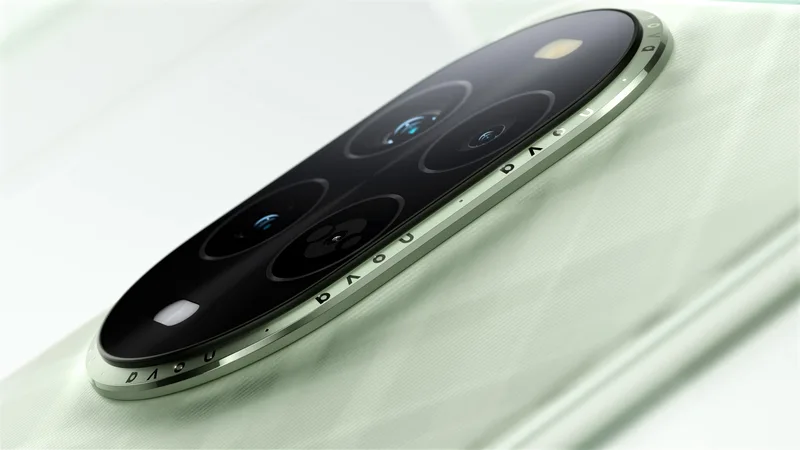
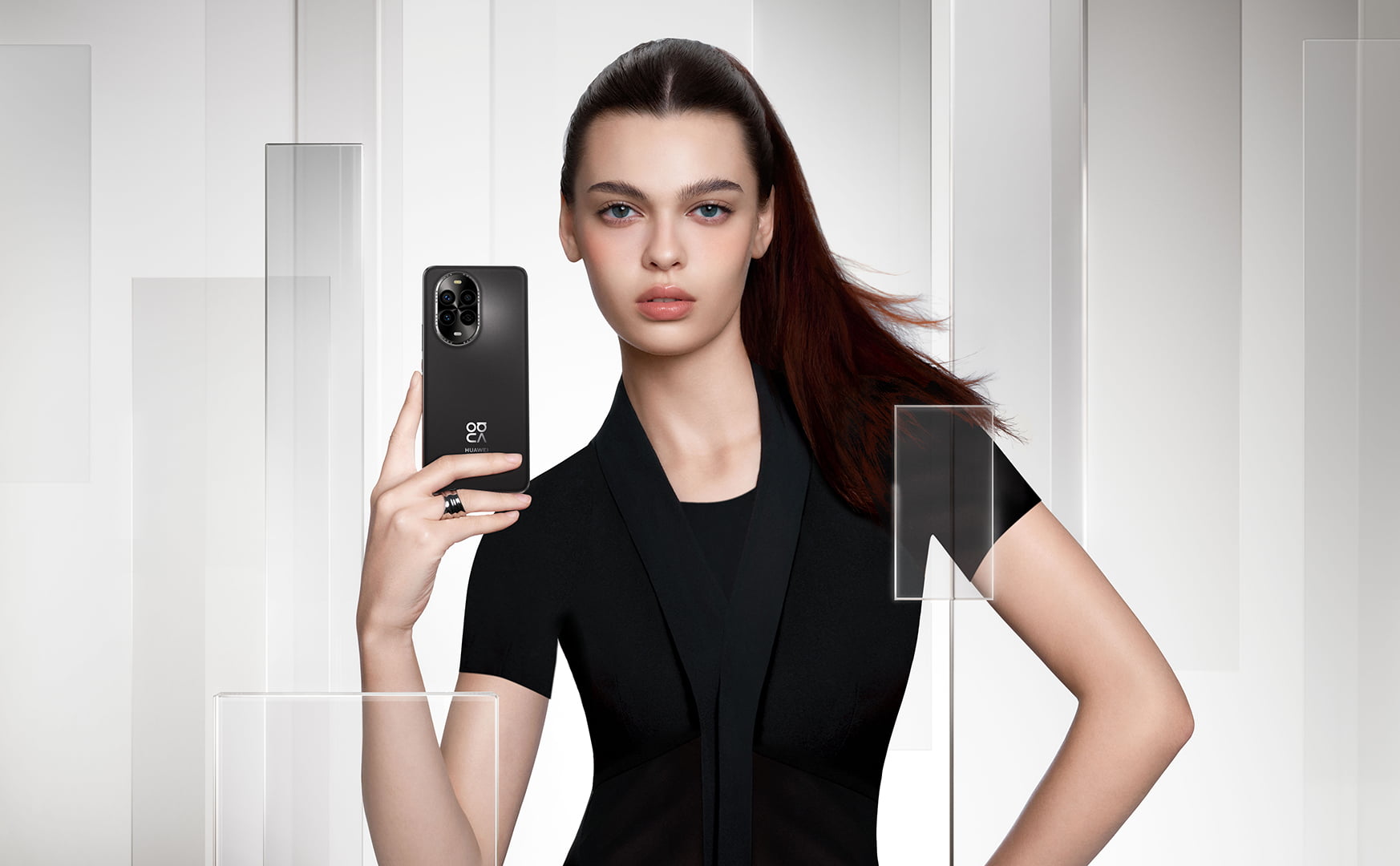
The body measures 163.4 x 74.9 x 7.82 mm and weighs about 209 g. That makes it noticeably heavier than the flat-edged standard nova 13, and the extra weight goes along with the larger screen and the four-lens camera module. Huawei's design story centres on a dynamic plaid texture on the back and an oval camera module with an engraved ring. The glass-like surface changes pattern with the light, and in the press images the green version looks pale and soft, while the black one is plain and the white one reflects the plaid pattern more clearly. The device has a Type-C port that also supports Type-C digital headsets, and the spec sheet confirms a fingerprint sensor, an infrared sensor, a laser focus sensor and a gyroscope.
Chip, memory and software
The chipset is the Kirin 8000, an eight-core processor, and the storage options are 256GB and 512GB. Huawei's product pages do not state the RAM figure, so we do not quote one, and the page does not publish benchmark results. The Kirin 8000 is a mid-range chip, so everyday apps, video and casual games are the realistic expectation. The phone runs EMUI 14.2, Huawei's own interface, and Huawei's site points users to its AppGallery app store. Anyone who depends on specific Google apps should check what is available in their market before buying.
The software side includes AI features that Huawei highlights. AI Best Expression selects the best facial expression from a burst of group photos, there is a cut-out sticker feature for themes, and there are privacy and security centres for permission management. The connectivity list covers Wi-Fi 6 (802.11ax) with 2 x 2 MIMO, Bluetooth 5.2 with the LDAC, AAC and L2HC audio codecs, NFC and a USB 2.0 Type-C port. A noteworthy point is that the published network list names LTE, WCDMA and GSM bands, and does not name any 5G bands. A buyer who needs 5G should therefore check the exact regional model before purchasing.
Camera
This is where the Pro earns its name. The main rear camera is a 50MP sensor with an adjustable physical aperture from F1.4 to F4.0 in ten steps, an RYYB colour filter array and optical stabilisation. Huawei says the wide opening is good for portraits with blurred backgrounds, F2.0 for pets and scenery, and the narrow F4.0 for star-shaped light bursts and group photos. The second lens is a 12MP telephoto portrait camera with F2.4, optical stabilisation and 3x optical zoom (Huawei gives focal lengths of 15.9 mm, 23 mm and 68.5 mm for the system), with 30x hybrid zoom. The third is an 8MP ultra-wide that doubles as a macro lens, with a 112-degree field of view and focusing as close as 2 cm. A laser focus sensor and a ten-channel colour temperature sensor help with focus and white balance. Photo size reaches 8192 x 6144 pixels and video reaches 4K.
The front pair is unusual. A 60MP ultra-wide autofocus camera (F2.4, 100 degrees) is combined with an 8MP close-up portrait camera (F2.2) that offers 2x optical and 5x digital zoom, so selfies can run from 0.7x to 5x. Huawei calls it a dual-camera portrait system and notes that this feature is exclusive to the Pro. Rear portraits can be taken at 0.6x, 1x, 2x and 3x. Huawei's marketing mentions an XD Portrait Engine with natural, delicate and stylish looks, which is a software effect and not a hardware spec. We have no independent photo samples, so we cannot say how well the processing handles skin tones or low light.
Battery and charging
Huawei lists the battery as 5,000 mAh typical, with a rated capacity of 4,900 mAh. That distinction is normal in Huawei documents: the typical value is a nominal figure, and the rated value is the guaranteed minimum. Wired charging reaches 100W with the HUAWEI SuperCharge Turbo system, and Huawei states a charge from 3% to 50% in 9 minutes, a laboratory figure obtained at 25 degrees Celsius with the original charger and cable and Turbo mode on. Without the original charger and cable, the speed will be lower. The box may or may not contain a charger depending on the market, and it holds a USB-C cable, a protective TPU case in some markets, and the SIM eject tool. The charging controls include a temperature management system with 0.1 degree gradient control, night charging and overcharge protection. The spec sheet lists no wireless charging.
Who it is for
The nova 13 Pro suits selfie and portrait enthusiasts who want hardware rather than filters, social-media creators who record front-camera video in 4K, and people who like a curved premium-feeling screen at a mid-range tier. It also suits users who value fast charging and the Huawei ecosystem. If your routine depends on particular Google apps, check the app situation before you buy. People who want the thinnest body or the lightest phone should look at the standard nova 13. For other choices, the comparison with the nova 14 and the rankings are the right places to look next.
Compromises
- Weight and thickness: about 209 g and 7.82 mm are heavier than the standard model.
- Network: the published band list names no 5G bands.
- Software ecosystem: EMUI 14.2 with Huawei's AppGallery, so app availability needs checking.
- Information gaps: RAM is not stated on the pages we read, and there is no price.
- Charging speed depends on accessories: the 100W figure needs the official charger and cable.
- Mid-range chip: the Kirin 8000 is not aimed at demanding games.
In short, the Huawei nova 13 Pro is a well-specified camera and screen phone for people who photograph themselves and others a lot, with a clear price in weight, ecosystem and network choices.
Where it ranks
Compare Huawei nova 13 Pro with similar devices
More from Huawei
Frequently asked questions
When was the Huawei nova 13 Pro released?
The Huawei nova 13 Pro was released on 2024-10-01, according to the manufacturer’s published information.
What are the main specs of the Huawei nova 13 Pro?
Headline figures for the Huawei nova 13 Pro: Battery: 5,000 mAh, Refresh rate: 300 Hz, Main camera: 50 MP. The full specification table is further up this page.
Is the Huawei nova 13 Pro worth buying?
That depends on your priorities. Use the editorial review on this page for our view, check the rankings above to see where the device stands on battery, display and camera, and compare it directly with similar models before you decide.


