Smartwatches
Amazfit T-Rex Dual Solar
Amazfit's expedition watch adds solar charging on both the AMOLED display and a glass-ceramic back plate, with up to 25 days of typical battery life, 3,000-nit screen and offline maps.
Key figures at a glance
Gallery

Specifications
- Display
- 1.32-inch AMOLED, 466x466, 353 ppi, up to 3,000 nits, sapphire glass
- Body
- Grade 5 titanium bezel and buttons, fiber-reinforced polymer frame, titanium and glass-ceramic back; 51.4 mm case, 14.5 mm thick (16.9 mm with sensor); 69 g without strap; 26 mm strap
- Battery
- Up to 25 days (typical use), up to 34 days with 3 hours of front solar, up to 51 days with 3 hours of rear solar, up to 13 days (heavy use); up to 41 hours in accurate GPS mode; 660 mAh
- Solar
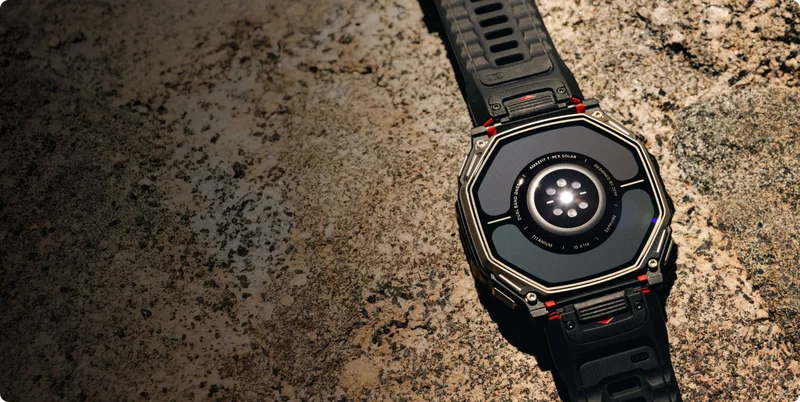
- Dual-sided solar charging through the AMOLED display and a glass-ceramic back plate with more than twice the active area
- Positioning
- Dual-band GPS with six satellite systems; preloaded full-color maps, route planning with up to 100 routes, turn-by-turn navigation
- Sensors
- BioTracker 6.0 PPG sensor (5PD + 2LED), accelerometer, gyroscope, geomagnetic, barometric altimeter, ambient light, temperature
- Connectivity
- Bluetooth 5.2, Bluetooth calls, Wi-Fi 2.4GHz; microphone and speaker; white and red flashlight
- Durability
- 10 ATM water resistance, recreational diving support to 50 m; low-temperature mode to -30 C; military-standard certification
- Sports
- 180+ sports modes, HYROX training, Expedition mode, HybridCharge training and recovery view
- OS
- Zepp App for Android 7.0+ and iOS 15.0+, no subscription required for workout and recovery data
The Amazfit T-Rex Dual Solar is a 51mm expedition smartwatch that Amazfit describes as the first AMOLED watch with solar charging on two sides. Instead of only collecting light through the front of the display, it adds a larger solar panel built into the glass-ceramic back plate, so the watch can also recharge while it lies on a rock or hangs from a backpack. Amazfit, which belongs to Zepp Health, announced it on 22 September 2026, the autumnal equinox, and put it on sale the same day at $649.99. This page reviews the published specifications, explains where the watch sits in Amazfit's range and lists its trade-offs. It is based on the manufacturer's specifications and press information rather than on hands-on testing.
Where it fits in the lineup
Amazfit's T-Rex family is the rugged line of the brand. The T-Rex 3 is the value model at $279.99, the T-Rex 3 Pro at $399.99 adds a titanium bezel and a choice of two sizes, and the T-Rex Dual Solar is the new flagship at $649.99. Compared with the T-Rex 3 Pro 48mm, it has a larger 51.4mm case, a smaller 1.32-inch screen than the 1.5-inch Pro, a slightly smaller battery at 660 mAh against 700 mAh and, crucially, the dual-sided solar system. Amazfit's own comparison also lists the older T-Rex Ultra 2, which has a bigger 870 mAh battery and longer typical battery life of up to 30 days but no solar charging.
Outside Amazfit's range, the watch competes with other premium outdoor watches. Readers can see a side-by-side data view against Garmin's rugged flagship on Amazfit T-Rex Dual Solar vs Garmin Fenix 8, against Apple's expedition watch on Amazfit T-Rex Dual Solar vs Apple Watch Ultra 3, and against the brand's own premium round watch on Amazfit T-Rex Dual Solar vs Amazfit Balance 2.
Design, materials and display
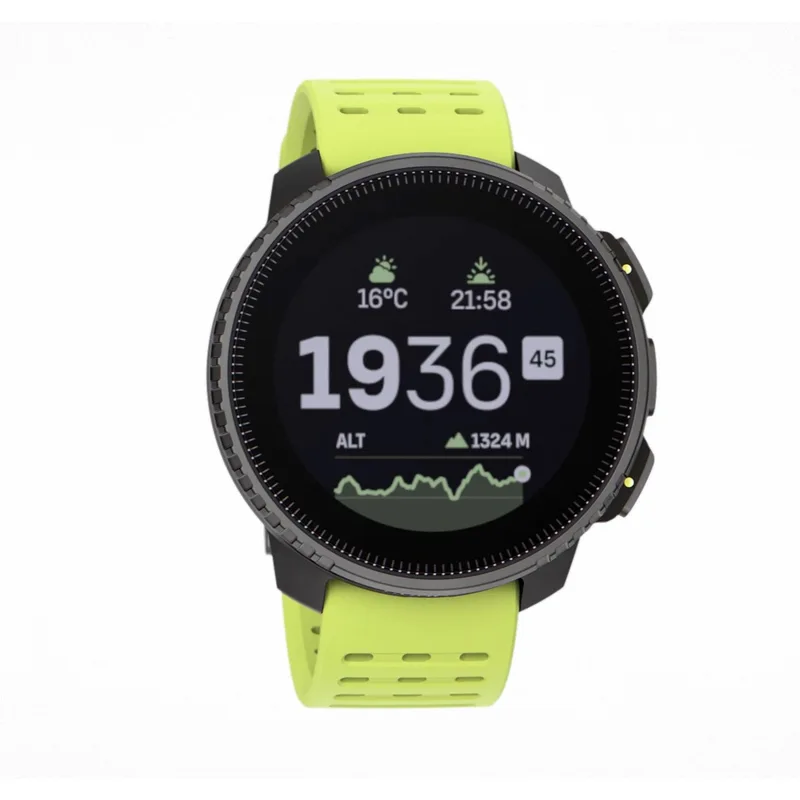
The case has an octagonal rugged look with a Grade 5 titanium bezel and buttons, a fibre-reinforced polymer middle frame and a bottom shell that combines Grade 5 titanium with the glass-ceramic solar plate. The watch body is 51.4mm across, 14.5mm thick without the heart-rate sensor and 16.9mm with it, and weighs 69 grams without the strap. The silicone strap adds 25.5 grams and uses a 26mm quick-release fitting with a classic pin buckle for wrists between 145mm and 215mm. There are four buttons and a linear vibration motor. The only colour listed is Basalt Black with a black strap. Amazfit also states that the watch meets military-grade durability standards.
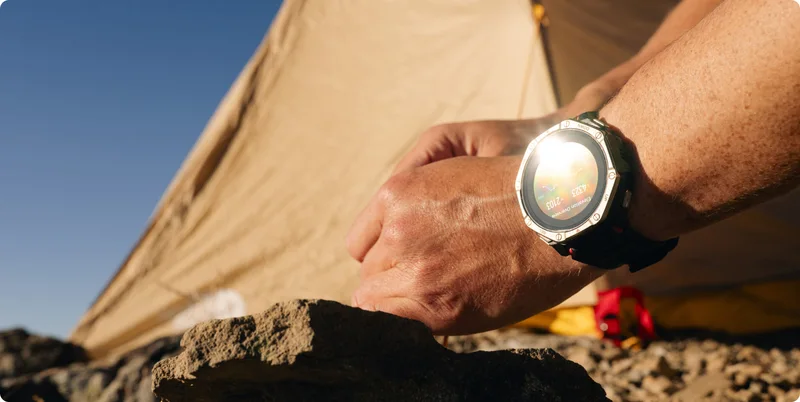
The screen is a 1.32-inch AMOLED panel with a 466 x 466 resolution, about 353 pixels per inch, under sapphire glass, with a stated peak brightness of 3,000 nits. The screen diameter is 43.9mm. A 1.32-inch screen on a 51mm watch means the surrounding frame is wide, so the display is smaller than the 1.5-inch panel on the T-Rex 3 Pro 48mm. For an outdoor watch, the very high peak brightness matters more than the size, because maps and metrics need to be readable in direct sun. Since the front solar collector works through the display, the AMOLED panel doubles as a charging surface, which is the technical achievement Amazfit emphasises.
Solar charging and battery life
The battery has a rated capacity of 660 mAh. Amazfit quotes up to 25 days in typical use and up to 13 days in heavy use. Under its typical-use test conditions, three hours per day at 50,000 lux of front-side sunlight lifts the typical figure to up to 34 days, while three hours of rear-side exposure at the same brightness gives up to 51 days. The rear plate has more than twice the active area of the front, which is why its contribution is larger, but it needs the watch to be off the wrist and facing the sun. Solar Priority Mode puts the watch into an ultra-low-power state to maximise this off-wrist recovery.
Other published endurance numbers include up to 41 hours in the accurate GPS mode, 48 hours in normal trail-running mode, 33 hours in heavy trail-running mode, up to 60 days in clock mode and up to 40 days in the Outdoor Extreme mode, which reduces power consumption while keeping essentials such as GPS track points active. A new Expedition activity mode builds on that low-power setting for multi-day trips. Solar gains in everyday life will depend heavily on climate, season and whether the watch sits under a sleeve, so the headline day counts come from Amazfit's controlled tests and should be read as best-case examples. It is a good safety margin rather than a replacement for a power bank on very long trips, although alpinist Jost Kobusch, quoted in the launch material, says it could help him avoid carrying one just for navigation.
Navigation and outdoor tools
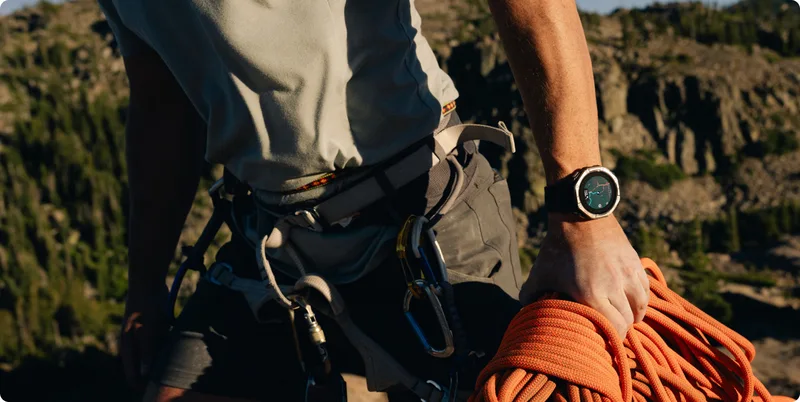
The watch has dual-band positioning with six satellite systems and a circularly polarised GPS antenna. Navigation is a strong point: full-colour preloaded maps with expanded road networks, downloadable contour and ski maps, route planning on the wrist with up to 100 stored routes, turn-by-turn guidance, automatic rerouting, point-of-interest search and checkpoint alerts. A Navigation Gradient Curve shows upcoming climbs and descents in colour. LiveShare lets the wearer send real-time location, heading and key activity data to friends or family, although Amazfit states that it needs a compatible smartphone and a data connection and is not a substitute for an emergency device.
The sensor set includes the BioTracker 6.0 optical heart-rate sensor with five photodiodes and two LEDs, an accelerometer, a gyroscope, a geomagnetic sensor, a barometric altimeter, an ambient light sensor and a temperature sensor. The watch is rated 10 ATM and supports recreational diving down to 50 metres according to Amazfit's launch material. A low-temperature mode keeps essential functions running down to minus 30 degrees Celsius. The built-in flashlight offers white and red light, with a boost mode and an SOS signal. A microphone and speaker handle Bluetooth calls and audio prompts, and connectivity includes Bluetooth 5.2 and 2.4GHz Wi-Fi.
Training and software
The watch runs the Zepp ecosystem and works with phones running Android 7.0 or later and iOS 15.0 or later. More than 180 sports modes cover hiking, trail running, cycling, golf, diving and HYROX training. HybridCharge is Amazfit's energy view that combines training load, recovery and daily stress. Training plans can be imported from services such as TrainingPeaks, Runna and Intervals.icu, and workouts sync to Strava, komoot and others. External sensors such as heart-rate belts, Stryd footpods, action cameras and air-quality monitors can be connected. Amazfit says that workout and recovery data in the Zepp App needs no subscription, which sets it apart from some competitors.
Who it is for
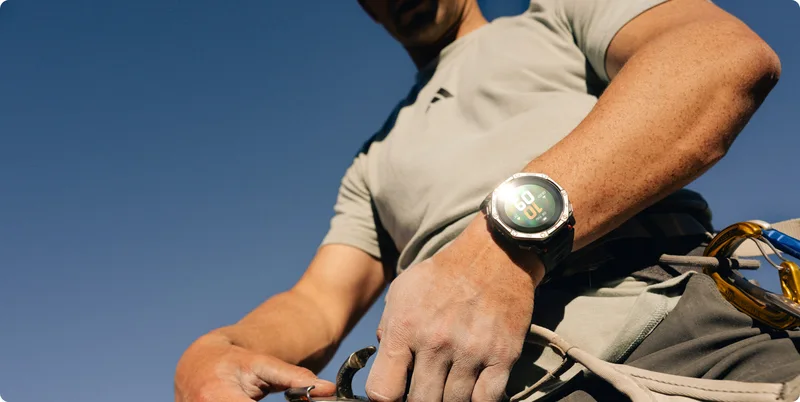
This is a watch for long-distance hikers, mountaineers, trail runners and expedition planners who want an AMOLED screen and who regularly go days without a charger. It is also a reasonable option for someone who works outdoors in strong sun. The solar plate makes most sense for people who can leave the watch exposed to light while not wearing it, for example clipped to a pack during a break. Those who simply want a rugged everyday watch at a lower price will be better served by the T-Rex 3 or T-Rex 3 Pro, and anyone who wants a smaller, lighter design might prefer the round Amazfit Balance 2.
Compromises to consider
- Size and weight: 51.4mm and 69 grams without the strap is large, especially for smaller wrists.
- Price: at $649.99 it costs considerably more than other T-Rex models.
- Screen size: 1.32 inches on a 51mm case is modest compared with the 1.5-inch screens on other models.
- Solar claims: the 34 and 51 day figures assume three hours at 50,000 lux, which is stronger than ordinary cloudy conditions.
- No charging cable in the box: Amazfit includes only a magnetic charging base, expecting users to supply a USB-C cable.
Independent tests will say more about solar yield in real use, GPS accuracy and screen visibility. Until then, the figures here are manufacturer claims. The full data table is on the Amazfit T-Rex Dual Solar page, and the rankings show how it compares with other watches.
Where it ranks
Compare Amazfit T-Rex Dual Solar with similar devices
More from Amazfit
Frequently asked questions
When was the Amazfit T-Rex Dual Solar released?
The Amazfit T-Rex Dual Solar was released on 2026-09-22, according to the manufacturer’s published information.
How much does the Amazfit T-Rex Dual Solar cost?
The estimated range for the Amazfit T-Rex Dual Solar is $585 to $715 in US dollars, based on the launch list price. Actual prices vary by country, retailer and storage option.
What are the main specs of the Amazfit T-Rex Dual Solar?
Headline figures for the Amazfit T-Rex Dual Solar: Battery life: 25 days. The full specification table is further up this page.
Is the Amazfit T-Rex Dual Solar worth buying?
That depends on your priorities. Use the editorial review on this page for our view, check the rankings above to see where the device stands on battery, display and camera, and compare it directly with similar models before you decide.