Smartwatches
Amazfit T-Rex 3 Pro
Amazfit's rugged outdoor watch adds a Grade 5 titanium bezel, sapphire AMOLED, dual-band GPS with offline maps and a two-color flashlight, in 48 mm and 44 mm sizes with up to 25 days of battery.
Key figures at a glance
Gallery
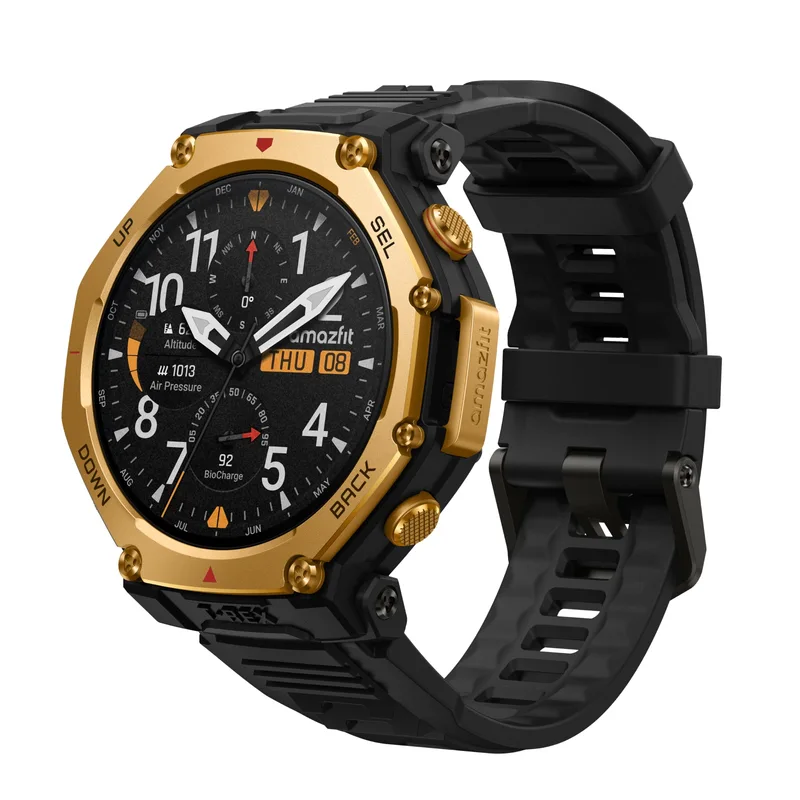
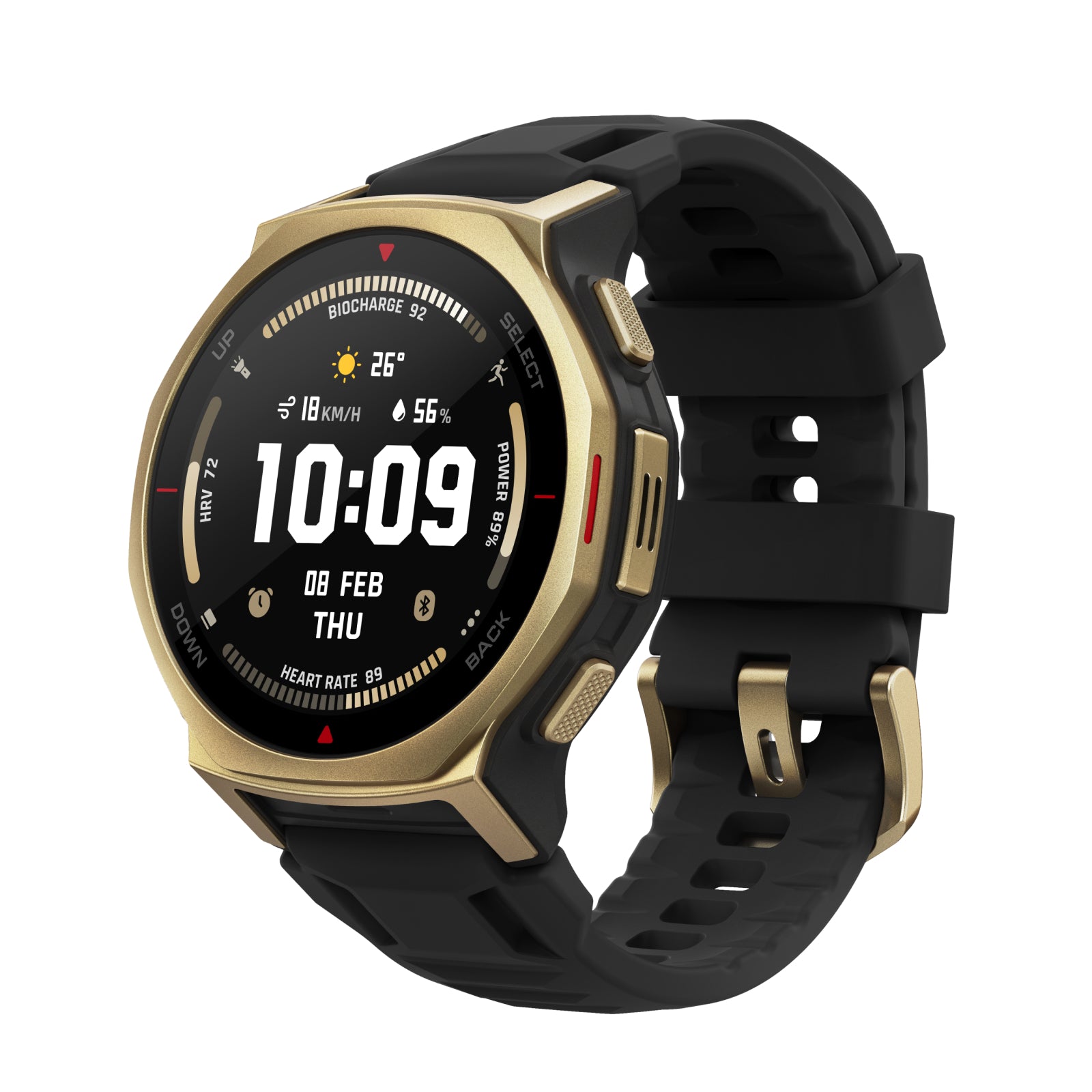
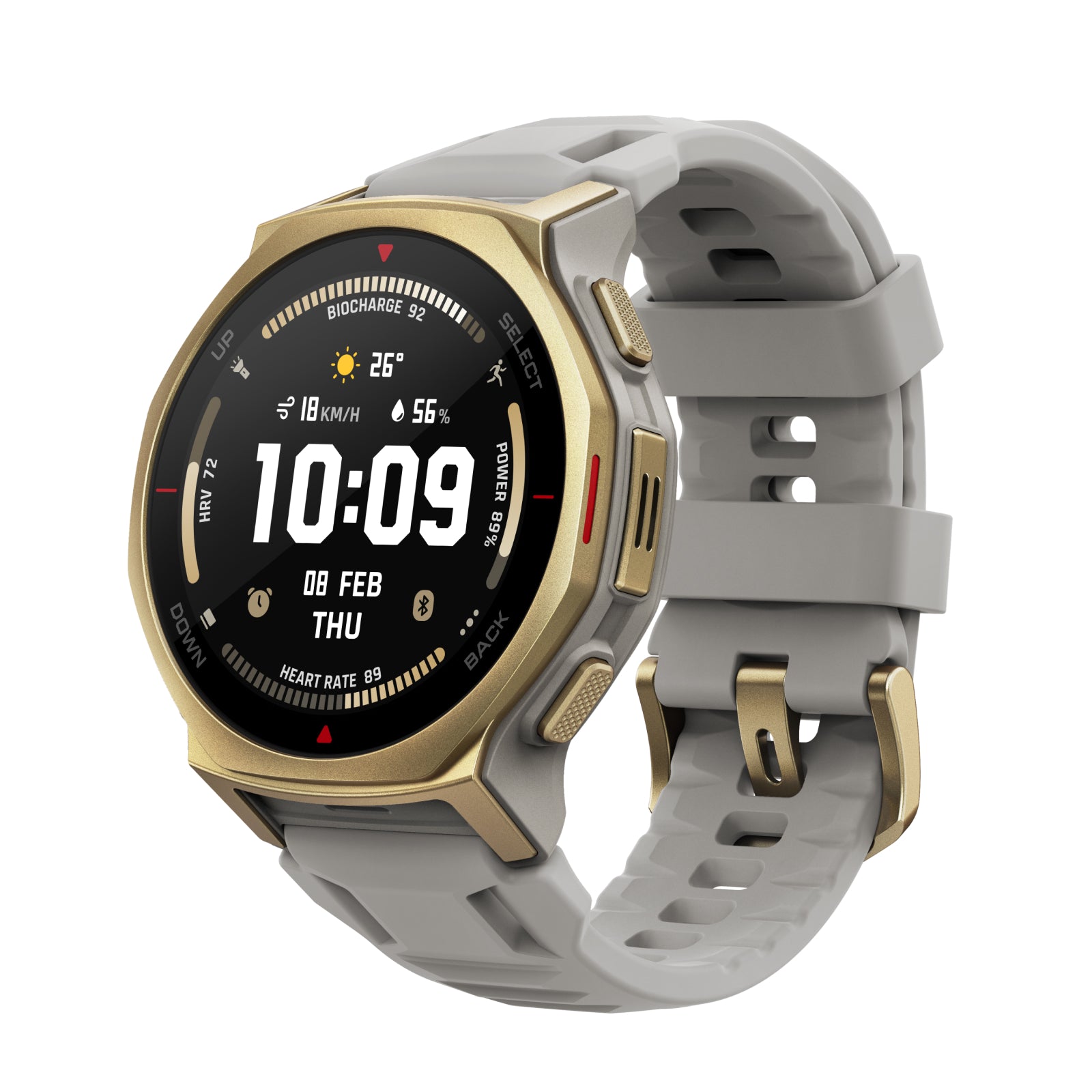
Specifications
- Display
- 1.5-inch AMOLED (48 mm) or 1.32-inch AMOLED (44 mm), sapphire glass, up to 3,000 nits peak brightness
- Body
- Grade 5 titanium alloy bezel and buttons, military-grade design; 48 mm and 44 mm case sizes
- Battery
- Up to 25 days (48 mm), up to 17 days (44 mm)
- Positioning
- Dual-band GPS with six satellite systems; offline maps with turn-by-turn directions, rerouting, route creation and POI search; ski maps with resort, slope and lift data
- Durability
- Operates down to -30 C
- Extras
- Built-in two-color LED flashlight with Boost mode, red light and SOS flash; speaker and microphone for Bluetooth calls; Zepp Flow voice features
- Sports
- 180+ sports modes including trail running, recreational scuba diving, strength training with automatic rep detection and HYROX; BioCharge energy monitoring
- Compatibility
- Zepp App on Android and iOS, subscription-free; works with Helio Strap and Helio Ring
- Colors
- Tactical Black and Black Gold (48 mm); Arctic Gold and Black Gold (44 mm)
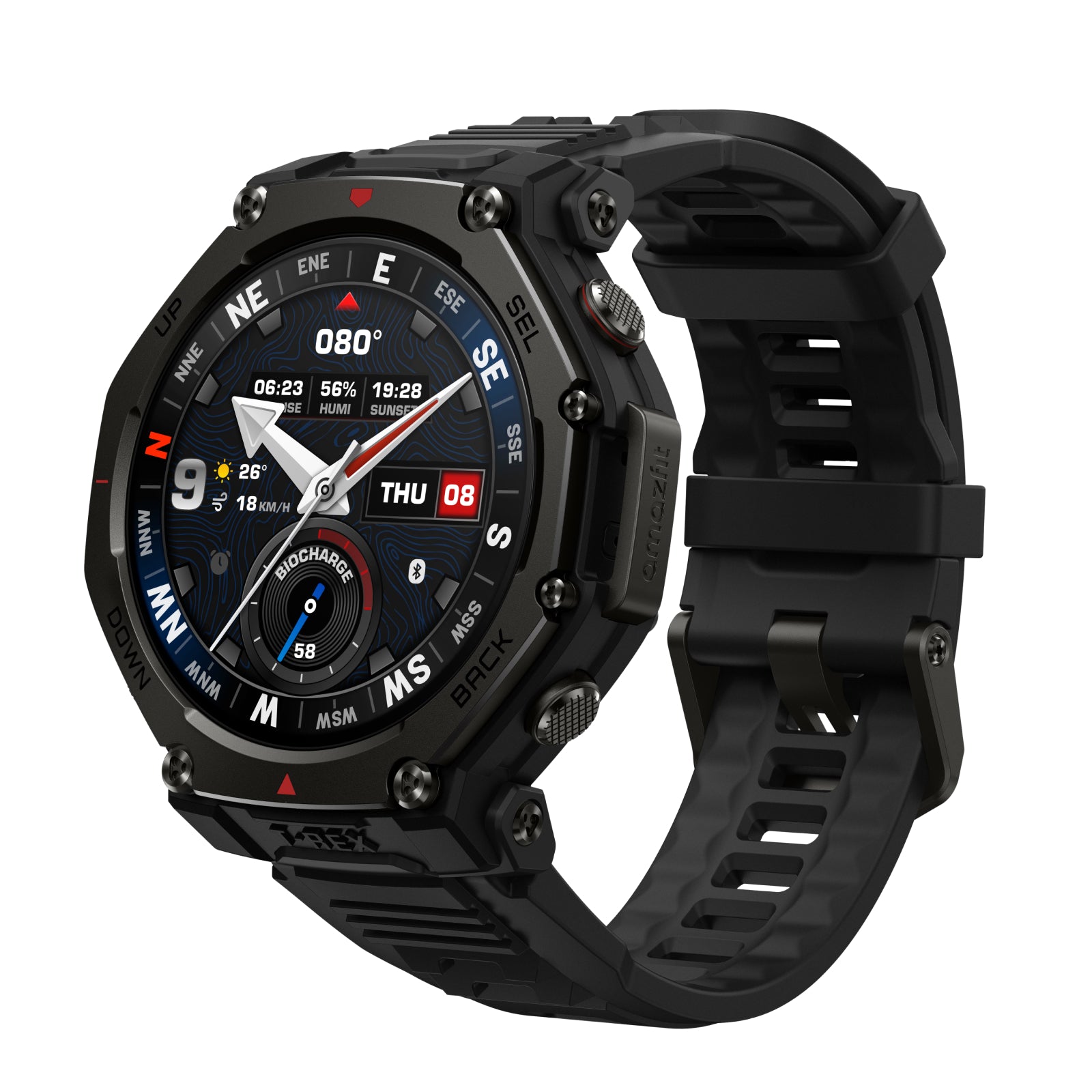
The Amazfit T-Rex 3 Pro is a rugged outdoor smartwatch that Zepp Health launched on 5 September 2025. It takes the T-Rex line's military-style toughness and adds a Grade 5 titanium bezel and buttons, a sapphire-glass AMOLED display, dual-band GPS with offline maps, a built-in two-colour flashlight and a speaker for Bluetooth calls. It comes in two case sizes, 48 mm and 44 mm, so it is also one of the few tough watches that does not assume a large wrist. This page is based on the published specifications and manufacturer information, and it explains where the watch sits in Amazfit's range, what it offers and where its limits are.
Where it sits in the lineup
Amazfit's T-Rex series is the brand's outdoor and expedition family. At the top of it is the Amazfit T-Rex Ultra 2, a larger and more expensive watch with a titanium bezel and back panel, a 51 mm case and extra mapping and diving features. The Amazfit T-Rex Dual Solar is another sibling, built around dual-sided solar charging. The T-Rex 3 Pro is the more compact and less expensive idea: tougher and better equipped than a basic sports watch, but smaller and lighter than those two. Amazfit set the US price at 399 dollars, with the 48 mm Tactical Black model on sale from 5 September 2025 on Amazfit.com and Amazon, a Black Gold 48 mm version following on 25 September on Amazfit.com, and the 44 mm Arctic Gold and Black Gold versions arriving in the fourth quarter.
Design and display
The watch has an octagon-influenced case with exposed screws and large buttons, the visual language of the T-Rex family. The bezel and buttons are Grade 5 titanium alloy, a material that is lighter and more corrosion-resistant than steel, and Amazfit describes the design as military-grade. The 48 mm model has a 1.5-inch AMOLED display, while the 44 mm model has a 1.32-inch panel. Both are covered by scratch-resistant sapphire glass, and Amazfit lists a peak brightness of up to 3,000 nits, which is high enough to read in direct sun. Operating temperatures reach as low as minus 30 degrees Celsius, which makes it more suitable than most watches for winter hiking and snow sports.
The two sizes are a notable choice. Large rugged watches can overwhelm smaller wrists, and the 44 mm case gives those users a rugged option with the same core features. The colour options are Tactical Black and Black Gold in 48 mm, and Arctic Gold and Black Gold in 44 mm. The trade-off is battery life, because the smaller watch has a smaller battery.
Outdoor features and navigation
The watch uses dual-band GPS with support for six satellite systems, which generally gives more accurate tracking in forests, canyons and city streets than single-band receivers. Offline maps are included with turn-by-turn directions, automatic rerouting, route creation and a points-of-interest search, and there are ski maps showing resort data, slope colour codes and lift locations. Amazfit lists more than 180 sport modes, among them trail running, recreational scuba diving, strength training with automatic repetition counting and HYROX modes. The watch also has a built-in LED flashlight with two colours, a boost mode, a red light, an SOS flash and safety alerts. A flashlight on the wrist is a real convenience when setting up a tent, walking a dark trail or fixing a bicycle.
A speaker and microphone allow Bluetooth calling directly from the wrist, and Amazfit adds hands-free communication through its Zepp Flow voice features. Offline maps need to be downloaded in advance, and the full set of mapping tools is less extensive than on the most expensive Amazfit models, so serious expedition planners should compare it with the Ultra line before deciding.
Health tracking and software
Health and recovery data feed into BioCharge, an energy score that Amazfit calculates from workouts, recovery and stress. The watch works with the Zepp app on Android and iOS and can integrate with the Helio Strap and Helio Ring for additional recovery data. Amazfit states that the software is subscription-free, so the training features and coaching tools do not require a monthly fee. The press materials do not list the sensor set in detail, so readers who need a specific measurement, such as blood-oxygen or ECG-style readings, should check Amazfit's own product page for the model they intend to buy.
Battery life
Amazfit rates the 48 mm model for up to 25 days of battery life and the 44 mm model for up to 17 days. These are manufacturer figures for typical use, and they fall quickly when the always-on display, dual-band GPS tracking, the flashlight and Bluetooth calls are used heavily. Even with that caveat, a rugged GPS watch that goes more than two weeks between charges is attractive for multi-day hikes. Amazfit's material does not give battery life in hours for GPS mode, so planned long activities should be checked against the app's estimates.
Everyday use and wearing comfort
A rugged watch is only useful if it is comfortable enough to wear all day, and that is where the two case sizes matter most. A tough watch that is left in a drawer because it feels heavy does not protect anyone on a trail, while one that stays on the wrist day and night collects the long-term sleep and recovery data that the BioCharge score depends on. The titanium bezel and buttons help keep weight down compared with an all-steel build, and the sapphire glass should resist the scratches that daily knocks against door frames and rock faces produce. Amazfit also gives the watch a speaker and microphone, so short calls can be answered without taking out a phone, which is handy with gloves on or while carrying a pack.
Who it is for
The T-Rex 3 Pro suits hikers, trail runners, cyclists and skiers who want a tough watch with proper navigation and long battery life at a lower list price than the large premium outdoor watches from Garmin. It also suits people with smaller wrists who have found rugged watches too bulky. For a direct look at how it compares with a premium rival, see the Amazfit T-Rex 3 Pro vs Garmin Fenix 8 table, and the Garmin Forerunner 970 page shows a running-focused alternative. The rankings page shows how it scores against other watches in the catalogue.
Compromises to consider
- Specifications not fully published. Amazfit's launch material does not list water resistance, storage or the full sensor set.
- Shorter battery on the 44 mm model. Up to 17 days against up to 25 days on the 48 mm watch.
- Staggered availability. Only the 48 mm Tactical Black was on sale at launch, and the other colours followed later.
- Offline maps need preparation. Maps must be downloaded to the watch before a trip, and the feature set is not as deep as on dedicated expedition watches.
- Weight and bulk. Even with titanium parts, a tough 48 mm watch is thicker than an ordinary sports watch.
- Ecosystem. The apps and third-party integrations are not as broad as those of the largest platforms.
Overall, the Amazfit T-Rex 3 Pro offers a lot for 399 dollars: titanium, sapphire glass, a bright AMOLED display, dual-band GPS, offline maps, a flashlight and a long battery in two sizes. Its limits are mostly about incomplete published details and a feature set that stops short of the Ultra line.
Where it ranks
Compare Amazfit T-Rex 3 Pro with similar devices
More from Amazfit
Frequently asked questions
When was the Amazfit T-Rex 3 Pro released?
The Amazfit T-Rex 3 Pro was released on 2025-09-05, according to the manufacturer’s published information.
How much does the Amazfit T-Rex 3 Pro cost?
The estimated range for the Amazfit T-Rex 3 Pro is $359 to $439 in US dollars, based on the launch list price. Actual prices vary by country, retailer and storage option.
What are the main specs of the Amazfit T-Rex 3 Pro?
Headline figures for the Amazfit T-Rex 3 Pro: Battery life: 25 days. The full specification table is further up this page.
Is the Amazfit T-Rex 3 Pro worth buying?
That depends on your priorities. Use the editorial review on this page for our view, check the rankings above to see where the device stands on battery, display and camera, and compare it directly with similar models before you decide.