Smartwatches
Garmin Forerunner 165
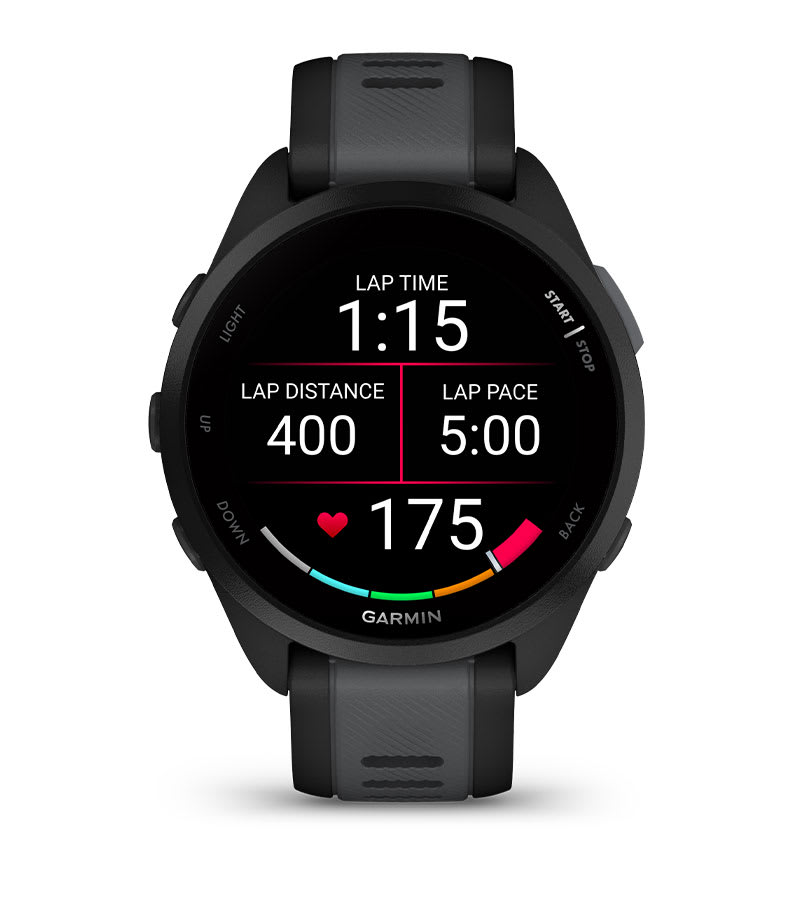
Garmin's entry-level AMOLED running watch: 1.2-inch touchscreen with five buttons, up to 11 days of battery, adaptive training plans, running power and sleep tracking for $249.99.
Key figures at a glance
Gallery
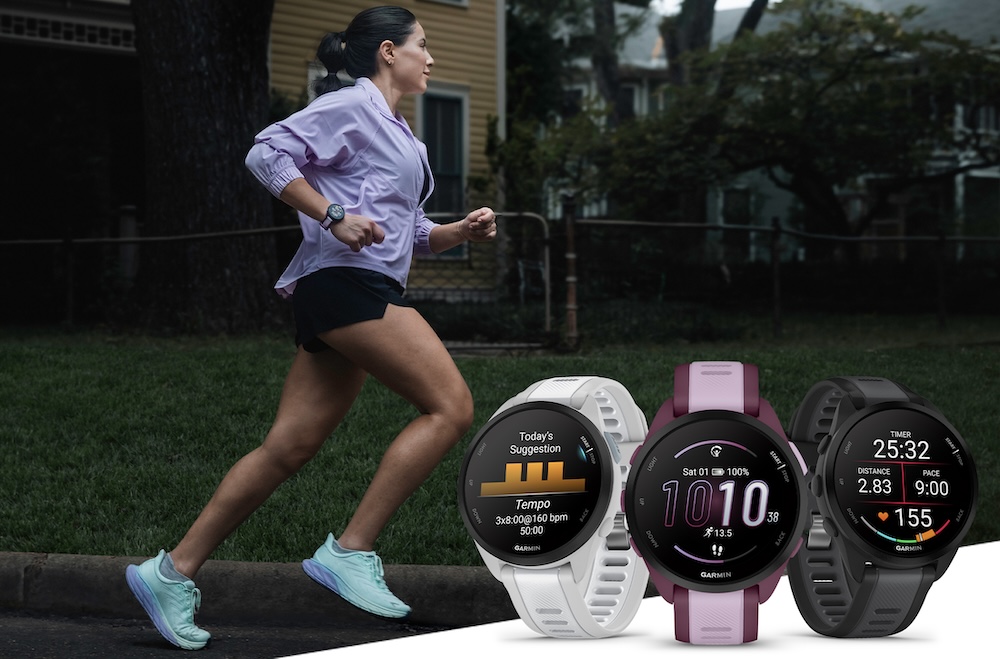
Specifications
- Display
- 1.2-inch (30.4 mm) AMOLED touchscreen, 390 x 390 pixels, optional always-on mode; five physical buttons; chemically strengthened glass lens
- Case
- 43 x 43 x 11.6 mm; 39 g; fiber-reinforced polymer bezel; silicone strap with 20 mm quick release; fits wrists of 126-203 mm
- Battery
- Up to 11 days in smartwatch mode; up to 20 days in Battery Saver smartwatch mode; up to 19 hours in GPS-only GNSS mode; up to 17 hours in All-Systems GNSS mode (Garmin figures)
- Navigation
- GPS, GLONASS and Galileo; barometric altimeter; compass; course guidance
- Health Sensors
- Elevate wrist heart rate monitor, Pulse Ox blood oxygen, accelerometer, thermometer, ambient light sensor; sleep score, Body Battery, HRV status, respiration, all-day stress, fitness age, women's health tracking
- Sports
- 25+ activity profiles including trail running, open water swimming, pickleball and tennis; adaptive training plans, daily suggested workouts, PacePro, running power and running dynamics
- Connectivity
- Bluetooth, ANT+; Connect IQ store; smart notifications; Garmin Pay; compatible with iPhone and Android
- Memory
- 4 GB
- Water Resistance
- 5 ATM
The Garmin Forerunner 165 is an affordable GPS running watch with an AMOLED display. Garmin announced it on 20 February 2024, together with the Forerunner 165 Music, and said both were available immediately. The standard model has a suggested retail price of $249.99 in the United States. The pitch is straightforward: give new and intermediate runners the training plans, recovery numbers and health tracking that Garmin usually reserves for pricier watches, on a bright color screen, without sacrificing multi-day battery life. This page is based on Garmin's announcement and its published specifications.
Where it sits in the lineup
The Forerunner family is Garmin's running line, and the 165 is the entry point for people who want an AMOLED screen and a touchscreen. It comes in two versions. The plain Forerunner 165 costs $249.99; the Forerunner 165 Music costs $299.99 and adds on-watch storage for songs and playlists from Spotify, Deezer or Amazon Music, which Garmin says requires a premium subscription, plus audio prompts through wireless headphones. Everything else is shared between the two. Other Forerunner models are described on the Forerunner 170 and Forerunner 70 pages, and the Forerunner 265 is a higher-tier running watch from the same family. You can see the 165 and the 265 side by side in the Forerunner 165 vs Forerunner 265 comparison.
Design and display
The case is 43 x 43 x 11.6 mm and the watch weighs 39 g. The bezel is fiber-reinforced polymer, the lens is chemically strengthened glass and the strap is silicone with a standard 20 mm quick-release fitting, so third-party bands fit. Garmin says it fits wrists with a circumference of 126 to 203 mm. Those are small, light numbers for a sports watch, which is helpful for sleep tracking and for runners who dislike a heavy wrist.
The screen is a 1.2-inch (30.4 mm) round AMOLED at 390 x 390 pixels, with an optional always-on mode. Garmin gives it a touchscreen and keeps the traditional five-button layout, so you can swipe through widgets in the shop and still press physical buttons during a sweaty interval session. That combination is a deliberate choice: touchscreens are quick for scrolling but unreliable with wet fingers, and buttons cover the cases where touch is awkward. The display also has a large-font option and a red-shift mode listed in the specifications.
Running features and training
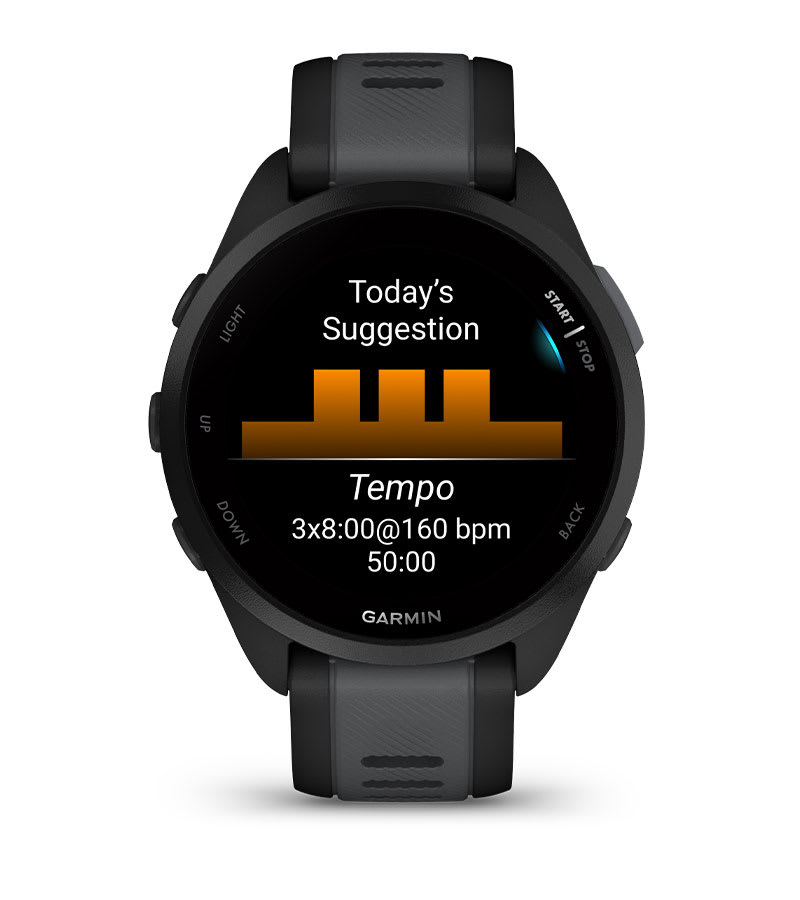
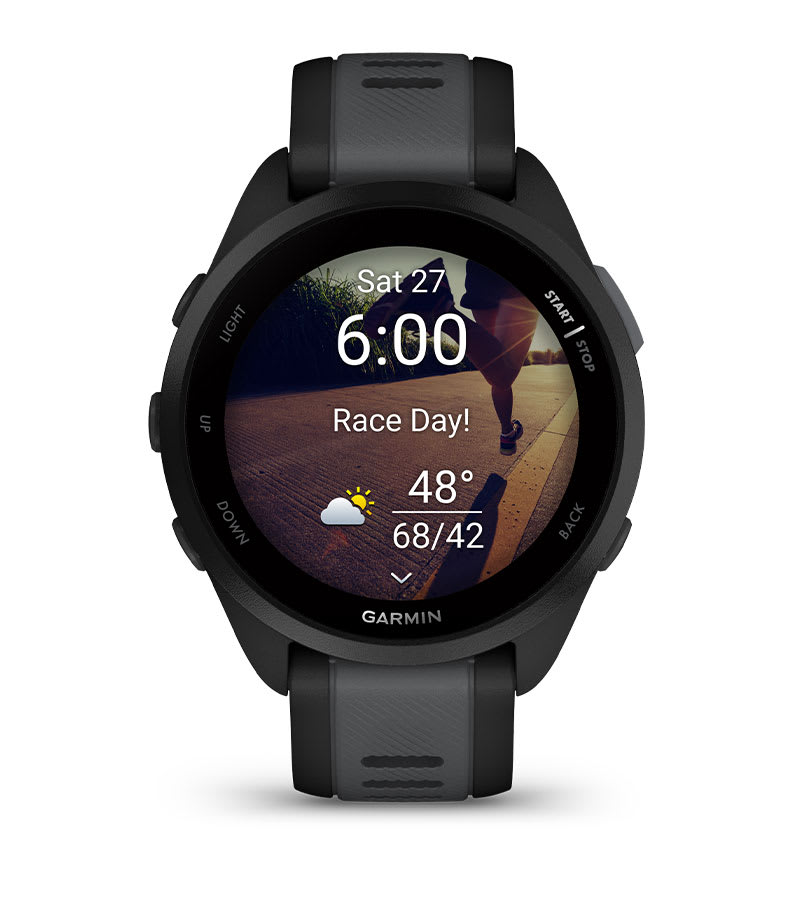
The training toolkit is the core of the watch. Garmin highlights race-adaptive training plans, where you enter a race into the Garmin Connect calendar and the plan adjusts after each run to match performance and recovery. You can also use free Garmin Coach plans for 5K, 10K and half-marathon distances. Daily suggested workouts adapt in the same way, and PacePro gives grade-adjusted pacing guidance for a course based on elevation and your pacing preferences.
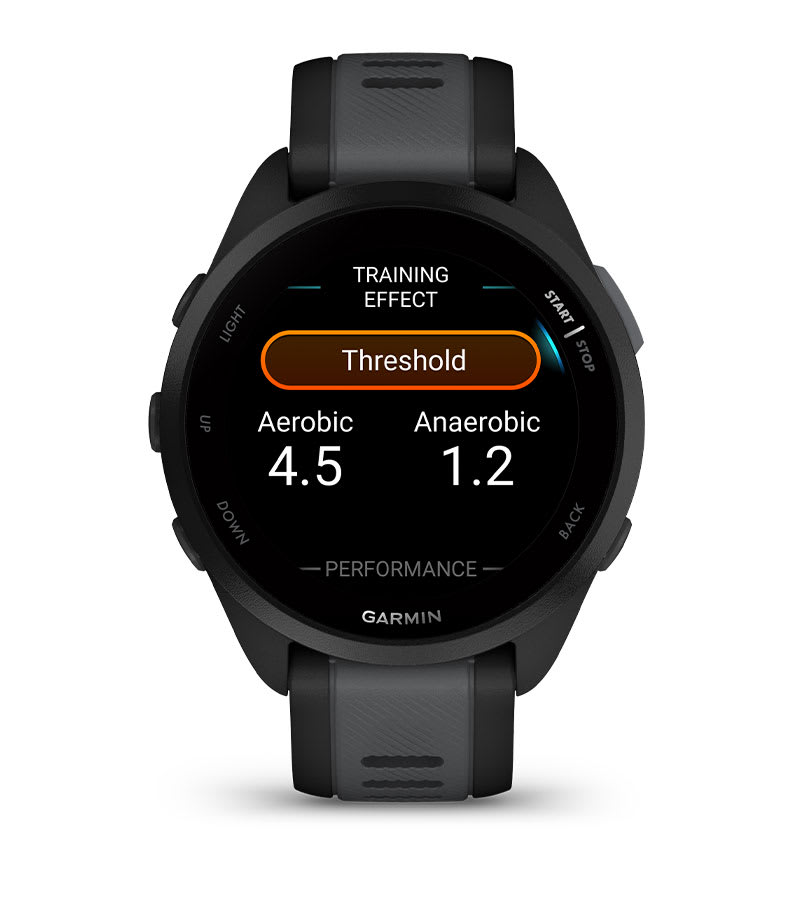
On the metrics side, the watch shows wrist-based running power and the running dynamics of cadence, stride length and ground contact time, which Garmin says help improve form. Training Effect shows how a workout affects fitness, and the spec sheet also lists VO2 max, recovery time, HRV status and heart rate zones. You can create or find courses in the Garmin Connect app, including from third-party platforms, and sync them to the watch. Beyond running, there are more than 25 activity profiles, among them trail running, open water swimming, pickleball and tennis, plus strength, HIIT, cardio, yoga and Pilates workouts. Garmin's running coach feature is listed without the strength add-on.
Positioning and sensors
The watch uses GPS together with GLONASS and Galileo, a barometric altimeter, a compass, an accelerometer, a thermometer and an ambient light sensor, plus Garmin's Elevate wrist heart rate monitor and a Pulse Ox blood oxygen sensor. Garmin does not describe dual-frequency GPS, offline maps or multi-band positioning for this model in the material reviewed, so runners who need those should check higher-tier watches. For routes, the course support listed above covers basic navigation needs. Memory is 4 GB, mainly for activity history and, on the Music version, songs.
Battery life
Garmin lists up to 11 days in smartwatch mode, up to 20 days in Battery Saver smartwatch mode, up to 19 hours in GPS-only mode and up to 17 hours in All-Systems GNSS mode. These are the manufacturer's figures for the standard model; the Music version is quoted at the same numbers in the press release, though in practice music playback with headphones will draw more power. For a marathon-length event, 19 hours of GPS recording leaves a wide margin for most finishers, and a runner who trains four or five times a week can plan on charging roughly once a week, depending on screen settings and always-on mode.
Health and daily use
Around the clock, the watch records heart rate, respiration, stress and Pulse Ox readings (spot checks, during sleep or all day). Sleep tracking produces a score, shows sleep stages and can detect naps. Body Battery estimates energy levels, fitness age compares your fitness to your real age, and a morning report summarizes sleep, HRV status, weather and the day's training outlook. Women's health tracking covers menstrual cycles and pregnancy. Garmin notes that Pulse Ox is not a medical device and is not available in every country.
For everyday smartphone use, you get notifications, calls and texts on a paired iPhone or Android phone, weather and calendar, Find My Phone and Garmin's Connect IQ store for watch faces and apps. Text replies and rejecting calls with a text are Android-only. Garmin Pay is included for contactless payments in supported countries and with participating banks, and incident detection can send your name and location to emergency contacts during select activities when the watch is paired with the app.
Water resistance
The watch is rated 5 ATM, which Garmin defines as withstanding pressure equivalent to a depth of 50 meters. That covers pool swimming and open water swimming profiles, though it is not a dive computer.
Who it is for
The Forerunner 165 suits runners who want structured training and recovery guidance rather than raw data alone: first-time 5K and 10K runners, people stepping up to a half marathon, and casual multisport users who also swim, hike or play racket sports. The AMOLED touchscreen makes it easy to read and navigate, and the weight is low enough to wear all day.
Compromises
- Battery trade-off: the AMOLED screen means GPS endurance of 19 hours, shorter than in transflective, ultra-endurance models.
- Music only on the Music version: the cheaper watch cannot store songs, and streaming storage needs a premium subscription.
- No mapping features: navigation is limited to courses; the listed specifications do not mention offline maps.
- Focused activity list: the profiles lean toward running, with pool and open water swimming, cycling, hiking, gym and racket sports; the specifications do not list a triathlon or multisport profile.
- Price: $249.99 at launch is below the flagship models, but you can weigh alternatives on the rankings page.
Where it ranks
Compare Garmin Forerunner 165 with similar devices
More from Garmin
Frequently asked questions
When was the Garmin Forerunner 165 released?
The Garmin Forerunner 165 was released on 2024-02-20, according to the manufacturer’s published information.
How much does the Garmin Forerunner 165 cost?
The estimated range for the Garmin Forerunner 165 is $225 to $275 in US dollars, based on the launch list price. Actual prices vary by country, retailer and storage option.
What are the main specs of the Garmin Forerunner 165?
Headline figures for the Garmin Forerunner 165: Battery life: 11 days. The full specification table is further up this page.
Is the Garmin Forerunner 165 worth buying?
That depends on your priorities. Use the editorial review on this page for our view, check the rankings above to see where the device stands on battery, display and camera, and compare it directly with similar models before you decide.