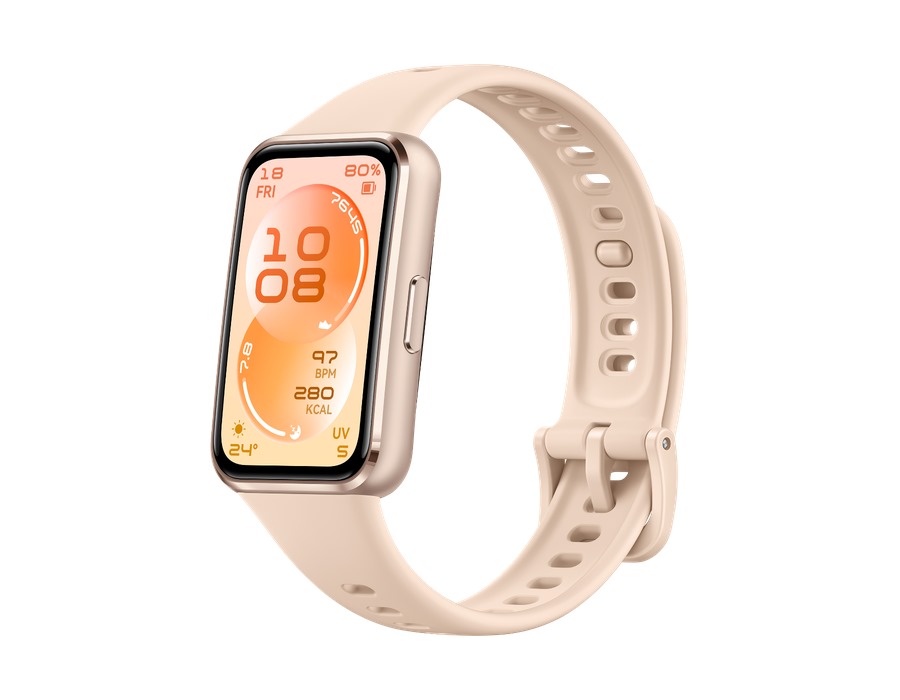
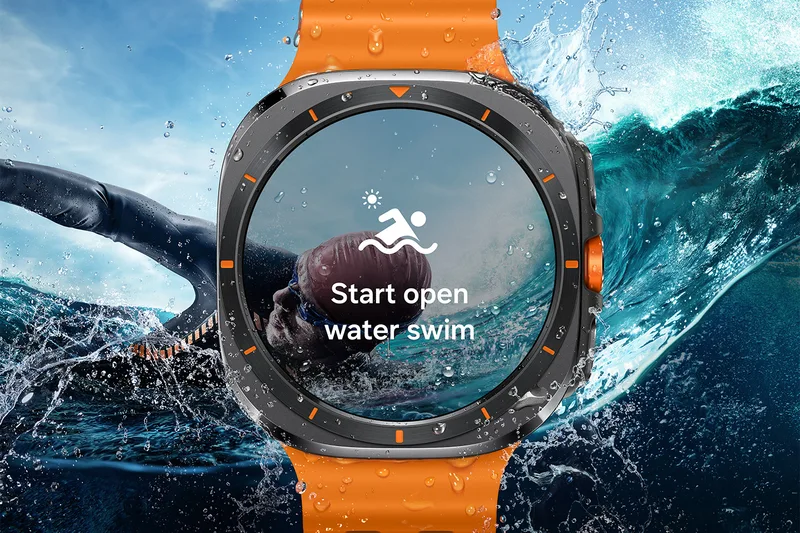
| Display | 1.62-inch AMOLED, 286x482 pixels (347 ppi), 60 Hz, up to 1500 nits peak brightness, touchscreen with Always-On Display | 1.5-inch (37.3 mm) 480 x 480 Super AMOLED, always on, up to 3,000 nits |
|---|
| Body | 42.6 x 28.2 x 8.99 mm (thickness measured at thinnest point, excluding sensor area); about 17 g with aluminium alloy case (beige, green, purple, white, black) or about 16 g with durable polymer case (purple, black); fluoroelastomer straps; fits 120-210 mm wrists depending on colour | — |
|---|
| Battery | Up to 14 days (light use), up to 8 days (typical use), up to 3 days with Always-On Display; 300 mAh, magnetic charging (5V/1A) | — |
|---|
| Sensors | Optical heart-rate sensor, 9-axis IMU (accelerometer, gyroscope, magnetometer), ambient light sensor | Samsung BioActive Sensor (optical, electrical heart signal, bioelectrical impedance), temperature, barometer, gyro, geomagnetic, light |
|---|
| Connectivity | Bluetooth 6.0 and BLE, 2.4 GHz; relies on the phone for GNSS during outdoor cycling | LTE, Bluetooth 5.3, Wi-Fi 2.4 + 5 GHz, NFC, dual-frequency GPS |
|---|
| Durability | 5 ATM water resistance (ISO 22810:2010) | 10ATM, IP68, MIL-STD-810H; operates from 100 m below to 9,000 m above sea level |
|---|
| Health | 24/7 heart rate, SpO2, HRV monitoring, TruSleep sleep tracking, Sleep Breathing Awareness, pulse wave arrhythmia analysis (region dependent), emotional wellbeing and stress tools, cycle calendar; not a medical device | — |
|---|
| Sports | Around 100 workout modes, Active Rings activity goals including a wheelchair mode | — |
|---|
| Compatibility | Huawei Health app; Android 9.0 or later and iOS 13.0 or later | — |
|---|
| Case | — | 47 mm, Titanium Grade 4, 47.1 x 47.4 x 12.1 mm, 60.5 g |
|---|
| Processor | — | Exynos W1000 (5-core, 3 nm) |
|---|
| OS | — | Wear OS 5 (launch) |
|---|
| Colors | — | Titanium Grey, Titanium White, Titanium Silver (Titanium Blue added in 2025) |
|---|
| Price | — | 599 pounds in the UK at launch |
|---|